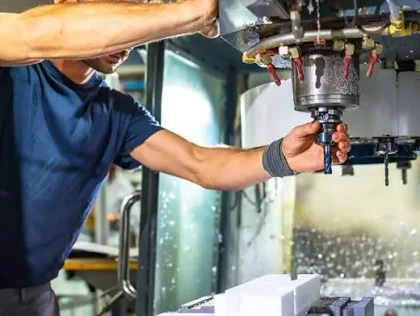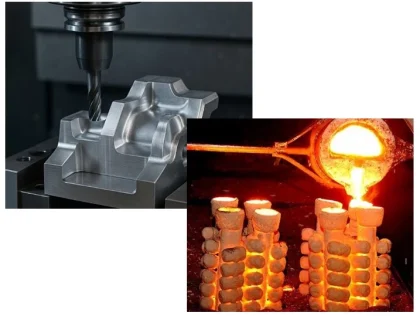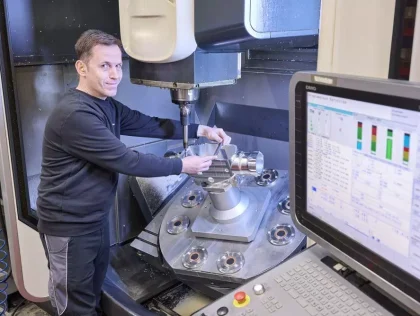
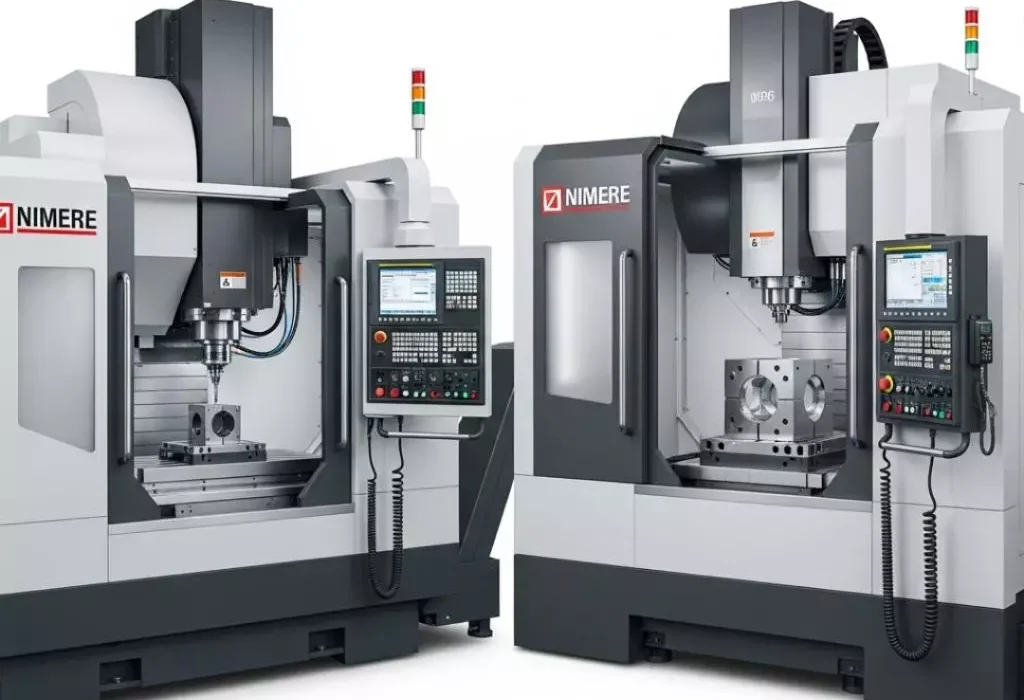
Choosing between a vertical machining center (VMC) and a horizontal machining center (HMC) is not simply a matter of comparing two machine configurations.
Both can perform milling, drilling, tapping, boring, and other CNC machining operations. The difference becomes more meaningful when the machine has to deal with the actual geometry of a part.
A flat mounting plate with holes and pockets may be straightforward to machine on a VMC because most of its features can be reached from one direction. A gearbox housing, valve body, or other multi-face component can present a different problem. Its functional features may be distributed across several sides, making workholding, tool access, chip evacuation, and the number of setups more important to the manufacturing process.
Production quantity also changes the decision. A machine setup that is practical for ten prototype parts may not be the most efficient approach when the same component is produced hundreds or thousands of times.
This is why the useful question is not simply whether a VMC or HMC is more capable. The better question is:
Which machine configuration allows this particular part to be produced with a practical number of setups, reliable tool access, suitable cutting conditions, and a reasonable cost per part?
That distinction is important when evaluating CNC machining for a new component, selecting equipment for a machine shop, or deciding which manufacturing process to use for repeat production.
What Is a Vertical Machining Center?
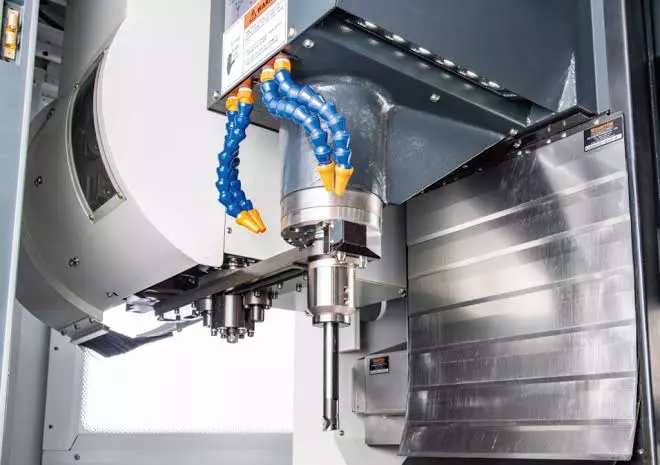
A vertical machining center has a spindle positioned vertically, with the cutting tool approaching the workpiece primarily from above. The workpiece is generally secured to a horizontal machine table, and the machine controls the relative movement between the cutting tool and workpiece.
A standard 3-axis VMC provides movement along the X, Y, and Z axes. Depending on the machine, a rotary axis can be added for indexed machining, while more advanced configurations can provide simultaneous multi-axis movement.
The basic arrangement makes a VMC particularly convenient when the important machining features are accessible from the top of the component.
Consider a 6061-T6 aluminum mounting plate. If the drawing calls for a series of drilled and tapped holes, pockets, counterbores, and an outside profile, many of these operations can be completed while the part remains in one primary orientation. The machining process is relatively direct because the spindle can approach the required features without the workpiece being repeatedly repositioned.
This type of geometry is common in brackets, plates, fixture components, tooling parts, and many prototype components.
The fact that a VMC approaches the workpiece from above does not mean it is limited to top-side machining. With rotary equipment or additional axes, a vertical machining center can access features around a component. The real consideration is whether the additional equipment reduces setup work enough to make the process practical for the particular part.
For prototype and low-volume work, this flexibility can be useful because the machine can move between different components without relying on a production-oriented fixture system for every job.
What Is a Horizontal Machining Center?
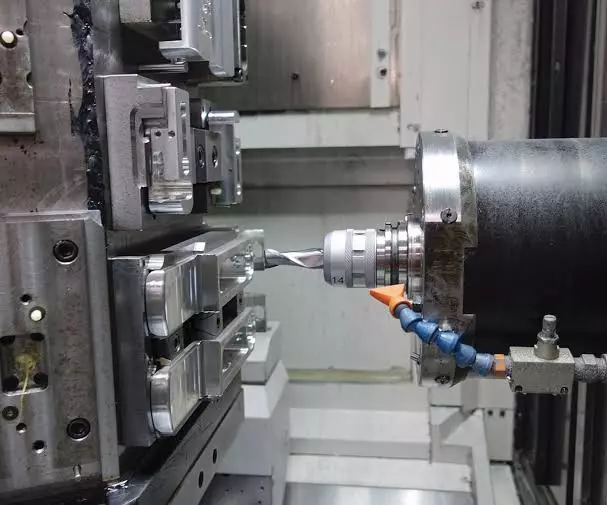
A horizontal machining center places the spindle horizontally relative to the workpiece. The part is commonly mounted on a pallet, and many HMC configurations use a rotary axis to position different faces toward the spindle.
This arrangement changes how a component can be fixtured and machined.
One common example is a tombstone fixture. Instead of securing a single part on a flat table, several workpieces can be mounted around a fixture, or several faces of one component can be made accessible to the cutting tool.
The difference becomes particularly useful when the component contains important features on multiple faces.
Imagine a machined aluminum housing with bearing bores on one side, mounting holes on another, threaded ports on the front, and internal pockets. The machining challenge is not simply producing each individual feature. The manufacturer also has to maintain the positional relationship between those features while deciding how the part should be supported and located.
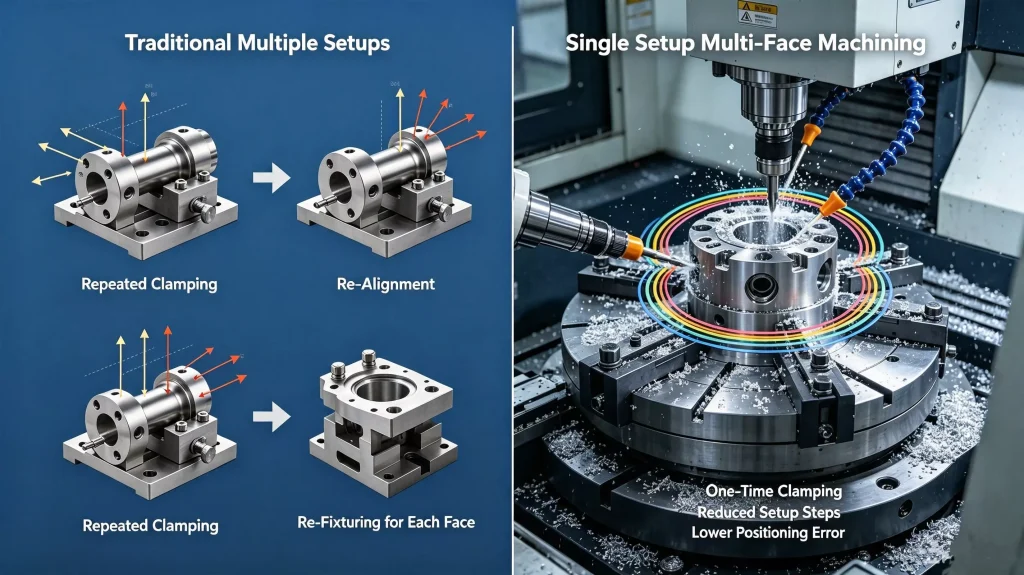
If each face requires a separate setup, the operator has to remove and reposition the component several times. An HMC with an appropriate fixture and rotary positioning system may allow more of these operations to be completed from a common workholding arrangement.
That is where the horizontal configuration can have a practical effect on production.
It is also important to distinguish between an HMC’s capability and its economic justification. A component may be physically suitable for horizontal machining but still be more economical on a VMC if it is produced in a small quantity or can be completed with only one or two straightforward setups.
The Difference That Matters: How the Machine Approaches the Part
The most obvious distinction is spindle orientation.
A VMC approaches the workpiece mainly from above. An HMC approaches it from the side.
On a simple part, this difference may have little effect. If every important feature is accessible from the top, there may be little reason to introduce a horizontal setup.
As the geometry becomes more three-dimensional, however, the orientation of the spindle begins to affect the entire machining sequence.
Suppose a component has a large top surface with several pockets, but also contains four side ports and two cross-drilled holes. On a conventional VMC, the manufacturer may need to rotate the workpiece or use additional rotary equipment to reach those features.
Each repositioning creates another setup task.
The part has to be located again. The work coordinate system has to be established. The fixture has to hold the part in the required position. Tool access has to be checked. If the relationship between features on different faces is important, the locating strategy becomes part of the dimensional-control problem.
An HMC may reduce some of this work because the horizontal spindle and rotary workholding arrangement allow the part to be presented to the tool from several directions.
This does not mean that every multi-face part should be moved to an HMC. A 4-axis or 5-axis VMC can also provide multi-face access, and for some parts that approach may be more practical.
The important point is that machine orientation affects the manufacturing sequence, not just the appearance of the machine.
Setup Count Is Often More Important Than the Number of Machining Operations
A common mistake when comparing machining processes is to count machining operations without considering how many times the part has to be repositioned.
Imagine a component that requires drilling, tapping, pocket milling, and boring. Those may sound like four separate operations, but if they can all be completed from one fixture, the manufacturing process can remain relatively simple.
Now consider a different component that requires only drilling and boring, but the holes are located on four different faces.
The second part may involve considerably more setup work even though it has fewer named machining operations.
This is why setup count deserves attention when comparing VMC and HMC processes.
Every time a component is removed and repositioned, there is additional work involved in establishing its location. Depending on the tolerance requirements, this can involve probing, edge finding, fixture alignment, datum verification, or other locating procedures.
The effect becomes more important when the drawing contains positional relationships between features on different faces.
For example, consider a housing with a bearing bore on the front face and a mounting-hole pattern on the side. The functional relationship between these features may matter more than the individual dimensional tolerance of either feature.
If both can be machined while the component remains in a stable fixture, the manufacturing process has fewer opportunities for errors associated with repositioning.
This is one of the reasons HMCs are often considered for multi-face production.
However, it would be inaccurate to say that an HMC automatically produces more accurate parts. Machine accuracy, thermal behavior, fixture rigidity, tool condition, probing, programming, cutting parameters, and inspection all influence the final result.
The more precise statement is that reducing the number of setups can simplify the control of relationships between features when the part geometry allows several operations to be completed from one workholding arrangement.
Chip Evacuation Is Another Practical Difference
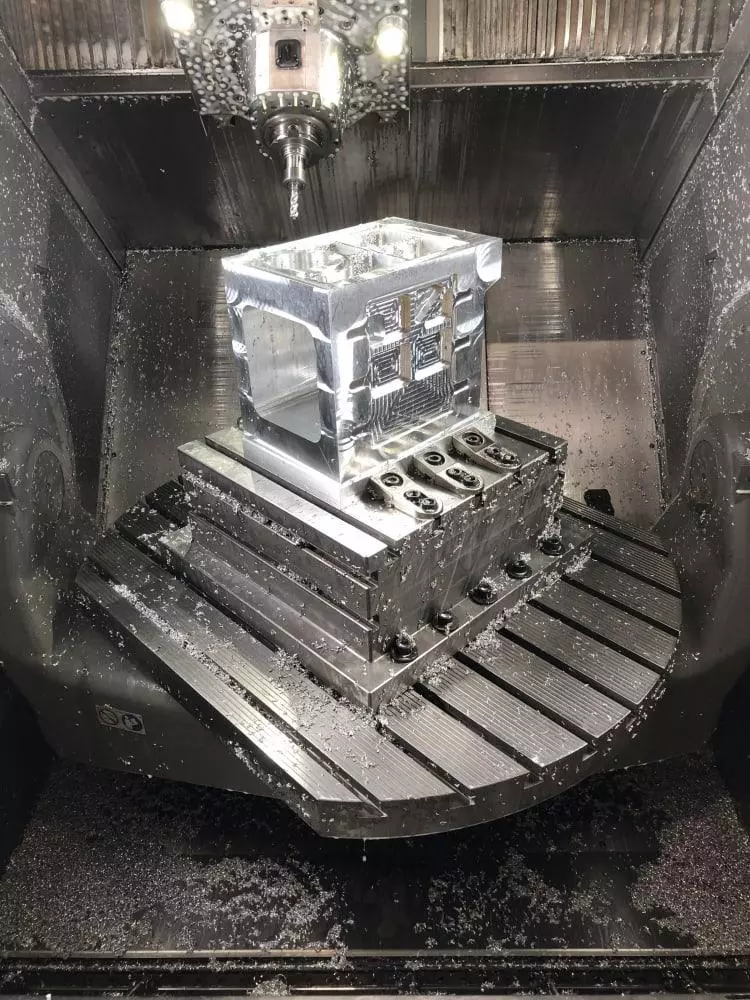
Chip evacuation is easy to overlook when comparing VMCs and HMCs, but it can affect the machining process when deep cavities or heavy material removal are involved.
On a VMC, chips produced inside a deep pocket can accumulate around the cutting area. Coolant, air blast, toolpath strategy, and cutter geometry can help move those chips away, but the pocket itself may still create an environment where chips remain near the tool.
This matters because recutting chips can increase cutting load and affect surface finish and tool wear.
The horizontal orientation of an HMC allows gravity to assist chip removal from many machining areas. When material is removed from a deep cavity, chips can fall away from the cutting zone instead of remaining directly underneath the spindle.
The benefit is more noticeable in certain roughing operations than in light finishing work.
For example, when machining a deep steel housing cavity, the amount of material removed can be substantial. If chips accumulate in the cavity, the cutting conditions can become less stable. A horizontal machining strategy can help with chip evacuation while the cutting tool continues to remove material.
This should not be interpreted as a general rule that HMCs provide better chip evacuation in every operation. Tool selection, coolant delivery, cutting parameters, cavity geometry, and the machine’s chip-management system still have a significant influence.
The useful distinction is that horizontal spindle orientation can support chip evacuation in situations where the geometry makes chip accumulation a concern.
Workholding Changes the Economics of the Two Machines
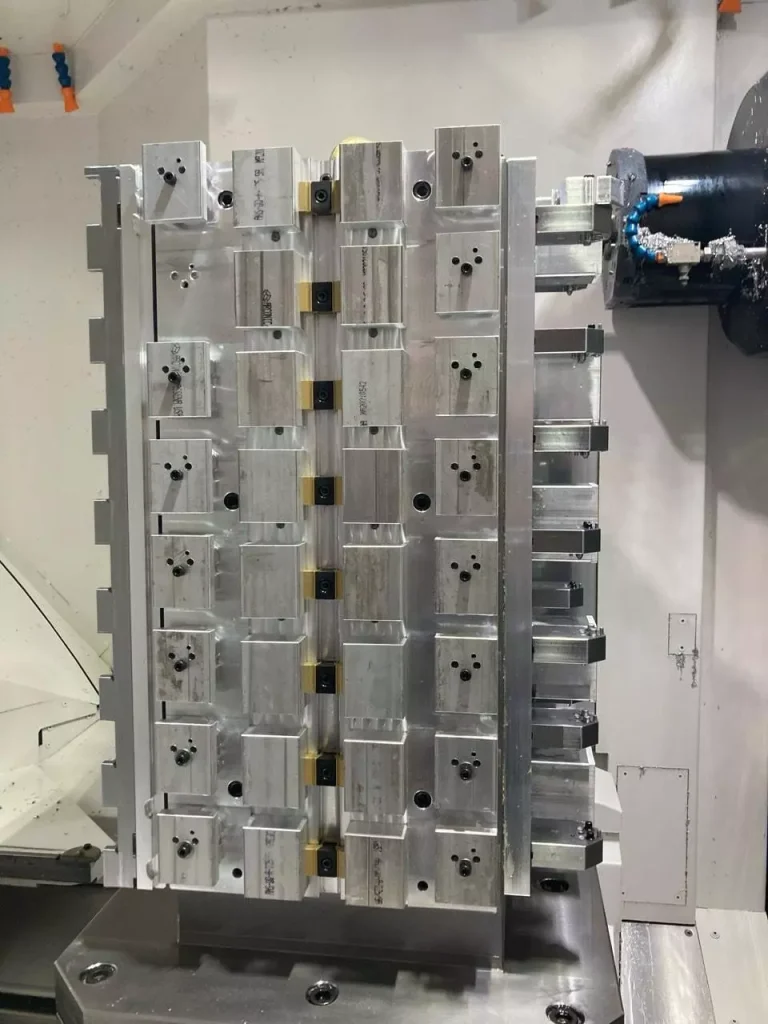
The difference between VMC and HMC becomes even clearer when workholding is considered.
A VMC may use a vise, soft jaws, modular fixture, or dedicated fixture mounted directly on the table. This arrangement works well for many individual components and can be convenient when production changes frequently.
An HMC is often designed around pallets and rotary fixtures. A tombstone can provide several mounting faces, allowing multiple parts to be loaded at the same time.
This can change the relationship between setup time and machining time.
For a prototype order, the manufacturer may only need to produce a small number of components. Creating an elaborate multi-part fixture may not provide enough benefit to justify the additional preparation.
For repeat production, the situation can be different.
Suppose a component requires machining on four faces and the same part is produced repeatedly. A dedicated tombstone fixture may allow several parts to be loaded and several faces to be machined through a programmed sequence.
The initial fixture design and setup effort can then be spread across a larger production quantity.
This is why HMCs are often associated with repetitive production. The reason is not simply that the machine is “more advanced.” The workholding system can change how the entire production process is organized.
VMC and HMC Are Better Under Different Part Conditions
The choice becomes easier when the component is evaluated from the geometry outward.
A VMC is often a practical starting point for a part where the important features are concentrated on one face and can be completed with relatively few setups.
A horizontal machine becomes more interesting when the part has several functional faces, deep cavities, or a production sequence where setup reduction has a noticeable effect.
The same material can be machined on either type of machine.
The same industry can also use either type.
Aerospace, automotive, industrial equipment, medical devices, and energy equipment all contain parts that can be produced on different machine configurations.
The machine decision should therefore start with the component rather than the industry label.
The drawing tells you more about the required machining strategy than the industry name does.
Production Volume Changes the VMC vs HMC Decision
Part geometry is usually the first thing to evaluate, but production quantity can change whether a particular machining strategy makes economic sense.
This is because the value of setup reduction depends on how many times the process is repeated.
For a prototype component, a difference of several minutes between two setups may not have much influence on the total project cost. The same difference becomes much more significant when the component is produced repeatedly and the setup work is performed again and again.
This is where the distinction between VMC and HMC becomes less about machine capability and more about production economics.
VMC for Prototype and Lower-Volume Work
Consider a customer developing a new aluminum enclosure and requesting 10 or 20 pieces for testing.
The component may have several machined faces, but the design is still being evaluated. Dimensions may change after the first batch, and the next order may require a different revision.
In this situation, manufacturing flexibility can be more valuable than building a production system around a dedicated fixture.
A VMC can often handle this type of work with relatively straightforward workholding. If the part requires a second orientation, the operator can change the setup and continue machining.
The process may not be optimized for thousands of identical parts, but that may not matter when only a small number of components are required.
There is another consideration: fixture investment.
A dedicated fixture designed to hold several parts simultaneously may reduce cycle time, but the cost of developing that fixture has to be recovered through production. If the customer only needs a small quantity, the fixture cost may represent a relatively large portion of the manufacturing cost per part.
For this reason, VMC-based production can remain practical for prototypes, samples, replacement components, and smaller production runs even when the geometry is not limited to one face.
Learn more about Production CNC Machining: How to Choose Between Low-Volume and High-Volume Strategies
When Repetition Starts to Change the Calculation
Now consider the same component being produced repeatedly.
Suppose one machining strategy requires four separate setups on a VMC. Each setup requires the part to be loaded, located, probed, and verified before machining continues.
The time required for each setup may appear small when looking at one component.
Across a large production run, however, that time is repeated many times.
An HMC with a suitable fixture may allow several of those operations to be combined into a smaller number of workholding stages. Pallet changing and tombstone fixtures can also change how parts move through the production process.
The important point is that an HMC does not automatically reduce cost simply because it uses a horizontal spindle.
The benefit appears when its configuration eliminates enough setup work, improves machine utilization, or supports a production arrangement that makes sense for the quantity being produced.
This is why there is no universal production quantity at which a manufacturer should switch from VMC to HMC.
The calculation depends on the part.
A component that requires only one VMC setup may remain economical on a VMC even at relatively high production volumes. Another component that requires several orientations may justify an HMC at a much smaller quantity if the setup savings are substantial.
Why Machine Price Is Not the Same as Part Cost
When comparing VMC and HMC, it is tempting to focus on the purchase price of the machine.
That matters when a shop is deciding which equipment to purchase, but it does not tell the whole story for a production job.
For a manufactured component, the relevant question is closer to:
How much manufacturing effort is required to produce one acceptable part?
A simplified cost model can include machining time, setup time, operator involvement, tooling consumption, workholding, inspection, and other process costs.
Consider two hypothetical processes.
The first uses a VMC with a relatively simple fixture. The machine itself may have a lower capital cost, but the component requires several setups.
The second uses an HMC with a more expensive pallet and fixture arrangement. The machine and workholding system may require more initial investment, but several operations can be completed from one fixture.
For a short run, the first process may make more sense because the additional HMC investment has fewer parts over which to spread.
For a long repeat-production run, the second process may become more attractive because the fixture and machine investment are distributed across many parts, while the reduction in setup and handling time is repeated throughout production.
The comparison therefore needs to be made at the process level, not simply at the machine level.
How VMC and HMC Choice Can Affect Machining Cost
Machining cost is influenced by more than spindle time.
Imagine two components that both require one hour of actual cutting time.
The first part remains in the machine for the entire hour and requires only a short loading and locating procedure.
The second part requires several machining orientations, with additional loading, probing, alignment, and inspection between operations.
Although the cutting time is the same, the total manufacturing time is not.
This is one reason setup reduction can have a meaningful effect on production cost.
For multi-face components, an HMC may reduce the amount of handling required between operations. A VMC equipped with rotary equipment may achieve a similar result for some geometries.
The important question is therefore not whether the machine has a higher or lower hourly rate.
It is whether the machine configuration produces the part efficiently enough that the total cost remains competitive.
Fixture Cost Has to Be Considered as Part of the Process
Fixture design is particularly important when comparing low-volume and repeat production.
A simple vise setup may be enough for a prototype. A repeat production component may benefit from soft jaws, dedicated fixtures, a tombstone, or multiple workholding stations.
The more specialized the fixture becomes, the more important production quantity becomes.
Suppose a dedicated fixture costs several hundred dollars to design and manufacture.
If only five parts are produced, that fixture cost is divided across five components.
If the same fixture is used for 1,000 components, its contribution to the cost of each individual part is much smaller.
This does not mean high-volume production should always use a dedicated HMC fixture. It means that production quantity changes the economics of fixture investment.
The machine and the workholding system need to be considered together.
Does HMC Mean Better Accuracy?
The assumption that an HMC is automatically more accurate than a VMC is too simplistic.
Both machine types can produce precision components when the machine, tooling, workholding, programming, cutting conditions, and inspection process are properly controlled.
The orientation of the spindle is not, by itself, an accuracy specification.
A more relevant question is whether the machine configuration makes it easier to maintain the dimensional relationships required by the drawing.
Consider a component with two precision bores located on different faces.
If the part is removed from the fixture between those operations, the second setup has to establish the part’s position again.
The result depends on how accurately the workpiece can be located and how the machining process compensates for any variation.
If both bores can be machined while the component remains in one stable workholding arrangement, the relationship between them can be controlled without transferring the workpiece to another fixture.
This is one area where an HMC can provide a process advantage.
But the same principle can be achieved with a VMC using suitable rotary or multi-axis machining.
Accuracy therefore comes from the complete manufacturing system rather than from the word “horizontal” or “vertical” on the machine specification.
Setup Reduction and Geometric Relationships
The benefit of reducing setups becomes clearer when looking at geometric relationships.
Suppose a machined housing has a bearing bore on the front face and a mounting-hole pattern on the side.
The drawing may specify the position of the mounting holes relative to the bearing centerline.
The challenge is not simply achieving the tolerance of each individual feature.
The manufacturer must also control their relationship.
If the front bore and side holes are machined in separate setups, the workpiece has to be accurately repositioned between operations.
If the machining strategy allows both features to be produced while maintaining a common reference, the process can be easier to control.
This is one reason HMCs can be useful for housings and other multi-face components.
Again, this does not make the HMC inherently more accurate.
It changes the way the component can be positioned relative to the spindle.
Can a VMC With a 4th Axis Replace an HMC?
This is a more useful comparison than simply asking which machine has more axes.
A 4th-axis VMC can rotate the workpiece around an additional axis, allowing different faces to be presented to the cutting tool.
For certain components, this can reduce the number of manual setups considerably.
Imagine a cylindrical manifold with radial holes around its circumference.
Instead of removing and rotating the component manually for each group of holes, a 4th-axis setup can index the part to the required angular position.
For this type of geometry, the combination of a VMC and rotary axis can be very practical.
The situation is different when the part is a large box-shaped housing with machining requirements on several sides and a high production quantity.
An HMC may provide a more suitable production environment because the spindle orientation, pallet, rotary axis, and fixture arrangement are designed around multi-face machining.
The distinction is therefore not simply:
4-axis VMC versus 4-axis HMC.
It is about how the machine handles the workpiece.
A rotary axis on a VMC can provide additional positioning capability, but the machine still retains a vertical spindle and its associated workholding arrangement.
An HMC is designed around horizontal access and can often use tombstones and pallet systems to organize multi-face production.
When a 4th-Axis VMC Can Be a Practical Alternative
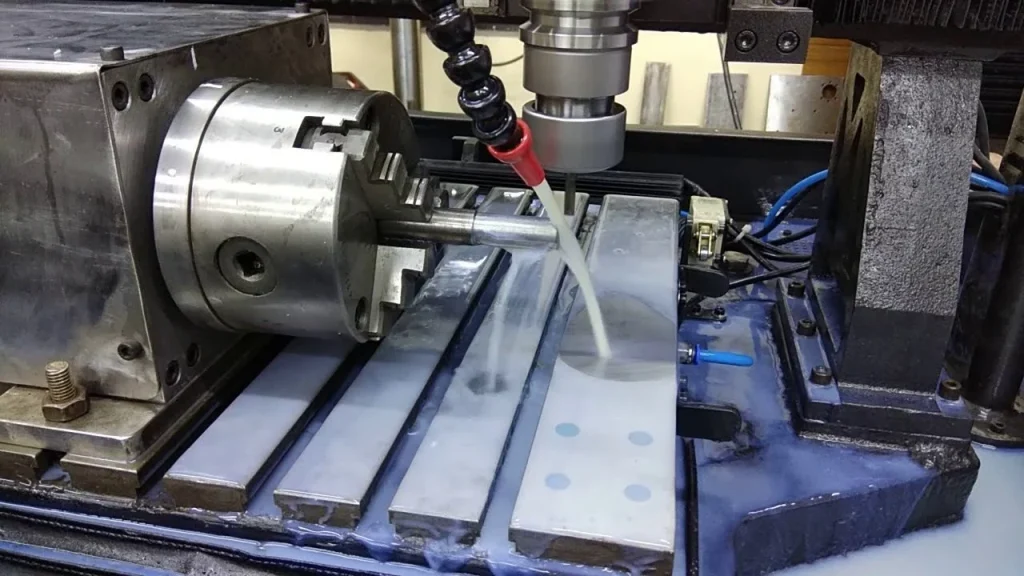
A 4th-axis VMC can be a sensible option when the part has indexed features rather than requiring extensive simultaneous multi-face machining.
Examples include components with holes distributed around a cylindrical body, repeated angular features, or side machining that can be completed after rotating the workpiece to defined positions.
It can also be attractive when production quantity does not justify dedicated HMC fixtures.
For example, producing 30 custom aluminum components may not justify a dedicated HMC production setup if a VMC with rotary equipment can complete the parts with a manageable number of setups.
The calculation changes when the same component is produced continuously and setup time becomes a larger part of the total cost.
What About 5-Axis Machining?
The comparison becomes more complicated when 5-axis machining is introduced.
A 5-axis machining center can orient the cutting tool and workpiece in ways that reduce the need for separate setups.
For complex aerospace components, impellers, molds, medical components, and other parts with compound surfaces, the question may no longer be simply VMC versus HMC.
A 5-axis process can provide access to multiple surfaces while maintaining the component in one primary setup.
However, 5-axis capability does not automatically make a machine more economical.
The programming requirements can be more demanding, tooling strategy becomes more important, and the machine configuration has to match the geometry.
For some parts, a 3-axis VMC remains the simplest solution.
For another part, a 4th-axis VMC may be appropriate.
For a high-volume multi-face housing, an HMC may provide a more efficient production process.
For a complex freeform component, 5-axis machining may be more suitable.
The part determines the process.
Practical Example 1: A Precision Aluminum Plate
Consider a 6061-T6 aluminum plate approximately 300 mm long with several drilled holes, threaded holes, pockets, and a machined perimeter.
The majority of the features are located on the upper surface.
The machining process may involve rough milling, finishing, drilling, tapping, and contouring while the plate remains in one primary fixture.
There is little benefit in introducing a horizontal production strategy if the part does not require extensive side access.
A VMC provides direct tool access to the majority of the features, and a relatively simple fixture may be sufficient.
In this case, the important factor is not the material or the industry. It is the relationship between the part geometry and the spindle orientation.
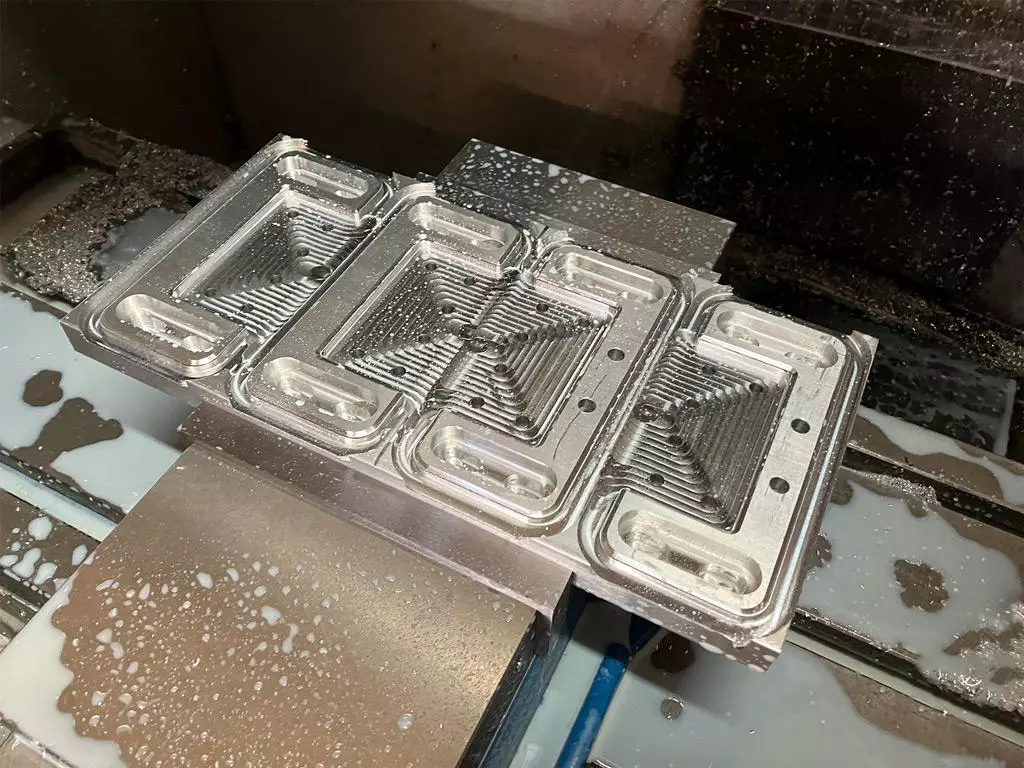
Practical Example 2: A Multi-Face Aluminum Housing
Now consider a machined aluminum housing.
The front contains a bearing bore.
The side contains threaded ports.
The rear contains mounting holes.
The top has a machined sealing surface.
The interior contains pockets that require roughing and finishing.
A VMC can machine this component, but a conventional process may require several orientations.
The manufacturer has to remove and reposition the housing while maintaining the relationship between the bearing bore, mounting features, ports, and sealing surfaces.
An HMC with a suitable fixture may allow more of these operations to be completed from the same workholding arrangement.
The advantage is not simply that the HMC can “reach more sides.”
The more important benefit is that the machining process can be organized around fewer major setups.
If this housing is produced repeatedly, that difference can have a noticeable effect on production efficiency.
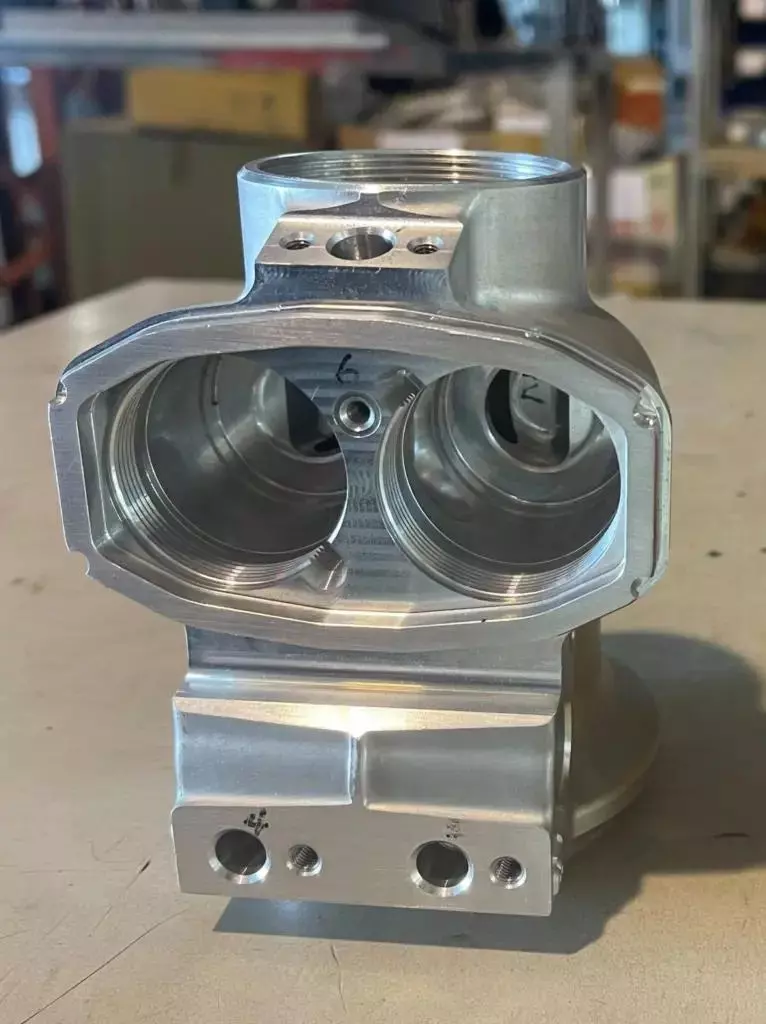
Practical Example 3: A Prototype Stainless Steel Bracket
Now consider a stainless steel bracket required in a quantity of 10 pieces.
The bracket contains a machined profile, several mounting holes, and two side features.
The customer expects to evaluate the first parts and may modify the design.
In this situation, the machining strategy needs to remain flexible.
A VMC can accommodate the part through a straightforward fixture and, if necessary, a second setup for the side features.
Building a more elaborate HMC fixture may not provide enough benefit for such a small quantity.
The material being stainless steel does not by itself determine the machine choice.
The quantity, geometry, setup requirements, and expected design changes are more relevant.
Practical Example 4: A Repetitive Industrial Component
Consider a steel industrial component produced in several hundred pieces per production run.
The component contains multiple drilled and tapped faces, two precision bores, and a deep internal pocket.
On a VMC, the component may require several orientations.
If the same setup sequence is repeated across hundreds of parts, the accumulated handling and alignment time can become a significant part of the production process.
An HMC with a pallet and dedicated fixture may allow the manufacturer to organize several operations around a common workholding system.
The machine can then spend more of the production cycle performing cutting operations instead of waiting for repeated manual repositioning.
This is the type of situation where the economics of an HMC can become more compelling.
The key is not simply that the quantity is “high.”
It is that the combination of geometry, repeated production, setup count, and fixture strategy creates an opportunity to reduce non-cutting time.
Why Many Machine Shops Use Both VMCs and HMCs
The comparison between VMC and HMC is sometimes presented as if a machine shop has to choose one or the other.
In actual manufacturing, many shops use both because the two machine configurations solve different production problems.
A VMC can be useful when flexibility and straightforward access are important. A shop may use it for prototype parts, brackets, plates, fixtures, small production runs, or components that can be completed efficiently from one or two orientations.
An HMC can be useful when the production process benefits from horizontal access, palletized workholding, multiple-part fixtures, or fewer major setups.
The same shop may therefore machine one customer’s bracket on a VMC and another customer’s housing on an HMC, even when both components are made from the same material.
Machine allocation can also change over time.
A part may begin as a prototype and be produced on a VMC because only a small quantity is required. If the design becomes a regular production item, the manufacturer may later review the process and determine whether a different machine, fixture, or automation strategy would reduce the cost per part.
This is a normal part of manufacturing process development.
The machine used for the first production run does not necessarily have to be the machine used for long-term production.
VMC vs HMC: Look at the Part Before Looking at the Machine
If you are trying to decide between a vertical and horizontal machining center, starting with the machine specification can lead to the wrong question.
Start with the part.
Look at the drawing and identify where the material has to be removed, where the critical dimensions are located, and how the different features relate to each other.
A plate with most of its features on one face may require very little workholding complexity.
A housing with features distributed around several sides presents a different manufacturing problem.
Then consider how many times the workpiece needs to change orientation.
This is often more informative than simply counting the number of machining operations.
For example, a part could require twenty drilling, milling, and tapping operations but still be completed in one setup.
Another part might require only six operations but need four different orientations.
The second part may create more setup work even though it has fewer operations.
After that, production quantity needs to be considered.
A setup that is reasonable for ten pieces may not be the most efficient approach for 5,000 pieces. Likewise, a highly optimized production fixture may not be justified for a small prototype order.
The machine selection should follow these manufacturing requirements rather than being decided first and forcing the part into the available process.
A Practical Way to Compare VMC and HMC
For a new component, the comparison can be approached in a simple sequence.
First, determine how many faces contain machining features.
If almost everything is accessible from one primary face, a VMC may provide a straightforward solution.
If important functional features are distributed around several faces, then an HMC or multi-axis VMC becomes worth evaluating.
Next, determine how many setups are required.
Do not count only the machining operations. Count how many times the workpiece has to be removed, rotated, relocated, or re-established.
Then look at the relationship between those features.
If a front bore needs to maintain a close positional relationship with a side hole pattern, the locating strategy becomes important.
If the features are functionally independent, additional setups may be less of a concern.
The next question is production quantity.
For a small prototype run, a flexible setup may be more appropriate.
For repeated production, setup reduction, dedicated fixtures, palletization, and automation can become more valuable.
Finally, compare the expected cost of the complete process.
This means considering machining time, setup time, labor, tooling, fixtures, inspection, and the quantity being produced.
Only after these factors have been considered does the VMC or HMC choice become meaningful.
VMC vs HMC: Quick Comparison
| Factor | Vertical Machining Center | Horizontal Machining Center |
|---|---|---|
| Spindle orientation | Vertical | Horizontal |
| Typical workholding | Table, vise, dedicated fixture, rotary fixture | Pallet, tombstone, rotary fixture |
| Access to top surfaces | Convenient | Depends on fixture orientation |
| Multi-face machining | May require rotary equipment or additional setups | Often well suited to multi-face work |
| Deep-pocket chip evacuation | Depends on geometry and chip-management strategy | Horizontal orientation can assist chip evacuation |
| Prototype flexibility | Often practical | Can be practical, depending on machine and setup |
| Repetitive production | Suitable for many parts | Often attractive for multi-face repeat production |
| Palletized production | Available on some configurations | Common production approach |
| Setup reduction | Depends on part and rotary capability | Can be a major advantage for multi-face parts |
| Best choice | Depends on geometry and process | Depends on geometry and process |
The table provides a starting point, not a universal ranking.
A VMC with a rotary axis can overlap with some HMC applications, while a high-end HMC can be configured very differently from a basic horizontal machine.
Machine specifications also vary between manufacturers, so the actual capabilities need to be evaluated from the machine configuration rather than the category name alone.
What Should You Consider When Choosing a CNC Machining Supplier?
If you are outsourcing the machining rather than purchasing a machine, you may not need to decide whether your component should be produced on a VMC or HMC yourself.
The supplier should be able to review the part and determine an appropriate machining process.
This is particularly useful when the component has multiple machining faces or tight positional relationships.
For example, you may know that your aluminum housing needs a bearing bore, several threaded ports, and mounting holes.
You do not necessarily need to specify:
“Please manufacture this on an HMC.”
The more useful information is the drawing, 3D model, material, quantity, tolerance requirements, surface finish, and any critical functional dimensions.
The machining supplier can then evaluate how the part should be fixtured and which machine configuration is appropriate.
A supplier may choose an HMC because the part can be completed with fewer setups.
Another supplier may use a 5-axis VMC because the geometry can be handled efficiently in one primary setup.
For a lower-volume component, a 3-axis VMC with an additional setup may even be the more economical option.
The machine type should support the manufacturing strategy rather than become a specification that limits the supplier before the part has been evaluated.
What Information Helps a Machining Supplier Make This Decision?
A 3D CAD file shows the overall geometry, but it does not necessarily communicate every manufacturing requirement.
The 2D drawing is important for understanding tolerances, datums, threads, surface finish, and other controlled features.
Material also affects the process.
Machining 6061 aluminum, 7075 aluminum, 316 stainless steel, 17-4 PH stainless steel, titanium, and hardened tool steel can involve very different cutting conditions and tooling strategies.
Quantity matters because the most suitable process for five prototypes may differ from the process used for several thousand production parts.
Critical dimensions matter as well.
If two features have a controlled positional relationship, the supplier needs to understand that relationship when planning the workholding and machining sequence.
For this reason, a useful RFQ package usually includes the CAD model, drawing, material, quantity, required finish, tolerances, and any specific inspection requirements.
The supplier can then determine whether the part is better suited to vertical, horizontal, rotary, or multi-axis machining.
Common Questions About Vertical and Horizontal Machining Centers
Is a VMC better than an HMC?
Neither is better for every application.
A VMC can be a practical choice when the part can be machined efficiently from one primary direction or when production flexibility is important.
An HMC can become more useful when several faces need machining and the production process can benefit from fewer setups, palletized workholding, or multi-part fixtures.
The part geometry and production requirements determine which approach makes more sense.
Is an HMC always more expensive to operate?
Not necessarily.
The hourly cost of a machine is only one part of the calculation.
An HMC may have a higher operating cost per machine hour, but if it reduces setup time and handling for a multi-face component, the total cost per part can still be competitive.
Conversely, using an HMC for a simple component that can be completed efficiently on a VMC may add cost without providing a corresponding benefit.
Which machine is better for aluminum CNC machining?
Both can machine aluminum effectively.
A simple aluminum plate or bracket may fit naturally into a VMC process.
A complex aluminum housing with several machined faces may benefit from an HMC or multi-axis setup.
The material does not determine the machine type by itself.
Which machine is better for stainless steel?
The same principle applies to stainless steel.
Machining stainless steel can place greater demands on tooling, cutting parameters, heat management, and chip control, but the choice between VMC and HMC still depends primarily on the part geometry and production strategy.
For deep pockets or large material removal, the chip-evacuation characteristics of an HMC may be useful.
For a relatively simple bracket, a VMC may remain a practical solution.
Is HMC machining faster than VMC machining?
There is no useful single answer.
For a simple component that requires one VMC setup, an HMC may not provide a meaningful cycle-time advantage.
For a multi-face component that requires several VMC setups, an HMC may reduce the overall production time by combining operations and reducing workpiece handling.
The relevant comparison is total production time rather than spindle speed alone.
Can a VMC machine a five-sided part?
It can, depending on the machine configuration.
A conventional VMC may require several setups. A VMC with a rotary axis can index additional faces, while a 5-axis machine can provide more continuous access to complex geometry.
Whether that approach is practical depends on the part size, geometry, tolerances, workholding, and production quantity.
Does HMC reduce setup time?
It can, particularly when a part has multiple machined faces and the fixture allows several operations to be performed without removing the workpiece.
The actual reduction depends on the component and fixture design.
An HMC does not automatically reduce setup time for every part.
Which machine is better for high-volume production?
An HMC can be attractive for repeat production when multiple faces need machining and palletized workholding or dedicated fixtures can reduce handling.
A VMC can also support high-volume production when the component geometry allows an efficient setup and the required automation can be integrated into the process.
Production volume should therefore be considered together with geometry and setup requirements.
Should I specify VMC or HMC when requesting a CNC machining quote?
Usually, it is more useful to provide the part requirements than to specify the machine type.
A supplier can evaluate the geometry, material, quantity, tolerances, and required finish and determine an appropriate machining strategy.
If you have a particular machine requirement for contractual, qualification, or process-control reasons, that can of course be included in the RFQ.
Final Takeaway: Choose the Process, Not Just the Machine
The difference between a vertical and horizontal machining center starts with spindle orientation, but the manufacturing consequences go much further.
A VMC can be a practical solution when the geometry is accessible from above, the number of setups is manageable, and production flexibility is important.
An HMC can become more useful when several faces require machining, setup reduction affects production efficiency, deep cavities create chip-management challenges, or repeat production justifies palletized workholding and dedicated fixtures.
A 4th-axis or 5-axis VMC can overlap with some HMC applications, which is why machine categories should not be treated as isolated choices.
For a real component, the most useful evaluation starts with the drawing.
How many faces need machining?
How many setups are actually required?
Which dimensions have important positional relationships?
How many parts are required?
Would a dedicated fixture provide enough benefit to justify its cost?
How much of the total production time is cutting, and how much is loading, locating, repositioning, and inspection?
These questions lead to a more useful manufacturing decision than simply asking whether vertical or horizontal machining is better.
If you are sourcing custom CNC machining, you can provide the part drawing or 3D CAD model together with the material, quantity, tolerances, and surface-finish requirements. The machining process can then be evaluated based on the actual component rather than selecting a machine type before the geometry and production requirements are understood.