Introduction
In precision manufacturing, selecting a CNC machining process is usually based on how effectively the process can meet the requirements of the part rather than simply choosing equipment with greater movement capability. Factors such as component geometry, material characteristics, tolerance requirements, surface finish, inspection standards, and production volume all influence the machining strategy. While 3-axis CNC milling remains suitable for many industrial components, some parts become increasingly challenging when they contain multiple machined surfaces, angled features, deep cavities, or complex three-dimensional contours.
The main challenge with these components is often not material removal itself, but maintaining consistency throughout the entire manufacturing process. A part may require several machining orientations, and each additional setup introduces new considerations related to fixture positioning, datum reference, tool access, and feature alignment. For precision components used in aerospace, robotics, semiconductor equipment, and industrial machinery, maintaining the relationship between multiple features can be more difficult than achieving a single dimensional requirement.
In many precision CNC machining applications, dimensional tolerances around ±0.01 mm are commonly specified, while components with demanding functional requirements may require control closer to ±0.005 mm. Achieving this level of accuracy depends on the complete machining process, including machine calibration, workholding stability, cutting parameters, CAM programming, environmental control, and inspection methods such as coordinate measuring machines (CMM). Five-axis CNC machining does not automatically create tighter tolerances, but it can provide a manufacturing approach that helps reduce certain limitations associated with complex part geometry and repeated setups.
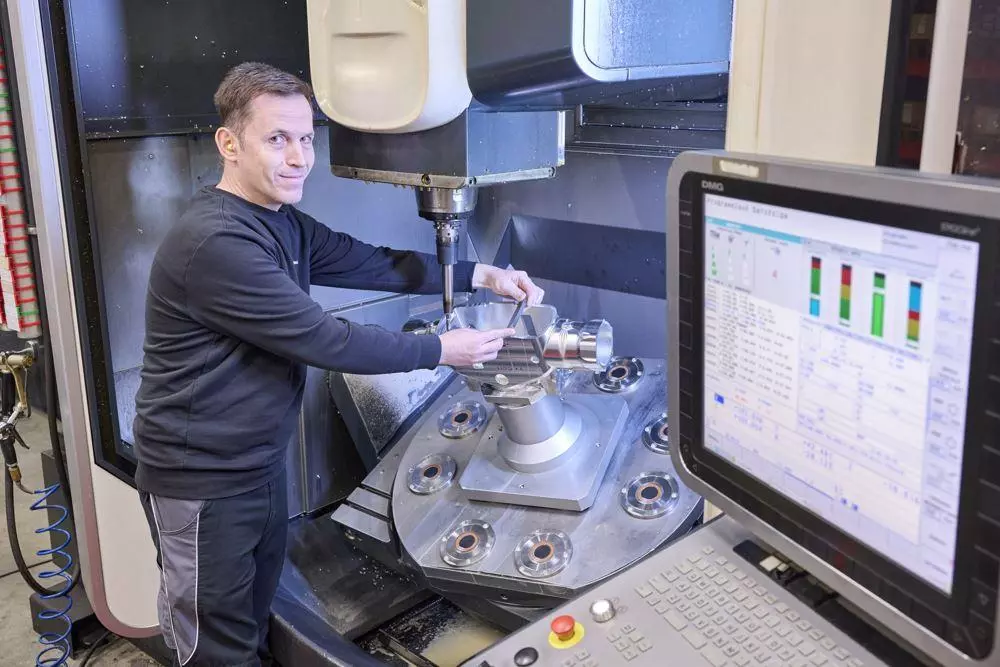
The main advantage of five-axis machining comes from controlling the relationship between the cutting tool and the workpiece. By allowing additional rotational movement, the process provides greater flexibility when machining complex components, improving access, reducing unnecessary repositioning, and supporting more controlled manufacturing strategies.
Advantage 1: Machine Complex Parts with Fewer Manufacturing Operations
One of the most important advantages of 5-axis CNC machining is the ability to manufacture complex components with fewer machining operations. Many industrial parts are designed with functional requirements that create challenging geometries, including angled surfaces, multi-face structures, curved profiles, and internal features that require different machining directions. Using conventional machining methods, manufacturers may need to divide the production process into several setups, where the workpiece is removed, repositioned, and aligned again before additional features can be machined. Each setup requires careful control of the fixture location and machining reference because even small positioning differences can influence the relationship between features. Five-axis machining allows the cutting tool to approach the workpiece from different orientations during the same machining process, which can reduce the number of repositioning operations required for suitable parts. This is particularly valuable for components manufactured from materials such as 6061-T6 aluminum, 7075-T6 aluminum, stainless steel, and titanium alloys, where maintaining stable machining conditions is important. The practical benefit for customers is not simply faster machining, but a more controlled production process where complex components can move from CAD model to finished part with fewer manufacturing interruptions.
Advantage 2: Maintain Accuracy Between Multiple Critical Features
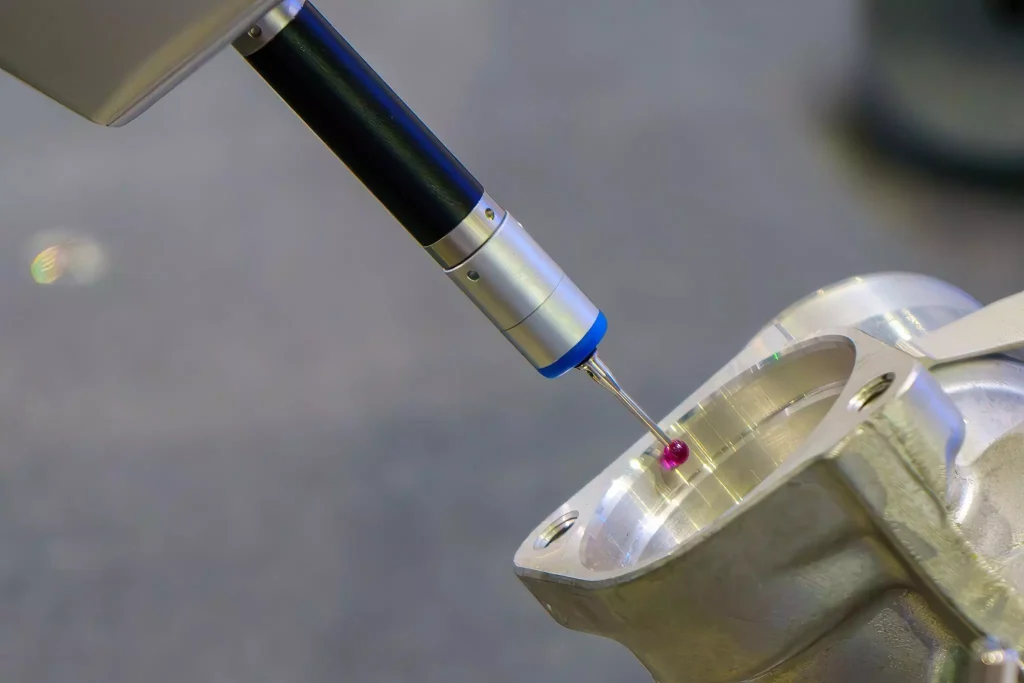
For precision CNC machining, achieving individual dimensions is only part of the manufacturing requirement. Many components need multiple features to maintain accurate relationships with each other, especially when they are used in assemblies where alignment and fit are critical. A machined surface may need to remain perpendicular to another feature, mounting holes may need to maintain precise positioning, or several reference surfaces may need to match assembly requirements.
When a component requires multiple machining setups, every repositioning requires the manufacturer to establish the datum reference again. Although modern fixtures and inspection methods can control this process effectively, additional setups increase manufacturing complexity. This becomes more important when tolerance requirements approach ±0.005 mm, where factors such as fixture repeatability, thermal changes, tool wear, and machine condition can influence the final result.
Five-axis machining can reduce some of these challenges by allowing more features to be machined within a consistent workholding arrangement. By minimizing unnecessary repositioning, manufacturers can simplify the relationship between different machining operations. However, the final accuracy still depends on the complete production system. A five-axis machine combined with proper CAM programming, rigid fixturing, and CMM verification provides a more reliable approach for managing complex precision requirements.
Advantage 3: Produce Complex Geometries That Are Difficult with Conventional CNC
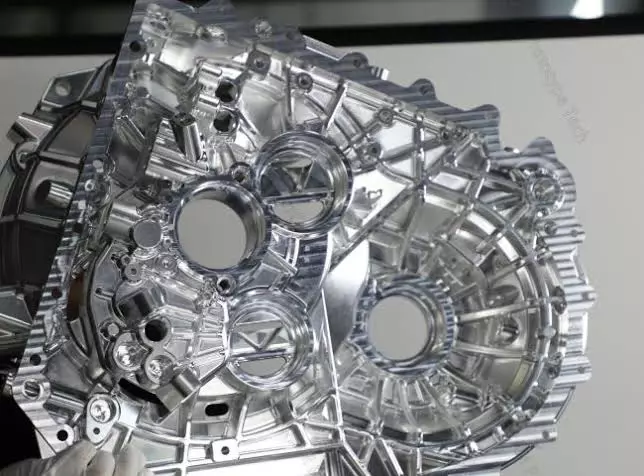
Many modern components are designed around performance requirements rather than manufacturing simplicity. Lightweight structures, compact assemblies, and optimized mechanical designs often include features that are difficult to produce using standard machining methods. Examples include curved surfaces, angled pockets, deep cavities, and complex transition areas where the cutting tool needs to approach the material from different directions.
In conventional CNC machining, these features may require additional setups or specialized fixtures to reach different areas of the component. This can increase manufacturing time and create more process variables. Five-axis CNC machining provides greater control over tool orientation, allowing manufacturers to develop machining strategies that better match the geometry of the part.
This capability is widely used in industries where complex components are common. Aerospace brackets, robotic components, semiconductor equipment parts, and medical devices often require precise machining of irregular geometries while maintaining dimensional consistency. The value of five-axis machining is that it allows engineers to consider more complex designs without being limited by traditional machining access restrictions.
Advantage 4: Improve Surface Quality on Complex Contours
Machining complex surfaces requires careful control because cutting conditions change continuously as the tool follows the geometry. Unlike flat surfaces, curved contours involve changing contact conditions between the cutting tool and the material, which can influence surface consistency and finishing requirements.
Five-axis machining allows the tool orientation to change while following complex surfaces, providing better control over the machining approach. This can help maintain more consistent cutting conditions when producing components with three-dimensional features.
Surface finish requirements depend heavily on material, tooling, cutting parameters, and machining strategy. For many precision CNC milling applications, surface finishes around Ra 1.6–3.2 μm may be achievable under suitable conditions, while tighter surface requirements may require additional finishing processes. Materials such as aluminum alloys, stainless steels, and titanium alloys may require different strategies because their machining characteristics vary significantly.
The advantage of five-axis machining is not that it automatically produces a specific surface finish, but that it gives manufacturers more control when machining geometries where maintaining consistent tool contact is difficult.
Advantage 5: Support Prototype Development and Low-Volume Production
Five-axis CNC machining is also valuable for prototype development and low-volume production, where flexibility and manufacturing efficiency are often more important than high-volume automation. During product development, engineers may need to produce several design iterations before moving into stable production. These prototype parts often contain complex features, tight tolerances, and changing requirements.
Traditional machining methods may require significant fixture adjustments or process changes when design modifications occur. Five-axis machining can simplify some of these transitions because the same equipment can handle a wider range of complex geometries without completely changing the manufacturing approach.
For industries such as robotics, aerospace, semiconductor equipment, and industrial automation, prototype and low-volume components often require both precision and adaptability. A typical project may involve tolerance verification, design adjustments, material evaluation, and repeat production planning. Five-axis machining combined with proper inspection procedures, including CMM measurement and dimensional reporting, can support this development process.
However, five-axis machining is not automatically the most economical option for every project. Production volume, material cost, machining time, and part complexity must still be evaluated to determine the most suitable manufacturing method.
When Should You Choose 5-Axis CNC Machining?
Choosing 5-axis CNC machining depends mainly on whether the additional machining capability solves a real manufacturing challenge. Not every precision component requires five-axis equipment, and many parts with simple geometries can be produced efficiently using 3-axis or 4-axis machining. The decision usually becomes more relevant when the component includes multiple machined faces, complex contours, tight positional requirements, or features that are difficult to access with conventional tool directions.
For parts that require several setups, five-axis machining may help simplify the manufacturing process by reducing repositioning operations and improving access to different areas of the component. This is especially useful when maintaining the relationship between multiple features is important. For example, a component with precision mounting surfaces, alignment holes, and angled structures may require careful control of the datum system throughout production. By completing more operations within a consistent fixture arrangement, five-axis machining can reduce some of the challenges associated with repeated setups.
Material selection is another factor that influences whether five-axis machining provides practical value. Aluminum alloys such as 6061-T6 and 7075-T6 are commonly machined for lightweight structural components, while materials such as 17-4 PH stainless steel, Inconel alloys, and titanium require more careful control because of their mechanical properties and machining behavior. When machining harder materials or complex geometries, maintaining suitable tool orientation can help manufacturers manage cutting conditions more effectively.
The requirement for inspection and documentation should also be considered. Precision components with tolerances around ±0.005 mm often require more than machining capability alone. Manufacturers may need to use CMM inspection, dimensional reports, and controlled measurement procedures to verify that the finished component meets the required specifications. Five-axis machining can support these requirements by simplifying certain aspects of the manufacturing process, but quality results still depend on the complete production system.
5-Axis CNC Machining vs 3-Axis CNC Machining: How to Select the Right Process
The choice between 5-axis and 3-axis CNC machining should be based on the requirements of the part rather than selecting the most advanced available equipment. Three-axis CNC machining remains a practical solution for many components with simple geometries, standard pockets, drilling operations, and flat surfaces. It generally involves simpler programming and can be highly efficient when additional tool orientation is not required.
Five-axis CNC machining becomes more suitable when part geometry creates challenges that cannot be easily addressed through standard machining methods. Components with complex surfaces, multiple machining directions, angled features, and strict feature relationships often benefit from the additional flexibility provided by five-axis equipment.
The difference between these processes is not simply the number of axes available. The main consideration is how the machining strategy manages part accessibility, setup requirements, and feature consistency. A well-planned 3-axis process may provide better efficiency for simple parts, while a five-axis process may offer advantages when reducing setup complexity and improving access to difficult features becomes important.
| Consideration | 3-Axis CNC Machining | 5-Axis CNC Machining |
|---|---|---|
| Part geometry | Suitable for standard features and simpler designs | Suitable for complex surfaces and multi-face components |
| Setup requirements | May require more repositioning for complex parts | Can reduce setups for suitable geometries |
| Tool accessibility | Limited machining directions | Adjustable tool orientation |
| Programming requirements | Generally simpler CAM programming | Requires more advanced CAM planning |
| Typical applications | General mechanical parts, brackets, housings | Aerospace, robotics, medical, semiconductor components |
The most effective manufacturing approach is usually determined by balancing part requirements, machining complexity, production volume, and overall project objectives.
Conclusion
5-axis CNC machining provides several practical advantages for precision manufacturing, particularly when producing components with complex geometries, multiple machining surfaces, and demanding dimensional requirements. Its value comes from improving access to difficult features, reducing unnecessary setup operations, supporting better control between critical features, and providing greater flexibility during prototype and low-volume production.
However, five-axis machining should be viewed as a manufacturing solution for specific challenges rather than a universal replacement for other CNC processes. The final machining strategy should consider factors such as component design, material characteristics, tolerance requirements, inspection needs, and production economics.
For engineers and purchasing teams evaluating CNC machining options, understanding these advantages helps determine whether five-axis machining provides meaningful value for a specific project. When the part design requires greater flexibility, tighter control of feature relationships, or more efficient handling of complex geometry, five-axis CNC machining can become an important part of the manufacturing process.