What Is Billet Aluminum?
Billet aluminum is not a grade of metal. The word “billet” describes the form of the material. In most machining applications, it means solid aluminum stock that a manufacturer cuts or machines into a finished part.
When a product is sold as a billet aluminum part, the manufacturer typically CNC-machines it from solid wrought aluminum stock rather than casting the part in a mold or forming it through a forging process.
That distinction matters because “billet” does not tell you everything about the part. It does not identify the alloy, temper, geometry, heat treatment, or final strength. A 6061-T6 billet part and a 7075-T6 billet part use the same basic manufacturing approach but have very different material properties.
People who search for what is billet aluminum are usually trying to answer a practical question. They have seen “machined from billet aluminum” on a valve cover, bracket, housing, wheel, or performance component and want to know what the term actually means—and whether it represents a real advantage.
The answer starts with the material itself.
Billet Aluminum Meaning: Two Definitions People Mix Up
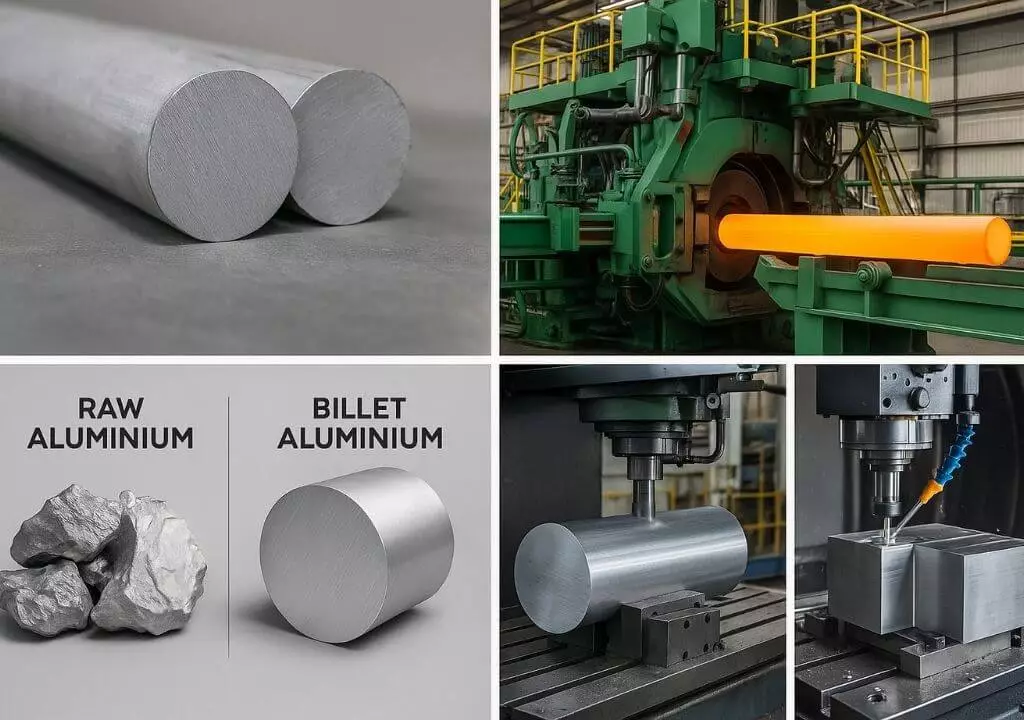
The word billet has two related meanings in aluminum manufacturing. The first describes a semi-finished mill product. The second is the way aftermarket manufacturers describe parts machined from solid wrought stock.
In the mill: billet is a semi-finished product
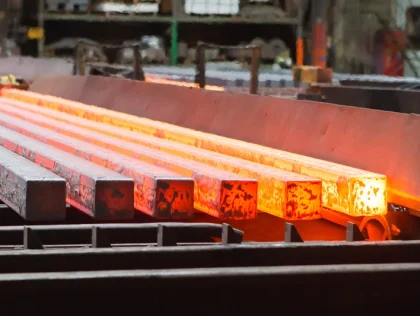
In a casthouse or extrusion plant, an aluminum billet is a semi-finished cast product used as feedstock for another process. Billets are commonly round, although square and rectangular forms also exist.
They belong to the same family of semi-finished aluminum products as ingots and slabs:
| Term | What it is | What happens next |
|---|---|---|
| Ingot | Large cast form used for storage, remelting, or further processing | Remelted or converted into another mill form |
| Slab | Large, relatively flat semi-finished casting | Rolled into plate, sheet, or foil |
| Billet | Usually a round or rectangular semi-finished form | Extruded, forged, or processed into other stock |
| Bar stock | Long finished mill product supplied in standard sizes | Machined by turning, milling, drilling, or other processes |
A useful distinction is that a billet is feedstock for another operation. The terminology changes once the material has been processed into bar, plate, extrusion, or another finished mill product.
Industrial billet sizes vary widely with the casting and extrusion equipment. Direct-chill (DC) casting can produce billets ranging from relatively small diameters to very large logs. Extrusion plants then cut the logs to lengths suitable for their presses.
This is where the word “billet” has its original manufacturing meaning. It does not mean that the final component itself came directly out of a casting mold.
In the aftermarket: “billet” means machined from solid
In performance and aftermarket parts, billet aluminum usually describes a manufacturing route.
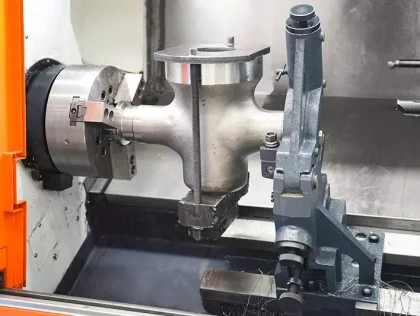
The manufacturer starts with wrought aluminum stock—often a bar, plate, or cut block—and removes material with CNC equipment until the required geometry remains.
That is what the phrase “machined from billet” usually means.
The finished part may show sharp edges, machined pockets, drilled holes, milled surfaces, and other features that would require different tooling or additional machining if the manufacturer produced the basic shape by casting.
The process also creates a significant amount of scrap. A large portion of the starting block can become chips during roughing. Those chips remain recyclable, but the manufacturer still has to buy the original stock and spend machine time removing it.
What Billet Aluminum Is Not
Several common descriptions make billet aluminum sound like a special type of metal. It is not.
1. Billet is not an alloy
6061-T6 and 7075-T6 can both serve as billet stock, but they have very different mechanical properties.
The word “billet” tells you how the material is supplied or, in aftermarket terminology, how the manufacturer made the part. It does not tell you the alloy.
2. CNC machining is not forging
CNC machining removes material from a solid workpiece.
Forging uses force to plastically deform a heated or otherwise prepared metal blank in dies. The two processes create different material structures and require different equipment and tooling.
A machined part can start from wrought material, but machining itself does not create the wrought structure.
3. Billet does not automatically mean stronger
A billet part can have excellent material properties, but geometry still controls how the finished component carries a load.
A thin billet housing with poor rib placement can fail before a well-designed casting. Likewise, a heavy billet part may be stronger than necessary but still be a poor choice if weight matters.
The process name is only one part of the engineering decision.
4. Wrought and cast aluminum are not interchangeable
Two materials can have similar nominal alloy chemistry but very different structures because one has gone through a wrought processing route and the other has solidified directly into a casting.
That difference affects mechanical properties, porosity, fatigue behavior, and the design values an engineer can reasonably use.
How Billet Aluminum Becomes Machining Stock
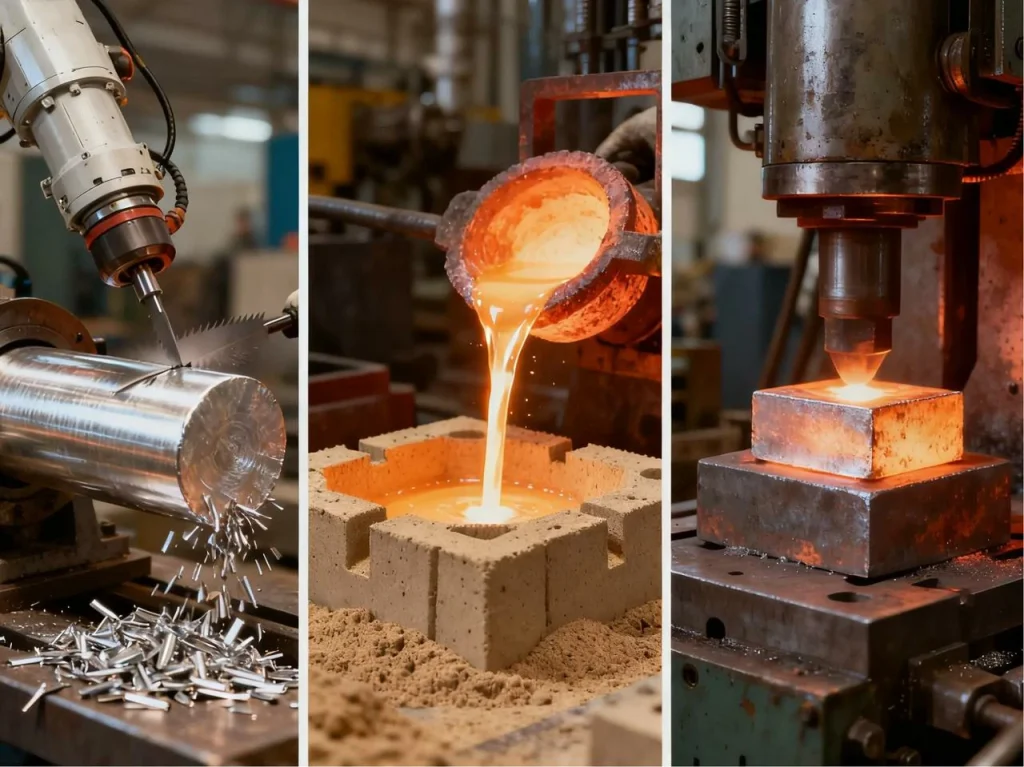
The manufacturing history explains why billet parts behave differently from raw castings.
Step 1 — Cast the aluminum billet
Industrial aluminum billets commonly begin with direct-chill (DC) casting.
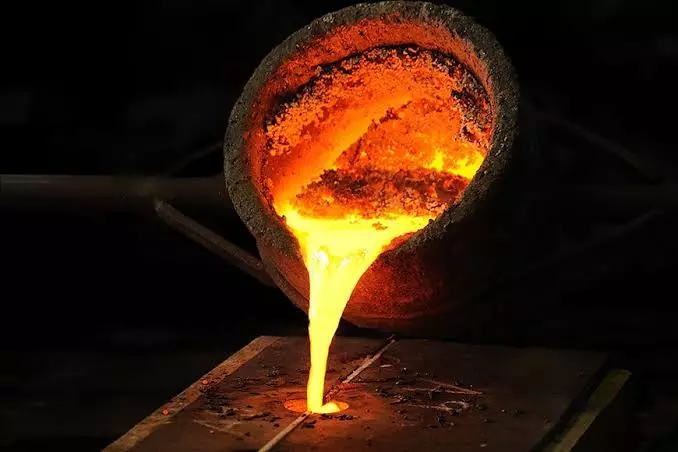
The producer melts the selected alloy and pours the molten metal into a water-cooled mold. As the emerging metal leaves the mold, secondary water cooling rapidly extracts heat and solidifies the billet.
The resulting billet is still a cast product. Its microstructure reflects the solidification process.
Industrial producers control variables such as:
- Metal temperature
- Casting speed
- Cooling-water flow
- Billet diameter
- Alloy chemistry
- Homogenization treatment
The exact parameters vary with alloy, billet size, casting equipment, and production requirements, so a single set of casting numbers should not be treated as universal.
Step 2 — Convert the billet into wrought stock
The cast billet can then become feedstock for extrusion, rolling, or forging.
During these processes, the manufacturer plastically deforms the aluminum. The deformation changes the microstructure and helps break up and redistribute features inherited from the original cast structure.
Heat treatment may follow, depending on the alloy and required temper.
This distinction is important:
The CNC machine does not turn cast aluminum into wrought aluminum.
If a manufacturer machines a 6061-T6 block, the material already has its wrought structure and temper before it reaches the machining center.
Step 3 — Machine the finished component
A CNC shop then cuts the wrought stock into the required component.
The process may include:
- Workholding and datum setup
- Rough milling
- Semi-finishing
- Finish milling
- Drilling and boring
- Threading
- Deburring
- Inspection
- Surface finishing
The machinist removes the material that the final component does not need.
That approach gives the manufacturer considerable freedom to change dimensions, holes, pockets, ribs, and other features without changing a casting die.
The tradeoff is material utilization and machining time.
For some brackets and housings, only a fraction of the original block remains in the finished component. The exact percentage depends heavily on the geometry, but 60–80% material removal is entirely possible on heavily machined parts.
That material does not simply disappear. It becomes chips that the manufacturer can recycle.
Billet vs. Cast vs. Forged Aluminum
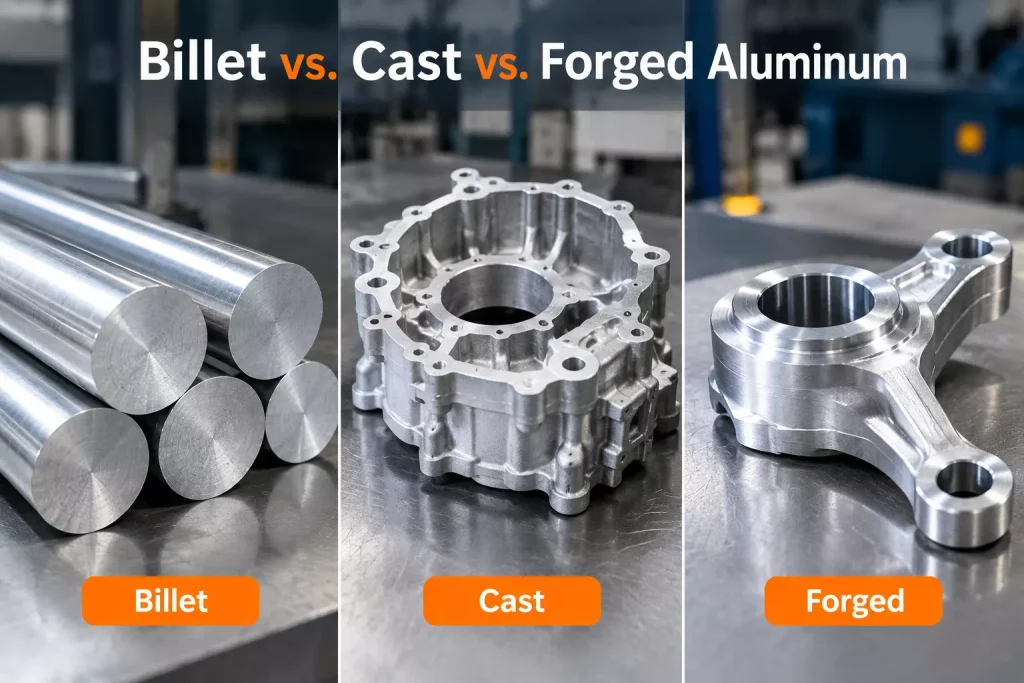
The easiest way to understand billet aluminum is to compare the manufacturing processes rather than treating billet, cast, and forged as three different grades of aluminum.
| Factor | Billet / Machined | Cast | Forged |
|---|---|---|---|
| How it is made | Machined from solid wrought stock | Molten metal solidified in a mold | Metal plastically deformed in a die |
| Material structure | Inherits wrought stock structure | Solidification structure; porosity may occur | Strongly worked structure with directional grain flow |
| Dimensional precision | Excellent after machining | Moderate before secondary machining | Good, but usually requires machining |
| Complex geometry | Excellent for external features; deep cavities can increase machining time | Excellent for complex shapes and internal passages | More limited by forging geometry |
| Tooling cost | Low; mainly fixtures and CNC programming | Moderate to high; molds and dies | High; forging dies and tooling |
| Low-volume production | Usually attractive | Tooling can be difficult to justify | Usually difficult to justify |
| High-volume production | Machining time can become expensive | Very attractive when tooling is amortized | Attractive for suitable load-bearing parts |
| Material utilization | Often low | Generally high | Usually better than heavily machined billet |
| Typical advantage | Precision, design flexibility, low tooling cost | Complex geometry and production volume | Fatigue and impact performance when properly designed |
None of the three processes wins every category.
The correct choice depends on geometry, loading, quantity, tolerance, material, tooling budget, and production schedule.
Is Billet Aluminum Stronger Than Cast Aluminum?
This is where product marketing often oversimplifies the issue.
Consider two commonly encountered materials: 6061-T6 wrought aluminum and A380 die-cast aluminum.
Typical published values for 6061-T6 wrought stock are approximately:
- Ultimate tensile strength: 45 ksi (310 MPa)
- Yield strength: 40 ksi (276 MPa)
- Elongation: roughly 12–17%
A380, a common aluminum die-casting alloy, can show a similar ultimate tensile strength on paper:
- Ultimate tensile strength: about 47 ksi (324 MPa)
- Yield strength: roughly 23 ksi (160 MPa)
- Elongation: about 3.5%
The important point is not that one number is higher than another.
A380 can approach 6061-T6 in ultimate tensile strength, yet its yield strength and elongation are substantially lower in these typical comparisons.
That means a simple “tensile strength” comparison can hide an important difference in how the material responds before failure.
Yield strength tells you more about when permanent deformation begins. Elongation gives an indication of how much plastic deformation the material can tolerate before fracture.
For a housing, bracket, gear support, or structural component, those properties may matter more than the headline tensile-strength number.
These values are typical published or handbook figures, not guaranteed properties for every finished component. Actual performance depends on alloy, temper, geometry, processing, defects, surface condition, and loading.
The Strength Myth: Geometry Still Matters
Material properties do not exist independently of part design.
A 6061-T6 billet block may provide relatively high and consistent material properties, but the machinist can still produce a weak component by removing too much material or creating poor load paths.
Consider a housing with:
- Thin walls
- Sharp internal corners
- Poorly supported bearing seats
- Insufficient ribbing
- Large stress concentrations
Changing the manufacturing process does not automatically fix those problems.
The same principle applies to castings. A casting with sound material, sufficient wall thickness, properly placed ribs, and controlled porosity can perform very well.
This is why experienced engineers evaluate material + geometry + loading + manufacturing process, rather than selecting a component solely because a product listing says “billet.”
Common Billet Alloys: 6061 vs. 7075
Two alloys appear frequently in machined aluminum components: 6061-T6 and 7075-T6.
6061-T6
6061-T6 is popular because it provides a practical balance of:
- Strength
- Machinability
- Corrosion resistance
- Weldability
- Availability
- Anodizing performance
Typical published values are around 45 ksi (310 MPa) tensile strength and 40 ksi (276 MPa) yield strength, with Brinell hardness around 95.
For general brackets, housings, fixtures, covers, mounts, and many aftermarket components, 6061-T6 provides a useful balance between performance and manufacturing cost.
7075-T6
7075-T6 moves the strength numbers substantially higher.
Typical values are around:
- Ultimate tensile strength: 83 ksi (572 MPa)
- Yield strength: 73 ksi (503 MPa)
- Brinell hardness: about 150
That gives 7075-T6 roughly 80% higher yield strength than 6061-T6 based on these typical values.
The tradeoffs are equally important.
7075 generally costs more, has poorer weldability, and offers less corrosion resistance than 6061. Its copper content can also make anodizing color less predictable.
For a part where strength-to-weight ratio matters, those tradeoffs may be worthwhile. For a general-purpose bracket, they may not justify the additional material cost.
If a product listing says only “billet aluminum” without specifying the alloy and temper, the material description is incomplete.
“Aircraft grade” is not a sufficient engineering specification by itself. The buyer should still ask for the actual alloy and temper.
Where Billet Aluminum Is Used
Billet machining makes the most sense when the manufacturer needs precise geometry without investing in dedicated molding or forging tooling.
Off-road and UTV components
Machined housings, brackets, mounts, and other aftermarket components often use billet aluminum because manufacturers can change the design without producing a new mold.
Automotive performance parts
Valve covers, accessory brackets, suspension components, engine hardware, and other visible components often use billet aluminum.
The machining itself can become part of the appearance. Flat milled surfaces, sharp transitions, pockets, and anodized finishes create a look that a conventional casting does not necessarily provide.
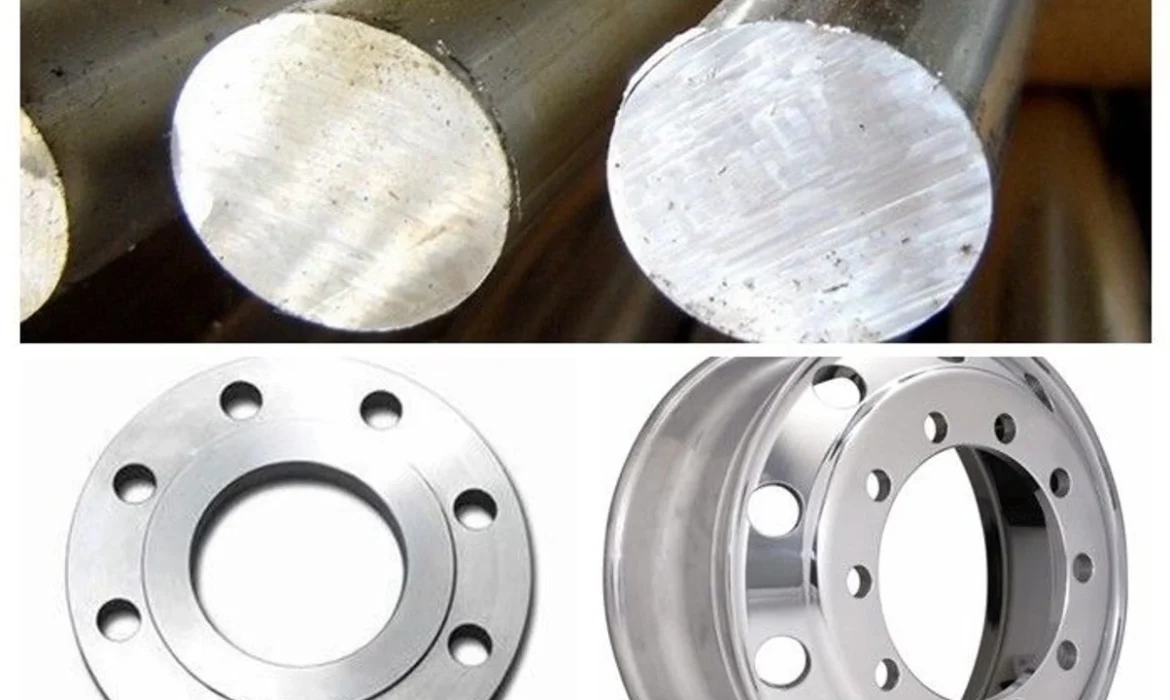
Wheels
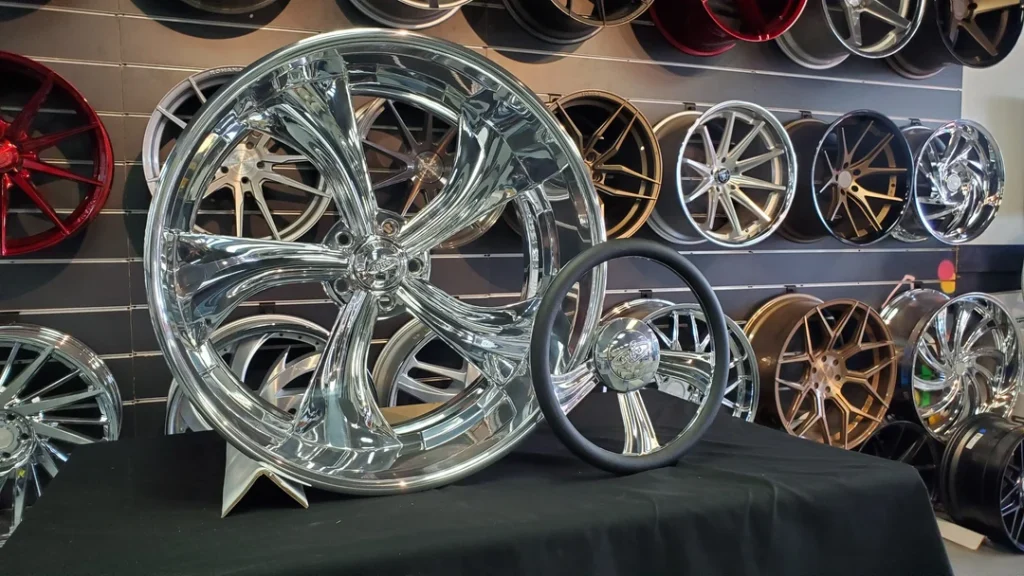
Billet and forged wheels are not interchangeable terms.
A CNC-machined billet wheel component starts from solid wrought stock. A forged wheel starts with a forging process that mechanically works the material.
For applications where weight, fatigue performance, and load rating dominate, engineers often evaluate forged construction. Billet machining remains useful when low-volume production or unusual geometry makes dedicated forging tooling difficult to justify.
Aerospace and industrial fixtures
Machined aluminum is widely used for brackets, fixtures, tooling, housings, and low-volume components where dimensional control and design flexibility matter.
For certified flight hardware, however, the decision depends on the applicable material specification, process controls, traceability, and qualification requirements—not simply whether the part uses billet stock.
Extrusion feedstock
At the industrial end of the market, aluminum billet has another major role: it serves as feedstock for extrusion.
Extruders heat the billet and push it through a die to produce profiles such as heat sinks, window frames, structural sections, and automotive profiles.
In this context, “billet” does not mean a CNC-machined part at all. It means the starting material for another forming process.
Why Billet Parts Cost More
The cost difference becomes easier to understand when you look at what happens to the starting block.
Suppose a finished bracket weighs 1.2 kg.
The manufacturer may need to start with a 3–4 kg blank, depending on the stock dimensions and machining strategy.
If the final component weighs 1.2 kg and the starting blank weighs 4 kg, roughly 70% of the starting material leaves as chips.
The customer is effectively paying for:
- The aluminum blank
- CNC machine time
- Cutting tools
- Setup and workholding
- Programming
- Inspection
- Surface finishing
- Material handling
The manufacturer can recycle the aluminum chips, but recycling does not eliminate the original machining cost.
This explains why billet machining often makes economic sense at low or medium quantities but becomes less attractive as annual volume increases.
A casting die or forging die costs much more at the beginning, but the tooling cost can become small on a per-part basis when the manufacturer spreads it across thousands of components.
When Billet, Cast, or Forged Makes Sense
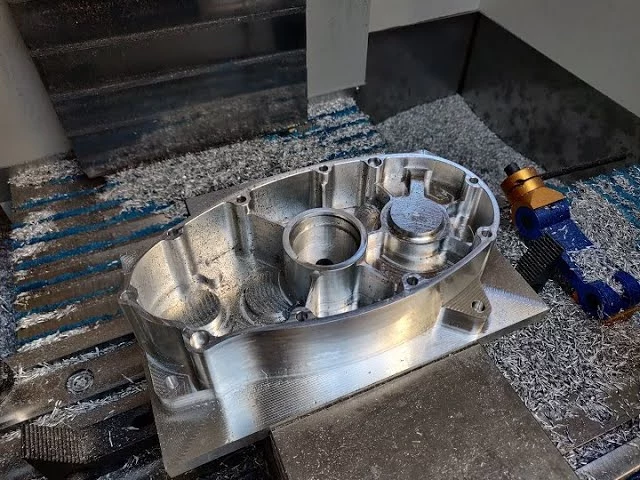
Instead of asking which process is “best,” ask what the part actually needs.
Choose billet machining when:
- The quantity is low or moderate.
- The design may change.
- Tight dimensional tolerances matter.
- The part requires extensive machining anyway.
- You want to avoid casting porosity in the machined material.
- The finished surface or machined appearance matters.
- Dedicated casting or forging tooling would not be economical.
Choose casting when:
- Production volume is high.
- The geometry contains complex internal passages.
- Thin walls or complex external shapes are important.
- The tooling cost can be spread across enough parts.
- The required mechanical performance fits the selected casting alloy and process.
Choose forging when:
- Fatigue and impact loading dominate.
- The part carries significant repeated loads.
- The geometry suits a forging process.
- The production volume can justify forging dies.
- Weight reduction and structural efficiency justify the additional process cost.
The important point is that the manufacturing process follows the part requirements. Engineers do not normally select billet, casting, or forging in isolation.
How to Read a “Billet Aluminum” Product Listing
The word “billet” should not be the only material information on the page.
Before paying a premium for a billet component, check:
1. Alloy and temper
Look for a specific designation such as 6061-T6 or 7075-T6.
2. Manufacturing process
Confirm that the manufacturer actually machines the component from wrought stock rather than machining a cast blank.
3. Heat-treatment condition
Check whether the supplier specifies the temper, such as T6 or T651, where applicable.
4. Geometry
Look at wall thickness, ribs, fillets, bearing seats, mounting points, and other load-carrying features.
A machined appearance does not automatically make a part structurally better.
5. Surface finish
Check whether the part is supplied as-machined, polished, or anodized. If anodized, check whether the specification calls for Type II, Type III hardcoat, or another finish.
6. Supporting documentation
For production or safety-critical components, ask what material certification, dimensional inspection, pressure testing, fatigue testing, or other qualification data the supplier can provide.
These checks separate a genuine machined-from-billet component from a product listing that uses “billet” mainly as a marketing term.
FAQ
What is billet aluminum?
Billet aluminum refers to solid aluminum stock used as feedstock for another manufacturing process. In aftermarket parts, “billet aluminum” usually means the manufacturer machined the component from solid wrought aluminum stock rather than casting the finished shape.
Is billet aluminum stronger than cast aluminum?
It can be, but the answer depends on the alloy, temper, geometry, and casting quality. For example, typical 6061-T6 wrought stock has substantially higher yield strength and elongation than typical A380 die-cast material. However, a well-designed casting can outperform a poorly designed billet component.
Is billet aluminum stronger than forged aluminum?
Not generally. A properly designed forging can provide excellent fatigue and impact performance because the forging process works the material and can align grain flow with the load path. Billet machining offers different advantages, particularly dimensional control, design flexibility, and low tooling cost.
What does “machined from billet” mean?
It means the manufacturer started with solid wrought aluminum stock and removed material with CNC milling, turning, drilling, or related machining processes until the finished component remained.
Why are billet aluminum parts more expensive?
CNC machining can remove a large percentage of the starting material as chips, and the manufacturer must pay for machining time, tooling, setup, inspection, and finishing. Casting and forging require more upfront tooling but can reduce the cost per part at higher production volumes.
Is 6061 billet the same as 6061 cast?
No. The alloy designation alone does not describe the entire material structure. Wrought 6061 and cast aluminum with similar chemistry can have different microstructures and mechanical properties because they follow different processing routes.
Is 7075 better than 6061 for billet parts?
7075-T6 provides substantially higher strength than 6061-T6, but “better” depends on the application. 6061 offers better weldability, corrosion resistance, and generally lower cost. 7075 makes more sense when higher strength or strength-to-weight performance justifies its disadvantages.
Does billet aluminum mean forged aluminum?
No. Billet machining and forging are different manufacturing processes. A billet part usually starts from solid wrought stock and removes material. Forging reshapes a metal blank under high compressive force.
Conclusion
What is billet aluminum? The term describes a material form and, in aftermarket product descriptions, often describes a manufacturing method. Manufacturers typically machine billet parts from solid wrought aluminum stock rather than casting the finished component.
That does not make billet a special alloy, and it does not automatically make every billet part stronger than every casting.
The useful specification is more complete:
process + alloy + temper + geometry
Choose billet machining when you need design flexibility, tight dimensions, a machined appearance, or economical low-volume production without dedicated tooling. Choose casting when complex geometry and production volume dominate. Choose forging when repeated impact, fatigue, and structural efficiency justify the additional tooling and process cost.
The word “billet” tells you how to start understanding the part. It should not be the end of the engineering decision.
Billet is not limited to aluminum; the term can also describe steel, stainless steel, titanium, and other metals used as machining stock, as explained in this guide to billet metal and billet stock for CNC machining.