Choosing a CNC machining supplier is easy if price is the only requirement.
Industrial sourcing rarely works that way.
A buyer may send the same STEP file to five machine shops and receive five very different quotes. One supplier prices two setups, another assumes four. One includes material traceability and a dimensional report, another includes only machining and a basic material certificate. One plans to inspect a critical bore with a CMM or bore gauge, while another treats the same feature as a normal shop dimension.
The prices are different because the jobs being quoted are different.
That is why comparing CNC machining services should start with scope, capability, quality evidence, and process risk rather than unit price.
A practical comparison process is:
- Define the part and its requirements.
- Qualify suppliers before comparing prices.
- Verify machining capability with evidence.
- Normalize the CNC quotes.
- Score the qualified suppliers according to the risk of the part.
- Use a trial order to verify the supplier before releasing production.
This approach works for production components, industrial replacement parts, housings, brackets, shafts, manifolds, large machined components, and other applications where dimensional accuracy, repeatability, documentation, and delivery all matter.
The 5-Step CNC Supplier Comparison Framework
Before getting into individual criteria, it helps to separate supplier comparison into five stages.
Step 1 — Define the part
Give every CNC machine shop the same technical information, including the drawing, material, tolerances, finish, quantity, and documentation requirements.
Step 2 — Apply qualification gates
Eliminate suppliers that cannot meet a mandatory requirement, such as machine envelope, material capability, required certification, or documentation.
Step 3 — Check evidence
Ask how the part will be machined, held, inspected, and documented. Look for actual evidence rather than general capability statements.
Step 4 — Normalize the quotes
Put material, machining, finishing, inspection, tooling, packaging, freight, and lead time on the same basis.
Step 5 — Run a controlled trial
For an important production part, use a first order to evaluate not only dimensional quality but also communication, documentation, delivery, and corrective-action response.
The order matters. A supplier with an attractive price should not reach the final comparison if it fails a mandatory requirement.
1. Define the Part Before You Compare CNC Machine Shops
A CNC supplier can only quote what the RFQ actually defines.
More importantly, the RFQ is often the first process review of the part. Before a machinist calculates cycle time, someone has to decide what material is being cut, which surfaces establish the datums, which features actually control assembly, and how those features will be inspected.
Consider a simple request:
“7075 aluminum housing, 20 pieces, please quote.”
Five CNC machine shops can interpret that request in five different ways.
Does “7075” mean 7075-T6? Is full material traceability required? Is the housing anodized after machining? Is there a sealing bore? Are the mounting faces functionally related? Does the 2D drawing define a general tolerance? Which dimensions require CMM inspection?
Those decisions eventually appear in the quote as machining time, setup count, inspection time, material cost, finishing cost, and risk allowance.
Function: identify the dimensions that make the part work
Start with the function of the component rather than treating every dimension on the drawing equally.
A cover plate, locating bracket, hydraulic manifold, and bearing housing may all be machined from aluminum or steel, but the features that control their performance are different.
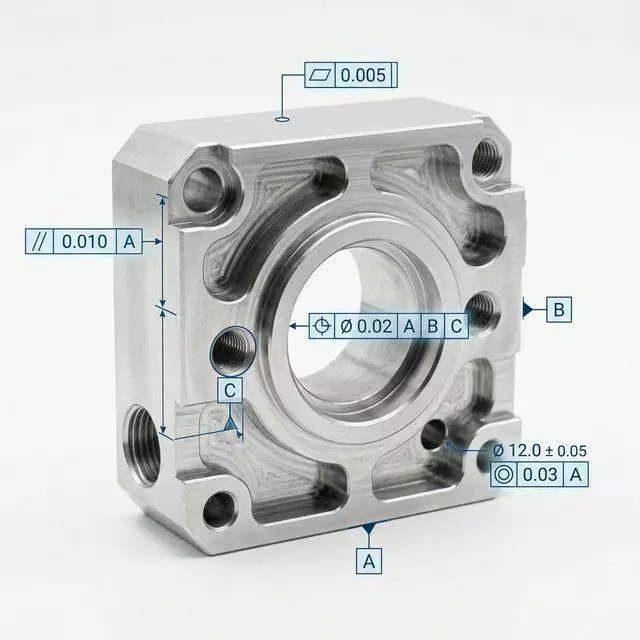
For a housing, a supplier may need to pay particular attention to the relationship between a precision bore and its mounting datum.
For a hydraulic manifold, several intersecting holes may matter more than the outside profile.
For a locating bracket, the position of a small group of mounting holes may determine whether the entire assembly can be installed.
This information changes the machining approach.
If two functional surfaces need a controlled relationship, it may be preferable to machine them from a common datum or in the same setup. If a bore is used for locating a mating component, its diameter, position, and sometimes surface finish deserve a defined inspection method.
That is why “tight tolerance” is not enough information for a CNC quote. The supplier needs to know which tolerance is functionally important and what it has to relate to.
Material grade: specify what actually arrives at the machine
Write the complete material requirement where the application requires it.
Examples include:
- 6061-T6
- 7075-T6
- 316L stainless steel
- 4140
- 17-4 PH
- Ti-6Al-4V
- Inconel 625
“Aluminum” is not a sufficient production specification.
Material condition can affect machining behavior, heat treatment, finishing, dimensional stability, and documentation. It also changes how suppliers source and certify the stock.
For a production RFQ, specify whether you require a material certificate and whether heat or lot traceability must remain connected to the finished parts.
This matters particularly when comparing suppliers from different regions. One supplier may quote material from readily available local stock. Another may include certified material with full traceability. Both may quote the same nominal alloy, but they are not necessarily offering the same material scope.
If an alternative material is acceptable, define the permitted substitution before quoting. Otherwise, the supplier has to decide whether a substitute is allowed and may build a different assumption into the price.
Critical tolerances and datums: mark what cannot move
A production drawing can contain hundreds of dimensions. That does not mean all of them deserve the same manufacturing attention.
Before sending the RFQ, identify the features that control:
- Fit
- Alignment
- Sealing
- Location
- Interchangeability
- Rotation
- Structural interface
Datums are particularly important.
Suppose a machined housing has a precision bore and a mounting face that establishes its position in an assembly. The supplier needs to understand the relationship between those features, not simply see two isolated dimensions.
The machining sequence may then be planned around that relationship.
This is also where unrealistic tolerance stacks can make a quote look unnecessarily expensive. If every dimension is assigned a very tight tolerance, the supplier may have to add additional inspection, extra setups, finishing operations, or grinding that the final assembly never actually needs.
A useful RFQ therefore distinguishes between:
dimensions that must be controlled tightly
and
dimensions that only need to remain within the drawing’s general tolerance.
The goal is not to loosen tolerances simply to reduce cost. It is to make sure the manufacturing effort is concentrated on the features that determine whether the component works.
A practical example: one bore can change the entire process
Imagine a 7075-T6 housing with a precision internal bore, several mounting holes, and a thin outer wall.
From the outside, it looks like a normal three-axis milling job.
During process planning, however, several questions appear:
- Can the bore and its reference face be machined in one setup?
- Does the thin wall need additional support?
- Will the part distort after being released from the fixture?
- Is the bore finished by milling, boring, or another operation?
- Does anodizing occur after dimensional inspection?
- Which dimensions need to be checked before and after finishing?
Those questions can affect both price and supplier selection.
This is why a useful CNC RFQ contains more than a 3D model and quantity. The supplier needs enough information to understand what must remain stable during machining and what will be checked at the end.
Secondary processes: include them before comparing the machining price
List processes that occur before or after CNC machining:
- Heat treatment
- Stress relief
- Grinding
- Anodizing
- Plating
- Passivation
- Powder coating
- NDT
- Laser marking
- Special cleaning
Do not assume that a finishing process is simply an extra line item.
Some secondary processes can affect the machining sequence or final dimensions.
For example, a part that will be anodized may require the supplier to distinguish between the pre-finish machining dimension and the finished requirement. A heat-treated component may require machining before and after heat treatment depending on the tolerance and material condition. A sealing surface may need a different finishing or inspection approach from a non-functional exterior surface.
If the CNC machining supplier sends parts to an outside processor, ask who controls that process and what documentation comes back with the parts.
When comparing quotes, make sure every supplier has either included or excluded the same secondary processes.
Quantity: ask how the process changes as volume increases
Do not request only one quantity if the part is expected to enter production.
A useful volume ladder might be:
1 / 10 / 100 / annual demand
The reason is not simply to negotiate a lower unit price.
The manufacturing method itself may change.
For one or two parts, the supplier may use standard workholding and spend more time setting up each component.
At a higher quantity, the supplier may justify:
- Dedicated soft jaws
- A multi-part fixture
- More efficient tool paths
- Batch inspection
- Tool-life planning
- Material purchasing by lot
- A repeatable setup sheet
That investment can reduce the unit cost and, more importantly, improve repeatability.
When comparing CNC machining suppliers, therefore, ask not only:
“What is the price at 100 pieces?”
Also ask:
“What changes in your process between 10 and 100 pieces?”
The answer reveals whether the supplier is actually planning for production or simply multiplying a prototype quote.
Documentation: define the evidence before the order
“Full documentation” is too vague for a useful RFQ.
Depending on the application, the requirement may include:
- Dimensional inspection report
- CMM report
- Material certificate
- EN 10204 3.1 certificate
- First Article Inspection
- Process records
- Heat-treatment certificate
- Surface-treatment certificate
- Certificate of conformity
There is also an important difference between asking for a report and defining what needs to be measured.
For a general bracket, a dimensional report covering selected critical features may be sufficient.
For a component with a precision bore, positional tolerances, and multiple functional datums, the inspection plan should identify those characteristics specifically.
If the supplier says that every dimension will be inspected by CMM, ask why. CMM capacity is useful, but the inspection method should match the feature and tolerance rather than being used as a generic quality statement.
Certification: verify scope rather than collecting logos
Certification should be matched to the actual program.
ISO 9001 can provide useful evidence of a supplier’s quality-management system for many industrial applications, but it does not prove that the supplier can machine your particular component.
For aerospace work, AS9100 or customer-specific requirements may apply. Medical-device programs may require ISO 13485. Certain special processes may require NADCAP accreditation. Defense work may involve separate requirements concerning controlled technical data and export compliance.
When certification is mandatory, check:
- Certificate
- Expiry date
- Certification body
- Legal entity
- Manufacturing site
- Scope
The physical site matters.
If a supplier has several facilities, the certificate covering one location does not automatically prove that another location has the same certification scope.
Schedule: define the consequence of being late
“Required in three weeks” tells a supplier when you want the parts.
It does not tell them what happens if the shipment is late.
There is a significant difference between:
“Three weeks would be preferred.”
and:
“These components are required to restart a production cell.”
For the second situation, schedule reliability should carry more weight in supplier evaluation.
Tell the supplier whether the date is:
- Preferred
- Required
- Production-critical
- Tied to another assembly or shutdown
This also helps explain why two otherwise similar quotes may deserve different scores. A supplier offering a slightly shorter but less certain lead time is not automatically better than one offering a longer, clearly committed production schedule.
Send the same technical package to every supplier
Once these requirements are defined, send the same information to each CNC machine shop:
- 3D model
- 2D drawing
- Drawing revision
- Material specification
- Surface finish
- Quantity
- Quantity breaks where relevant
- Inspection requirements
- Documentation requirements
- Secondary processes
- Required delivery date
This is one of the simplest ways to make a supplier comparison more reliable.
If one supplier receives only a STEP file while another receives a complete drawing and inspection requirement, their quotes should not be placed on the same spreadsheet and treated as equivalent.
The quality of the comparison starts with the quality of the RFQ.
2. Apply Qualification Gates Before Comparing Price
Not every CNC machining supplier should make it into the price comparison.
Some requirements are better treated as pass/fail gates.
For example:
| Qualification gate | Requirement |
|---|---|
| Machine envelope | Part fits with required access |
| Material | Supplier has relevant machining experience |
| Documentation | Required records can be supplied |
| Certification | Required certification is current and in scope |
| Inspection | Critical features can be measured correctly |
| Special processes | Required processes are controlled |
| Delivery | Supplier can support the required schedule |
If a supplier fails a mandatory requirement, a low unit price should not compensate for it.
This is especially important for regulated or high-consequence components.
A supplier without the required traceability system should not be allowed to recover through a strong price score. A machine shop without enough table travel cannot become suitable because its quote is 15% lower.
Qualification comes before optimization.
3. Match the Supplier Model to the Job
“CNC machining supplier” covers several different business models.
Regional job shop
A regional machine shop can make sense when you need:
- Short communication loops
- Urgent replacement parts
- Local pickup or delivery
- Frequent engineering discussion
- Direct access to the production team
For difficult or urgent parts, proximity itself can reduce risk.
Dedicated industrial CNC supplier
A dedicated machining supplier is generally more suitable when the job requires:
- Repeat production
- Formal inspection
- Material traceability
- Multiple machining processes
- Larger equipment
- Controlled subcontracting
- Production documentation
Here, the supplier’s process infrastructure becomes as important as the machine itself.
Online CNC platform or supplier network
Online platforms can be useful for simple components, price benchmarking, and finding additional capacity.
The important question is who actually manufactures the part.
If the platform assigns the job to another machine shop, evaluate the arrangement as a managed supplier network rather than assuming the platform itself owns the production equipment.
For critical production parts, identify the actual producing site and determine who controls inspection, material, process changes, and corrective action.
Offshore factory-direct supplier
Offshore sourcing can be attractive when:
- The drawing is stable
- Production volume justifies the logistics
- Freight and duty are understood
- Incoming inspection is available
- The organization can tolerate a longer correction loop
The comparison should use landed cost rather than factory-gate price.
A lower machining rate can disappear after freight, duty, inspection, rework, replacement shipping, and schedule disruption are included.
4. Verify CNC Machining Capability With Evidence
Machine lists are useful, but they are only the beginning.
A supplier may list 3-axis, 4-axis, 5-axis CNC machining, turning, Swiss machining, grinding, and EDM on the same capability page.
The more useful question is:
Can this supplier manufacture this particular part repeatedly and prove the result?
Start with the machine envelope
For milling, look at:
- X/Y/Z travel
- Table size
- Workholding space
- Spindle characteristics
- Maximum workpiece weight
- Tool capacity
- Rotary-axis configuration
For turning, consider:
- Maximum turning diameter
- Maximum length
- Chuck size
- Bar capacity
- Spindle speed and torque
- Live tooling
- Y-axis capability where relevant
A machine’s maximum envelope is not the same thing as a comfortable production envelope.
A large component may technically fit inside a machine but still be difficult to fixture, inspect, load, or machine without excessive overhang.
For large industrial parts, ask the supplier to explain how the actual blank will be loaded, supported, and referenced.
5. Look at Process Fit, Not Just Axis Count
More axes do not automatically mean better machining.
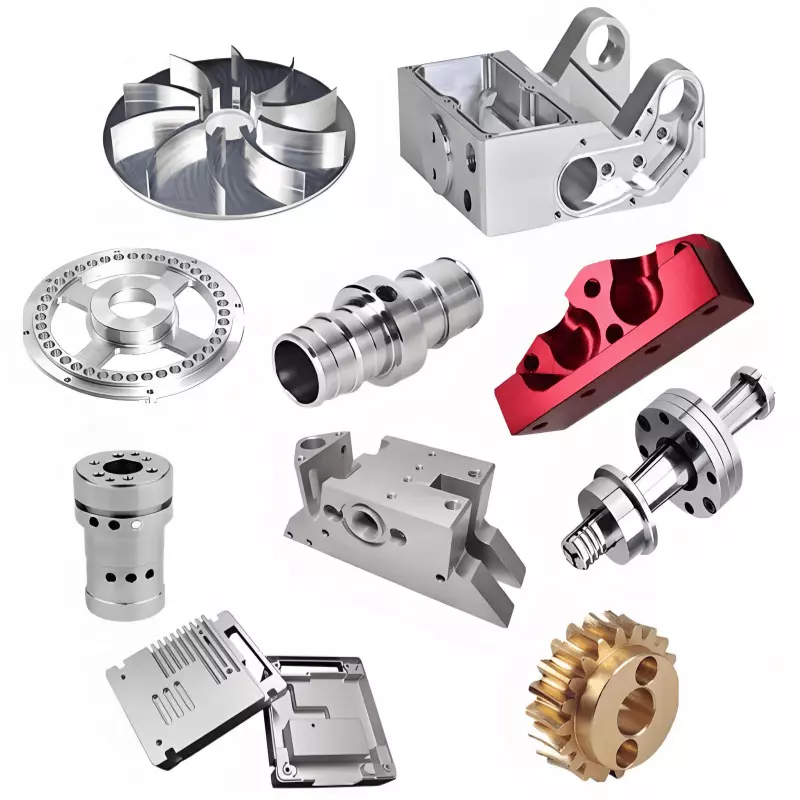
A relatively simple prismatic part may be more stable and economical on a 3-axis machine with a well-designed fixture.
A component with multiple related surfaces may benefit from 3+2 positioning or simultaneous 5-axis machining because important features can remain referenced to a common setup.
A turned shaft may need a turning center rather than a milling machine. If the part includes cross holes, slots, or other milled features, live tooling may eliminate a separate operation.
The key question is:
Which process gives the most reliable relationship between the critical features?
Consider a housing with a precision bore and mounting faces.
If the bore and one mounting datum can be machined in the same setup, their relationship may be easier to control than if the part is removed, flipped, and re-referenced.
That does not mean every feature should be machined in one setup. Sometimes additional operations are necessary. The important point is that the supplier should be able to explain the setup sequence and datum strategy before production begins.
6. Ask for Evidence: The Capability Proof Test
Instead of asking:
“Can you hold tight tolerances?”
ask questions that require the supplier to explain its process.
1. Show a neighbor job, not a portfolio photograph
Ask for a recent job that is similar in:
- Material
- Size
- Geometry
- Tightest tolerance
- Inspection requirement
Customer information can be redacted.
The useful evidence is not the photograph of the finished component. Look for the relationship between the drawing requirement, machining process, and inspection result.
A redacted inspection report from a similar job is much more informative than a gallery of polished parts.
2. Explain how the part will be held
Ask:
- Which machine family is planned?
- How many setups are expected?
- Which datum will establish the first setup?
- How will the second setup reference the first?
- Is a soft-jaw, fixture, tombstone, or custom support required?
This is particularly important for thin walls, deep cavities, large housings, and parts with several geometric relationships.
A supplier that identifies a potential datum or workholding problem before production has probably looked at the model rather than simply pricing the material and estimated machining time.
3. Identify the inspection method for critical features
Ask which instrument will be used for each critical characteristic.
Depending on the feature, the appropriate method might include:
- CMM
- Bore gauge
- Height gauge
- Micrometer
- Thread gauge
- Pin gauge
- Surface roughness measurement
- Optical measurement
A CMM is powerful, but it is not automatically the best tool for every dimension.
For a critical bore, the inspection method should match the bore size, tolerance, geometry, and required uncertainty.
The important point is that “we have a CMM” is not an inspection plan.
4. Trace material from the bar to the finished part
Ask:
- Who supplies the raw material?
- What certificate is supplied?
- How is the heat or lot number recorded?
- How is the material connected to the job traveler?
- How are remaining stock pieces identified?
- What happens if the material certificate is incorrect?
This is especially important for materials where traceability affects customer or regulatory requirements.
The supplier should be able to describe the flow rather than simply promise that the material is certified.
5. Ask who can stop the job
This is one of the most useful questions for a production supplier.
Ask what happens if the first article shows a critical feature outside tolerance.
Who is notified?
Who can stop the next operation?
How is WIP isolated?
How is the nonconformance documented?
What information is sent to the customer?
A controlled response to a failed feature tells you more about production discipline than a general “zero defects” statement.
7. Compare Quality Systems by Scope
A certificate is useful evidence, but only when you understand what it actually covers.
For example, ISO 9001 primarily tells you about the supplier’s quality-management system. It does not certify that every machining process, material, or tolerance is suitable for your part.
When certification matters, check:
- Certificate number
- Certification body
- Expiry date
- Legal entity
- Physical site
- Scope of certification
- Relevant manufacturing activities
Then check how the supplier handles processes that are not performed internally.
Heat treatment, plating, anodizing, grinding, NDT, and other special processes are commonly subcontracted.
That is not inherently a problem.
The question is whether the supplier can identify the subcontractor, control the process, and provide the required records.
For higher-risk parts, ask for a redacted example of the documentation package from a completed order.
A supplier that routinely generates dimensional reports, material records, and corrective-action documentation should be able to explain how those records are produced and retained.
8. Why Five CNC Machining Quotes Can Be So Different
A large quote difference does not necessarily mean that one supplier is inefficient.
The five suppliers may be pricing different assumptions.
Different tolerance assumptions
If a STEP model is supplied without a complete drawing, one shop may use its standard tolerance while another assumes tighter control.
The quotes are no longer comparable.
Different setup assumptions
One supplier may plan two setups.
Another may expect four because of workholding or access requirements.
Additional setups add:
- Fixture preparation
- Alignment
- Probing
- Re-referencing
- Inspection
- Handling time
Different inspection scope
One quote may include final inspection only.
Another may include CMM inspection of several critical characteristics.
Another may include additional in-process checks.
The resulting prices can differ substantially even though the machining operation looks identical on paper.
Different material scope
“7075 aluminum” does not describe the complete material requirement.
The buyer may require a specific temper, certificate, traceability, and approved material source.
Those requirements have a cost.
Different finishing assumptions
Anodizing, plating, heat treatment, passivation, grinding, or other secondary operations may be included in one quote and excluded from another.
Always check.
Different production strategies
Two suppliers may use completely different methods to produce the same quantity.
For a small batch, one shop may machine each part individually.
Another may invest more time in workholding so several parts can be run in a repeatable sequence.
The lower-cost process is not always the one with the lower hourly machine rate.
9. Normalize CNC Machining Quotes Before Ranking Them
Before comparing prices, put every quotation into the same scope.
At minimum, compare:
- Material grade
- Material certificate
- Machining operations
- Tolerance assumptions
- Inspection coverage
- Heat treatment
- Surface finishing
- Tooling and fixture charges
- Programming or NRE
- Packaging
- Lead time
- Freight
- Duties and import costs
- Rework or replacement responsibility
- Quantity breaks
If one of these items is blank, the quote may not be ready for a price comparison.
Compare landed cost, not just unit price
A useful way to think about industrial sourcing is:
Total procurement cost = part price + tooling/NRE + finishing + freight + duties + inspection + expected rework/replacement cost + delay impact
Not every project requires a formal calculation.
The point is to avoid treating the machine-shop unit price as the entire economic decision.
For a local replacement part, a slightly higher machining price may be reasonable if it reduces delivery time dramatically.
For a stable production part, a supplier with a higher first-order price may become cheaper after fixture investment and repeatability are considered.
10. Score Qualified CNC Machining Suppliers by Part Risk
Once suppliers pass the qualification gates and the quotes have been normalized, use a weighted score.
Do not use the same weighting for every part.
A painted equipment guard and a precision hydraulic component do not have the same risk profile.
General industrial parts
A reasonable starting point might be:
| Criterion | Weight |
|---|---|
| Capability match | 25% |
| Quality system | 20% |
| Delivery and communication | 20% |
| Landed cost | 25% |
| DFM support | 10% |
Regulated or documentation-heavy parts
For aerospace, defense, medical, or similarly controlled work, the weighting can shift toward:
| Criterion | Weight |
|---|---|
| Quality and documentation | 35% |
| Capability match | 25% |
| Traceability and special processes | 20% |
| Delivery | 10% |
| Price | 10% |
Large or heavy industrial components
For large machined parts, consider:
| Criterion | Weight |
|---|---|
| Machine envelope and handling | 30% |
| Similar recent work | 25% |
| Inspection capability | 15% |
| Delivery | 15% |
| Price | 15% |
The score should never override a failed qualification gate.
For example, a supplier without the required material traceability should not remain competitive simply because its price is low.
11. Example: Comparing Three CNC Suppliers
For a general industrial housing, the evaluation might look like this:
| Criterion | Weight | Supplier A | Supplier B | Supplier C |
|---|---|---|---|---|
| Capability match | 25% | 4 | 5 | 3 |
| Quality system | 20% | 3 | 5 | 4 |
| Delivery and communication | 20% | 5 | 3 | 4 |
| Landed cost | 25% | 5 | 3 | 4 |
| DFM support | 10% | 3 | 5 | 2 |
| Weighted total | 100% | 4.15 | 4.10 | 3.55 |
Supplier A has the highest numerical score.
But Supplier B is almost tied.
If the housing contains a sealing bore or a positional relationship that is expensive to correct after assembly, the small price advantage of Supplier A may not be enough to justify choosing it without further evidence.
The purpose of the scorecard is not to produce a mathematically perfect answer.
It is to make the trade-offs visible.
12. Use a Trial Order Before Releasing Production
A quotation describes what the supplier intends to do.
A trial order shows how the supplier actually works.
For an important production component, choose a trial part that tests the features that matter.
A good trial might include:
- A precision bore
- A positional tolerance
- A thin wall
- A deep pocket
- A long diameter with runout requirements
- A difficult material
- A critical surface finish
- A relationship between multiple datums
Do not choose a cosmetic or unusually simple component if production will involve difficult features.
Specify the same documentation requirements that will apply to production.
Then evaluate more than the finished dimensions.
Check the trial against five areas
1. Quote accuracy
Did the final invoice match the agreed scope?
2. Delivery
Did the parts ship on the committed date?
3. Dimensional performance
Did the critical characteristics meet the drawing requirements?
4. Documentation
Were material certificates and inspection reports complete and correct?
5. Response to problems
If something was wrong, how quickly did the supplier identify, contain, communicate, and correct it?
A trial order is therefore a supplier-behavior test, not simply a sample inspection.
A shop may produce an excellent first batch and still struggle with repeat production. Before moving to a blanket order, ask how the supplier plans to maintain the process when quantities increase.
13. Comparison Priorities Change by Industrial Application
The basic framework remains the same, but different applications change the weighting.
Heavy equipment and large industrial parts
Focus on:
- Machine envelope
- Table or chuck capacity
- Lifting capability
- Workholding
- Stress relief
- Material hardness
- Large-part inspection
- Shipping and handling
Ask for a recent component similar in size to yours.
A machine’s maximum specification is less useful than evidence that the supplier regularly handles work near that range.
Aerospace, defense, and energy components
Focus on:
- Quality-system scope
- Material traceability
- First Article Inspection
- Key characteristics
- Special-process control
- Data and drawing control
- Inspection records
For subcontracted heat treatment, coating, or NDT, understand how the supplier controls the sub-tier process.
Hydraulic and sealing components
Focus heavily on:
- Bore dimensions
- Diameter stability
- Surface finish
- Concentricity
- Runout
- Thread quality
- Cleaning
- Repeatability between batches
A visually perfect part can still fail if a sealing or locating feature is wrong.
Automation and repeating wear parts
Interchangeability becomes particularly important.
Ask how the supplier maintains dimensions across multiple production lots.
A supplier that performs well on a 12-piece sample but treats every reorder as a completely new job may create unnecessary setup cost and process variation.
14. Common Mistakes When Comparing CNC Machining Services
Comparing prices from different scopes
This is the most common mistake.
If material, inspection, finishing, and tolerance assumptions are different, the unit prices are not directly comparable.
Sending only a STEP file
A STEP file defines geometry.
It does not necessarily define:
- Critical tolerances
- Surface finish
- Datums
- Material condition
- Inspection requirements
- Documentation
- Edge treatment
For production sourcing, the 2D drawing remains important whenever those requirements are not fully defined elsewhere.
Treating certification as proof of machining capability
A quality certificate tells you about a management system and its scope.
It does not prove that the supplier can hold your particular bore, flatness, positional tolerance, or surface finish.
Choosing a supplier because it has more machine types
A long equipment list does not automatically mean a better process.
A supplier with a suitable machine, good workholding, and a clear inspection strategy can be a better choice than one advertising a much larger machine inventory.
Treating five-axis capability as automatically superior
Five-axis machining can solve access and setup problems, but it is not automatically the most economical or stable process for every component.
The process should follow the geometry and functional requirements.
Ignoring subcontracted processes
Heat treatment, coating, plating, anodizing, grinding, and NDT can all affect the final component.
If they are outside the machining supplier’s facility, make sure responsibility and documentation are clear.
Using instant quote price as the industrial benchmark
Instant quoting is useful for estimating market price.
It does not replace supplier qualification for a critical production component.
15. CNC Supplier Comparison Checklist
Before issuing a purchase order, confirm that you have completed the following:
- Requirements brief prepared
- Drawing revision confirmed
- Material grade confirmed
- Critical features identified
- Inspection requirements defined
- Supplier model selected
- Three to five qualified CNC suppliers shortlisted
- Same RFQ packet sent to each supplier
- Machine capability verified
- Machine envelope checked
- Material capability verified
- Certification documents reviewed where required
- Capability questions answered
- Inspection method confirmed
- Material traceability confirmed
- Secondary processes identified
- CNC quotes normalized
- Landed cost compared
- Supplier scorecard completed
- Qualification gates passed
- Trial-order requirements defined
- Production release criteria established
If several of these items remain unclear, the comparison is probably not finished.
You may have five prices, but you do not yet have five comparable offers.
FAQ
How do I compare CNC machining services?
Start with the same technical RFQ for every supplier. Define the material, tolerances, critical features, finishing, quantity, inspection, documentation, and schedule. Qualify suppliers against mandatory requirements, verify their machining and inspection approach, normalize the quotes, and use a risk-based scorecard. For important production parts, confirm the final supplier with a trial order.
What should I look for when choosing a CNC machining company?
Look at capability fit, workholding strategy, inspection methods, material traceability, quality-system scope, production experience with similar parts, communication, delivery reliability, and total landed cost. Machine count alone is not enough.
How do I compare CNC machining quotes?
Make sure every supplier is quoting the same material, tolerance assumptions, inspection coverage, finishing, tooling, packaging, lead time, and shipping scope. Then compare landed cost rather than unit price alone.
Why are CNC machining quotes so different?
Quotes can differ because suppliers make different assumptions about material, number of setups, machining strategy, inspection, finishing, tooling, documentation, and production quantity. A large price difference is often a scope difference rather than simply a difference in machining efficiency.
How many CNC machine shops should I request quotes from?
For most industrial parts, three to five qualified suppliers provide a useful comparison. One supplier provides no meaningful benchmark, while a very large RFQ list can reduce the quality of supplier evaluation and increase internal workload.
How can I verify a CNC machine shop’s capabilities?
Ask for the machine class and work envelope, the proposed setup strategy, the inspection method for critical features, and a recent similar job with identifying information removed if necessary. Evidence such as inspection records is more useful than a general statement that the shop can hold tight tolerances.
Is ISO 9001 enough for industrial CNC machining?
It can be a useful quality-system baseline for many general industrial applications, but it does not automatically prove machining capability. Some projects require additional quality systems, customer requirements, export-control measures, or special-process accreditation.
Should I use an online CNC machining platform for production parts?
It can be useful for simple parts, price benchmarking, or additional capacity. For repeating or high-risk components, identify the actual producing facility and verify who controls machining, inspection, material traceability, and corrective action.
Do I need a trial order before production CNC machining?
For a new supplier and an important production component, a controlled trial is usually worthwhile. Use a part that exercises the critical features and documentation requirements of the eventual production work. Evaluate the supplier’s communication and delivery performance as well as dimensional quality.
What matters more than price when evaluating CNC machining suppliers?
For many industrial components, capability fit, process control, inspection, traceability, and delivery reliability can have a larger financial impact than a small difference in machining price. The right balance depends on the consequences of a nonconforming or late part.
Compare the Process, Not the Marketing
CNC machining suppliers often look similar on a search-results page.
They may all list three-axis, four-axis, and five-axis machining. They may all mention tight tolerances, quality control, engineering support, and fast delivery.
The useful comparison starts after those claims.
Look at the RFQ you actually sent. Look at the machine that will actually run the part. Ask how the part will be held and how the datums will be maintained. Identify how the critical features will be measured. Trace the material from its certificate to the finished components. Normalize the quote until every supplier is pricing the same scope.
Then use a trial order to see whether the supplier’s process works in practice.
The best CNC machining supplier is not necessarily the one with the lowest quote or the longest machine list.
For an industrial part, the stronger choice is usually the supplier that can explain how the part will be made, how the critical features will be controlled, and how the result will be proven—before the production order becomes a problem.