
In today’s competitive manufacturing landscape, companies require dependable partners capable of producing complex parts with high accuracy, short lead times, and favorable pricing. CNC machining service China delivers strong performance in precision milling for a wide range of industries. This in-depth guide examines the complete CNC milling process used by Chinese providers, placing primary focus on the practical elements that matter most to customers: consistent dimensional accuracy, reliable delivery schedules, clear cost structures, and smooth project execution.
From initial design review to final delivery, the following sections provide detailed insights into how CNC milling works in practice and how businesses benefit when sourcing from China.
Key Factors Customers Evaluate in CNC Milling Projects
Customers prioritize outcomes that directly influence project success, budgets, and timelines. The main considerations include:
- Precision and Repeatable Quality: Parts must meet exact specifications without variation. Chinese CNC facilities achieve standard tolerances of ±0.05mm to ±0.02mm, while critical features often reach ±0.005mm through advanced 5-axis equipment and systematic inspection protocols. Customers receive detailed reports from CMM machines and optical scanners, which support confident assembly and reduced risk of downstream issues.
- Delivery Speed and Schedule Reliability: Tight project deadlines drive many sourcing decisions. Providers commonly supply instant quotes, DFM feedback within hours, prototype parts in 3–7 days, and full production runs in 10–18 days. This performance results from continuous operations, substantial machine availability, and streamlined internal workflows.
- Cost Structure and Overall Value: Buyers look for meaningful savings paired with full transparency. Projects sourced through CNC machining service China often show 40–60% lower total expenses compared to many Western options. Detailed quotations outline material, machining, finishing, and logistics costs, with volume-based pricing adjustments that support scaling.
- Communication Effectiveness: Clear and timely updates matter for international collaborations. Dedicated project coordinators provide progress reports, visual documentation, and prompt responses, helping maintain alignment throughout the manufacturing cycle.
- Intellectual Property Safeguards: NDAs, encrypted data transfers, and controlled internal access address security needs for sensitive designs.
- Order Flexibility: Support for quantities ranging from single prototypes to thousands of units allows customers to test designs before committing to larger runs.
- Integrated Finishing Capabilities: One-stop services such as surface treatment, heat treatment, and marking reduce the need to coordinate multiple vendors.
These considerations guide many successful sourcing experiences with Chinese CNC milling providers.
In-Depth Exploration of the CNC Milling Process
The CNC milling process follows a structured sequence designed for efficiency and quality. Below is a thorough examination of each stage from the customer viewpoint.
Stage 1: Project Intake, Quoting, and DFM Analysis
Customers submit 3D models in STEP, IGES, or native formats along with 2D technical drawings that include geometric dimensioning and tolerancing (GD&T). Engineering teams review the files promptly and return pricing information along with a comprehensive Design for Manufacturability analysis. This review identifies opportunities to improve tool accessibility, reduce material waste, or simplify features such as deep narrow pockets, sharp internal corners, or overly thin walls. Adjustments proposed at this stage frequently lower machining hours by 15–35% while preserving the intended function and appearance of the part. Customers value this collaborative step because it prevents costly revisions after production begins.
Stage 2: Material Procurement and Initial Preparation
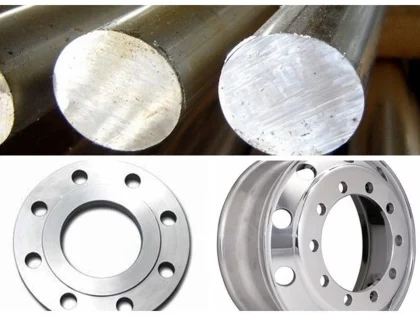
Material selection plays a central role in part performance and project economics. Suppliers offer extensive guidance based on mechanical requirements, environmental conditions, and budget parameters. Common options include:
- Aluminum alloys such as 6061-T6 and 7075-T651 for their favorable strength-to-weight ratio, corrosion resistance, and superior machinability. These materials suit electronics enclosures, automotive components, and structural brackets.
- Stainless steel grades 304, 316L, and 17-4PH for applications requiring robust corrosion resistance and hygiene, including medical instruments and food processing equipment.
- Titanium alloy Ti-6Al-4V for demanding uses where high strength and low weight are essential, such as aerospace fittings and biomedical implants.
- Copper and brass alloys for electrical conductivity and thermal dissipation needs.
- Engineering plastics including PEEK, POM (Delrin), ABS, and Ultem for lightweight, non-conductive, or chemical-resistant components.
Upon selection, raw stock undergoes inspection for composition and defects, followed by precision sawing into blanks. Stress-relief treatments minimize internal forces that could cause warping during machining. This preparation phase ensures dimensional stability and contributes to final part accuracy.
Stage 3: CAM Programming and Process Simulation
Programmers translate approved designs into detailed toolpaths using advanced CAM systems. They define cutting tool types (flat end mills, ball nose mills, drills, and thread mills), spindle speeds, feed rates, and step-over values. Strategies such as trochoidal roughing paths maintain consistent tool engagement to extend cutter longevity and accelerate material removal. Adaptive clearing algorithms dynamically adjust paths to avoid excessive loads. Full digital simulations run before any physical cutting occurs, verifying collision-free operation, estimating exact cycle times, and confirming surface finish expectations. Customers benefit from these simulations through shorter overall production durations and more predictable outcomes.
Stage 4: Core Machining Operations on Multi-Axis Equipment
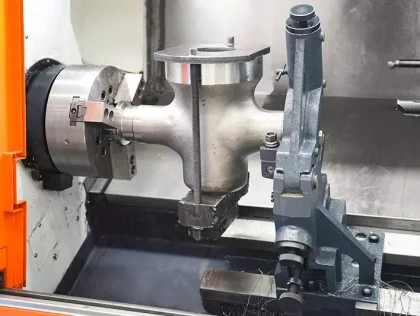
Machining represents the primary material removal phase. Facilities operate diverse CNC centers:
- 3-axis machines handle straightforward geometries such as plates, housings, and mounting brackets.
- 4-axis setups add rotational capability for features around cylindrical surfaces.
- 5-axis simultaneous machines excel at intricate contours, angled surfaces, undercuts, and freeform shapes that require minimal repositioning.
Typical workflow proceeds through distinct passes:
- Roughing removes the majority of stock using larger tools and aggressive parameters for efficient bulk reduction.
- Semi-finishing refines geometry while leaving a uniform allowance for the final pass.
- Finishing employs smaller tools, higher spindle speeds (often 18,000–24,000 RPM), and shallow depths of cut to achieve tight tolerances and fine surface textures down to Ra 0.4μm.
Specialized operations incorporate helical interpolation for threads, contouring for complex profiles, and pocketing for internal cavities. Real-time monitoring systems track spindle load, vibration levels, and tool condition, enabling immediate parameter corrections. This attention to detail supports consistent results across single parts or extended production batches.
Stage 5: Continuous Process Monitoring
Throughout machining, sensors and software collect data on key variables. Automated alerts notify operators of deviations, allowing adjustments without interrupting overall progress. Statistical process control methods track trends and maintain stability, resulting in low defect rates that customers rely upon for just-in-time inventory strategies.
Stage 6: Post-Machining Secondary Processes
Milled components advance to dedicated finishing areas for:
- Deburring via tumbling, brushing, or electrochemical methods to eliminate sharp edges.
- Heat treatment processes including solution annealing, artificial aging, or stress relieving.
- Surface enhancements such as Type II or Type III anodizing, hard anodizing, powder coating, electroless nickel or chrome plating, passivation for stainless steel, and PVD coatings.
- Precision polishing for optical or aesthetic requirements.
- Laser engraving for serial numbers, logos, or traceability codes.
Centralized finishing eliminates external handoffs, shortens total lead times, and maintains tighter control over final part appearance and properties.
Stage 7: Comprehensive Quality Verification
Inspection teams perform:
- Dimensional validation using CMM, height gauges, and 3D laser scanners.
- Surface roughness measurement with profilometers.
- Material composition and hardness testing.
- Visual and functional checks.
First Article Inspection reports and batch documentation provide full traceability. Customers in regulated sectors receive the supporting paperwork needed for internal audits and compliance.
Stage 8: Final Preparation and Logistics
Parts receive cleaning, corrosion protection, and custom packaging. Shipping arrangements accommodate air express for urgent deliveries or ocean freight for larger volumes, with complete tracking visibility provided to the customer.
This structured process supports the precision, speed, and cost performance that buyers expect.
How Precision Translates to Customer Benefits
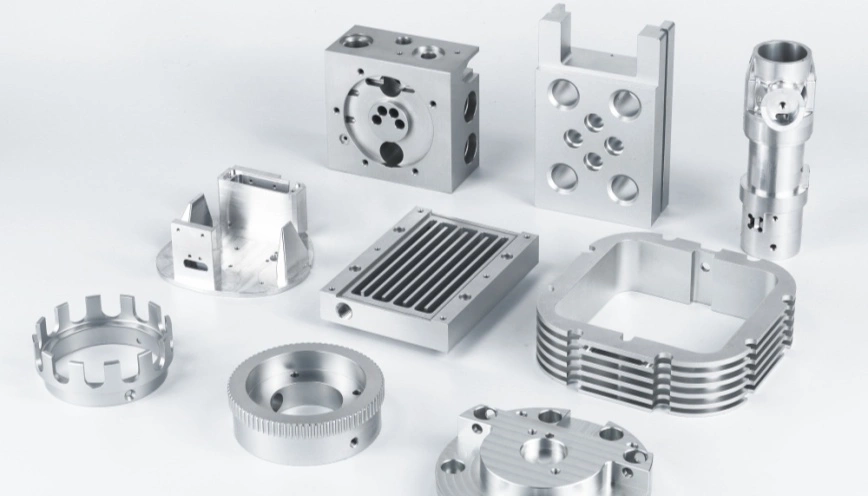
Accurate CNC milling reduces assembly problems, supports tighter design tolerances, and improves overall product reliability. Temperature-stable production environments and regular machine calibration contribute to repeatable results that minimize engineering change orders and accelerate validation phases.
Delivery Speed as a Competitive Factor
Short lead times enable rapid design iterations and faster responses to market opportunities. Automated systems and parallel processing across multiple machines help maintain schedule adherence even during peak demand periods.
Cost Structure Details and Savings Mechanisms
Savings originate from efficient toolpath strategies, domestic material availability, high machine utilization rates, and minimized overhead. Transparent pricing allows accurate project forecasting, while volume tiers reward larger commitments with per-piece reductions.
Material Guidance for Specific Use Cases
Suppliers assist with trade-off analysis so customers select materials that optimize function without excess expense. Aluminum often provides the best overall balance for general applications, while titanium or PEEK address specialized performance demands.
Industry Examples of CNC Milling Applications
CNC machining service China serves numerous sectors effectively:
- Automotive and electric vehicle projects use milled battery trays and motor housings for weight reduction and thermal management.
- Medical device manufacturers source surgical guides and implant components with full biocompatibility documentation.
- Electronics companies obtain heat sinks and enclosures with precise features for thermal and electromagnetic performance.
- Robotics developers create custom joints and structural elements for new automation systems.
- Aerospace teams receive lightweight brackets and complex fittings meeting strict weight and strength criteria.
Modern Machining Techniques Employed
Facilities apply high-speed machining for improved finishes on aluminum, micro-milling for miniature features, and hybrid approaches that combine milling with other processes for internal channels or lightweight structures. Intelligent tool holders with sensor feedback further enhance process control.
Practical Tips for Effective Collaboration
To achieve optimal results when working with CNC milling providers in China:
- Supply complete 3D models and fully dimensioned drawings at the outset.
- Highlight critical dimensions and functional requirements clearly.
- Discuss DFM recommendations openly to capture potential improvements.
- Begin with prototype quantities to confirm quality and communication flow.
- Specify finishing, marking, and packaging needs during quoting.
- Maintain regular contact with assigned coordinators.
Selecting providers with relevant industry certifications and verifiable production capabilities supports positive project results.
Conclusion: Advantages of CNC Milling China
CNC Milling China provides a balanced solution of precision engineering, efficient production timelines, and competitive pricing. Through systematic multi-axis machining, thorough quality controls, and customer-oriented project management, CNC machining service China supports businesses in controlling expenses while maintaining high standards.
The detailed process outlined above demonstrates how components move from digital files to finished parts with minimal waste and strong consistency. Companies across multiple sectors continue to realize measurable improvements in development speed and cost structure by working with capable Chinese CNC milling providers.
If your projects require custom machined components, consider reaching out to established cnc machining service china suppliers for quotations, DFM reviews, and production support. The combination of accuracy, turnaround reliability, and economic value offers practical benefits for product development and manufacturing programs.