
In the current industrial landscape, sourcing custom machining services is a critical decision-making process that dictates the success of an engineering project. Rather than treating all machine shops as interchangeable, procurement teams and engineers must align their project requirements with the specific operational strengths of the manufacturer. This guide outlines how to navigate the sourcing lifecycle to ensure technical accuracy, cost efficiency, and supply chain stability.
Phase I: The Efficiency-First Prototype (Aggregator Model)
For early-stage designs where speed is the primary metric, utilize high-capacity marketplaces. These platforms excel at eliminating communication latency through data-driven quoting engines. By uploading CAD files directly, engineers receive immediate feedback on manufacturability and pricing.
The objective at this stage is to validate design intent through physical components delivered under aggressive timelines. Using these aggregators allows for rapid iterations, helping to confirm form and fit before moving to more advanced production stages where design specifications are locked.
Phase II: The Geometry Challenge (Engineering-Centric Model)
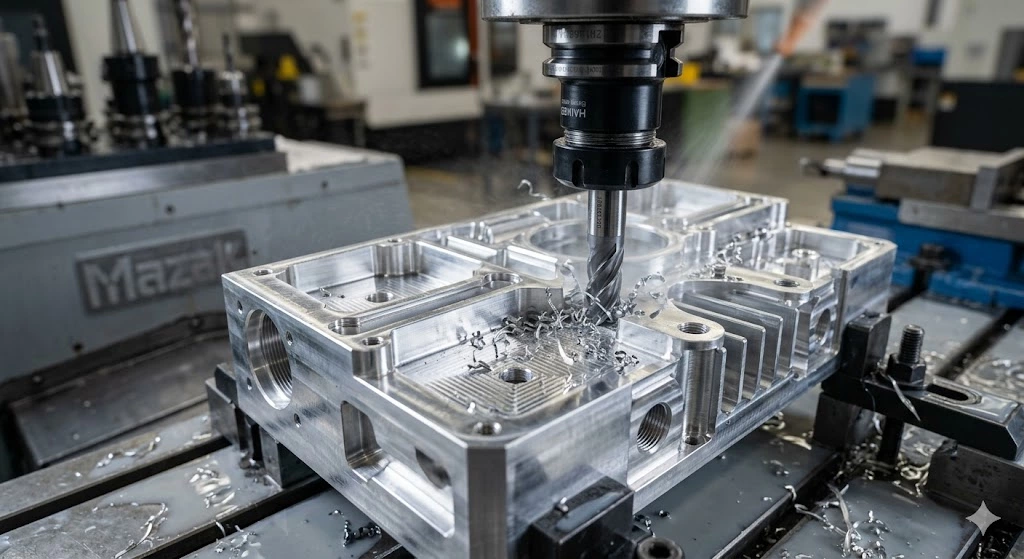
As designs mature toward terminal applications, geometric complexity often presents a risk to precision. This stage requires a partner focused on feasibility analysis. When a part involves thin-walled geometries, deep internal pockets, or tight tolerances, the risk of part rejection increases.
A specialized CNC machining manufacturer at this level acts as an extension of your technical team. Whether you require standard turning or advanced cnc milling machine services for complex contours, these partners identify potential tool-access issues or tolerance stack-up risks before the first chip is cut. Their role is to ensure the CAD design is structurally viable, maintaining the geometric integrity required for long-term functional reliability.
Phase III: Material-Critical Applications (Specialist Model)
Generalist shops often face limitations when handling high-performance insulators, specialty foams, or shielded enclosures. When material science is the core requirement, a manufacturer with proven expertise in your specific material is the necessary choice.
Material properties—such as heat deflection temperatures, electrical conductivity, or EMI shielding requirements—dictate the cutting parameters. Selecting a partner with deep experience in your specific material ensures that the final component performs according to its engineering specifications in the target operating environment.
Cost Transparency: How Much Does Custom CNC Machining Cost?
Understanding the financial structure of manufacturing is essential for budget management. When analyzing how much does custom cnc machining cost, it is helpful to look past raw material prices and focus on the engineering effort involved:
- Setup Premium: Higher for low-volume prototypes where machine programming and fixture design represent the bulk of the cost.
- Engineering Premium: Reflects the cost of feasibility analysis and complex CNC toolpath optimization required for difficult geometries.
- Material Premium: Specific to specialty resins, foams, or aerospace-grade alloys that require unique cutting parameters and extended procurement times.
These factors demonstrate that cost is a function of engineering effort rather than just raw material consumption.

Strategic Sourcing: Navigating “Custom Machining Services Near Me”
The search for custom machining services near me—or specifically looking for high-quality custom cnc milling near me—is common for project managers seeking to maintain supply chain control. However, physical proximity is only one variable in the equation.
While local shops offer immediate onsite communication, specialized manufacturing is increasingly decentralized. If a project requires niche material expertise or 5-axis geometric consistency, look for the manufacturer who holds the necessary ISO certifications and material experience. Technical capability and adherence to quality standards often provide more value to a project than physical location.
RFQ Best Practices for Engineering Success
To receive accurate and objective quotes, you must eliminate ambiguity in your RFQ documentation. Supply CAD files in neutral formats like STEP or IGES to prevent software-specific translation errors. Clearly identify “Critical-to-Quality” features on your drawings that require formal inspection reports, and reference specific ASTM, DIN, or ISO material standards rather than using generic descriptions. Explicitly state whether the order is for a “first-article” prototype or the beginning of a production run, as this information fundamentally changes how a manufacturer approaches machine programming and fixture strategy.
Conclusion
The “best” partner is one that aligns with your project’s lifecycle stage. Whether you require the rapid speed of an aggregator, the technical rigor of a feasibility-focused engineer, or the material expertise of a specialist, aligning your needs with the right production model is the foundation of successful component manufacturing. By following this lifecycle approach, you ensure your project maintains both technical integrity and fiscal discipline from prototype to mass production.
Frequently Asked Questions (FAQ)
Q: What is the most significant factor affecting the cost of custom machining services?
A: For low-volume and prototype orders, machine setup and programming time typically represent the largest cost component. Because professional CNC milling machine services require specialized toolpath optimization and fixture design, these fixed costs are higher for single units but decrease significantly as order volumes increase.
Q: How do I know if my project requires an aggregator or a specialized manufacturer?
A: If your design is finalized for form and fit and does not feature complex geometric tolerances, aggregator platforms provide the best balance of speed and price. However, if your drawings involve thin-walled geometries, complex 5-axis contours, or require adherence to strict CMM inspection reports, you should engage a specialized manufacturer capable of providing in-depth feasibility analysis.
Q: Why does material selection impact the machining process?
A: Different materials require specific cutting parameters to prevent defects. For example, high-performance plastics like PEEK require specific heat management to avoid thermal warping, while aerospace-grade stainless steel requires specialized cooling to manage tool stress. Choosing a manufacturer with proven experience in your specific material ensures higher dimensional accuracy and component reliability.
Q: How can I improve the accuracy of the quotes I receive?
A: Eliminate ambiguity by supplying CAD files in neutral formats (STEP or IGES). Clearly identify your “Critical-to-Quality” (CTQ) dimensions on technical drawings and reference standardized material specifications (e.g., ASTM or DIN). Additionally, explicitly stating whether your order is for a prototype or a production run allows the shop to optimize their programming strategy.
Q: Should I search for “custom cnc milling near me” or prioritize capability?
A: While local shops offer the convenience of proximity, specialized manufacturing is increasingly globalized. For components requiring niche expertise—such as ultra-precise geometric consistency or exotic material handling—it is more effective to select a manufacturer based on their process capability, ISO certifications, and material history rather than their physical zip code.