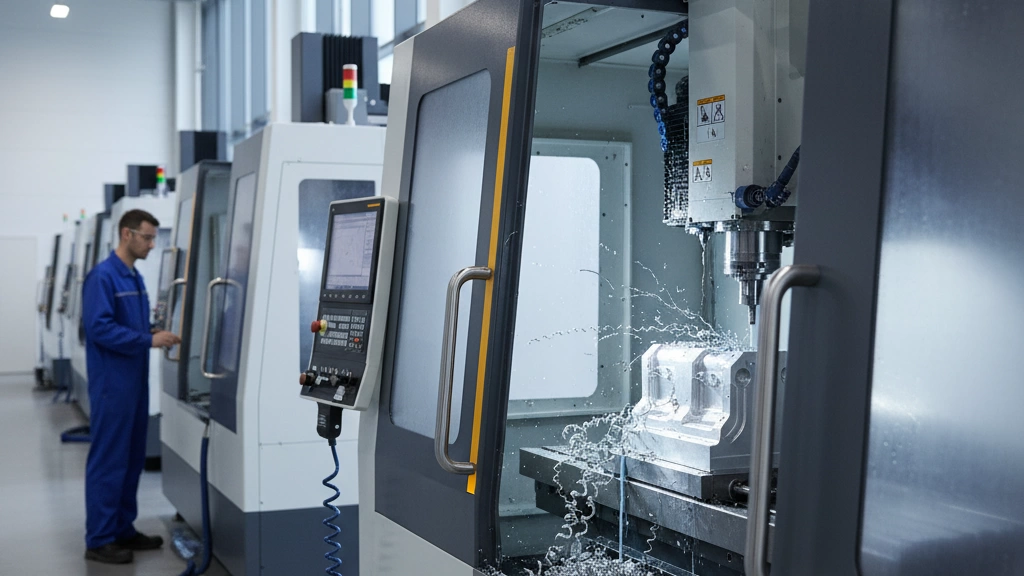
How CNC Machining Metal Really Works
When people ask us how CNC machining metal actually works, they’re usually trying to answer two questions:
- Can this process make my part accurately and repeatably?
- Is CNC the right way to make this part in metal vs casting, 3D printing, or fabrication?
Let’s break it down in plain language.
Basic Idea: Subtractive Metal Machining
CNC machining is subtractive manufacturing for metal parts.
- We start with a solid metal block, bar, or plate (aluminum, steel, stainless, titanium, etc.).
- Computer-controlled cutting tools remove material to reveal the final geometry.
- Everything is based on your 3D CAD model and engineering drawing.
Key points:
- High precision: ±0.001 in (±0.025 mm) is routine on many features; tighter is often possible.
- Fully dense parts: You get the full strength and properties of the base metal.
- No tooling required for complex shapes, unlike casting or molding.
Use CNC machining metal when you want accurate, strong parts from real production alloys without waiting months for tooling.
CNC Milling vs CNC Turning vs Mill-Turn for Metal Parts
Most machined metal parts you see are made using some combination of:
CNC Metal Milling
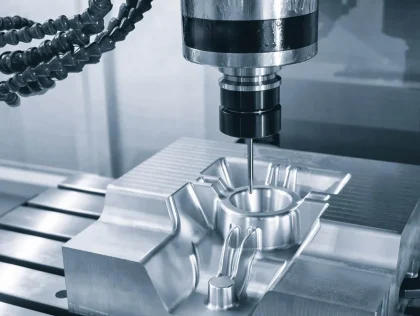
CNC milling is best for prismatic parts—think blocks, plates, housings, brackets, and complex 3D surfaces.
- The workpiece stays fixed (or moves slightly).
- A rotating cutting tool moves in X, Y, and Z to remove metal.
- Ideal for:
- Flat faces, pockets, slots, bosses
- Complex 3D contours
- Hole patterns and threaded holes
- Metal prototype machining and low-volume production
CNC Turning Metal Parts
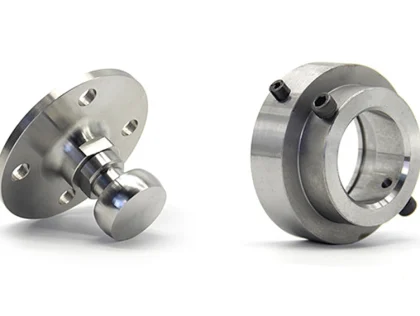
CNC turning is best for round parts made from bar or tube.
- The workpiece rotates, the cutting tool is stationary (relative to the spindle).
- Great for:
- Shafts, pins, bushings, spacers
- Fittings, couplings, threaded rods
- High repeatability on diameters and shoulders
If it’s mostly round with features along the length, turning is usually cheaper and faster than milling.
Mill-Turn (Multi-Task) for Complex Metal Parts
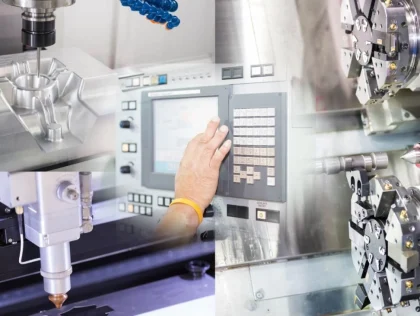
Mill-turn machines combine turning and milling in one setup.
- The part spins like a lathe part, but we can also:
- Mill flats and pockets
- Drill and tap cross holes
- Add keyways, slots, and complex features
Use mill-turn when:
- You have round parts with side features, cross holes, or milled flats.
- You want to cut setups and handling and get better precision between features.
This is often the sweet spot for precision metal machining on complex shafts, manifolds, and connector-style parts.
3-Axis, 4-Axis, and 5-Axis CNC Machining Metal
Axis count is one of the first things engineers ask about. It matters for both geometry and cost.
3-Axis CNC Metal Milling
- The cutting tool moves in X, Y, Z only.
- The part usually gets re-fixtured multiple times for different sides.
- Best for:
- Simple blocks and plates
- Basic enclosures
- Parts with features on a few accessible faces
3-axis is the lowest-cost option when it works for your geometry.
4-Axis CNC Machining Metal
- Adds a rotary axis (typically rotating the part around X or Y).
- Enables:
- Machining multiple sides in fewer setups
- Indexing around round or rectangular parts
- More accurate feature-to-feature relationships
Use 4-axis when you want to reduce setups, improve alignment, or handle parts with features distributed around the perimeter.
5-Axis CNC Machining Metal
- Adds two rotary axes (tool and/or part), allowing almost any orientation.
- Two modes:
- 3+2 (indexed): Machine from many angles, but one angle at a time.
- Full 5-axis (simultaneous): Tool moves along 5 axes at once for smooth 3D surfaces.
Best for:
- Complex aerospace and medical geometries
- Deep undercuts, compound angles, and organic surfaces
- Parts that would otherwise require many setups or be impossible to machine
5-axis CNC machining metal isn’t always “overkill.” When the geometry demands it, 5-axis can reduce total cost by cutting setups, improving accuracy, and shortening lead time.
How CAD, CAM, and G-Code Control Metal Machining
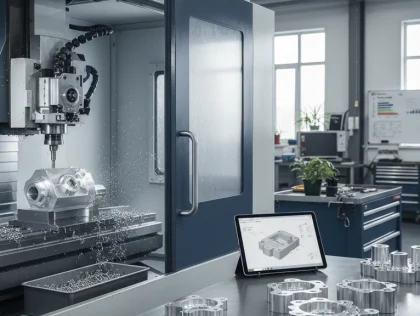
Modern CNC machining is all about the digital workflow. Here’s how your digital file becomes a real metal part.
-
CAD (Computer-Aided Design)
- You (or we) create the 3D model of your part in CAD (SolidWorks, Fusion, NX, etc.).
- This model defines every surface and critical dimension.
-
CAM (Computer-Aided Manufacturing)
- We import your CAD file into CAM software.
- We define:
- Tools (end mills, drills, inserts) matched to your metal material
- Speeds and feeds (how fast we rotate and move the cutter)
- Toolpaths (the exact route the cutter takes)
- The CAM system simulates the process and checks for collisions and gouges.
-
G-Code for Metal CNC Machining
- The CAM software outputs G-code, the machine’s “language.”
- G-code tells the CNC machine:
- Where to move (X, Y, Z, and rotary)
- How fast to move and spin
- When to change tools, turn coolant on/off, etc.
-
CNC Execution
- The CNC control reads the G-code and moves the machine with micron-level resolution.
- Probes and in-process measurements help us maintain tight tolerances and compensate for tool wear, thermal expansion, and material variation.
This CAD → CAM → G-code chain is what enables repeatable, high-precision metal parts from prototype to production.
When CNC Machining Metal Is the Best Fit
You shouldn’t use CNC machining metal for everything. It shines in specific scenarios.
CNC machining metal is usually the best choice when:
-
You need tight tolerances
- Typical shop capability: ±0.001 in (±0.025 mm)
- Tighter tolerances possible on critical features with proper process controls.
-
Your parts are complex but not insanely high-volume
- Prototypes and pilot runs
- Low- to mid-volume production
- High-mix, low-volume programs common in aerospace, medical, and robotics
-
You need real, production-grade alloys
- 6061/7075 aluminum, 1018/4140 steel, 303/304/316/17-4PH stainless, titanium, brass, copper, exotic alloys, and more.
- Full strength, fatigue resistance, and thermal properties of the base metal.
-
You want clean surfaces and functional features
- Tight-fitting assemblies
- Sealing surfaces, bearing bores, threaded connections
- Flatness, parallelism, and true position tightly controlled
CNC machining metal may not be the best fit when:
- You need hundreds of thousands of identical parts at the absolute lowest unit cost → stamping, forging, or die casting often wins.
- Your geometry is optimized for additive (internal channels, lattice, highly organic shapes) and cannot be reached with cutting tools.
- You can accept looser tolerances and rougher surfaces and want to minimize material waste → some casting or fabrication processes might be cheaper.
For most engineering teams, startup founders, and buyers doing mid-volume runs, tight-tolerance components, or serious functional prototypes in metal, CNC machining metal is the most practical, predictable, and controllable process you can choose.
CNC Machining Metal Materials
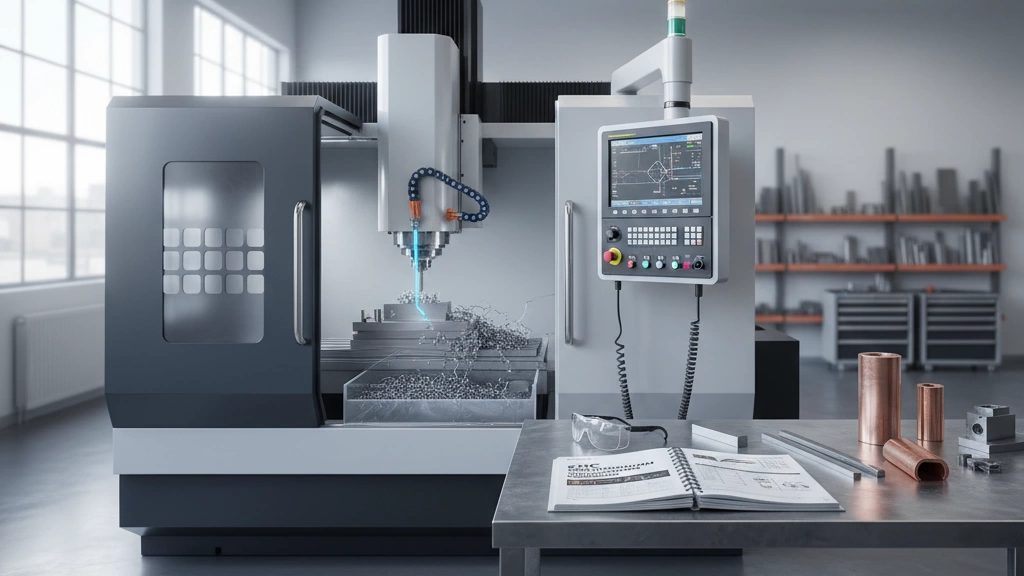
When we talk about CNC machining metal, the material you pick is just as important as the design. It affects cost, strength, weight, machinability, and lead time. Here’s how I look at the most common metals we machine every day in the U.S. market.
Most Common Metals Used in CNC Machining
For precision metal machining, the usual go-to materials are:
- Aluminum (6061, 7075, MIC-6)
- Carbon steels (1018, 4140, P20, tool steels)
- Stainless steels (303, 304, 316, 17-4PH)
- Brass and copper
- Titanium (Grade 2, Grade 5 Ti-6Al-4V)
- Exotic alloys (Inconel, Hastelloy, Monel)
Each has a “sweet spot” based on strength, corrosion resistance, weight, thermal performance, and cost.
Aluminum CNC Machining (6061, 7075, MIC-6)
Aluminum CNC machining is usually the best balance of price, speed, and performance.
-
6061-T6
- Great all-around workhorse for machining aluminum parts
- Good strength, very machinable, widely available in the U.S.
- Used in brackets, housings, fixtures, consumer products, and general prototypes
-
7075-T6
- Higher strength, closer to some steels but lighter
- Common in aerospace, performance automotive, drones, and structural components
- Slightly more expensive and a bit harder to machine than 6061
-
MIC-6 (cast aluminum plate)
- Very stable, stress-relieved cast plate
- Ideal for precision metal machining where flatness matters (fixtures, bases, tooling plates)
- Minimizes warping on large flat parts
Aluminum is also a top choice if you’re planning anodizing—especially when you want both protection and cosmetics. If you need a deeper dive on finish options, it’s worth understanding how anodizing aluminum works and what finishes make sense for CNC machined aluminum parts: anodizing aluminum and how it works.
Steel CNC Machining (1018, 4140, P20, Tool Steels)
CNC machining steel parts is the norm when you need strength, wear resistance, or durability under load.
-
1018 (low carbon steel)
- Affordable, easy to machine, decent strength
- Good for structural parts, shafts, and general mechanical components
- Often used when you’ll coat, plate, or paint it
-
4140 (alloy steel)
- Higher strength and toughness, especially in heat-treated condition
- Used in automotive, industrial equipment, and high-stress mechanical parts
-
P20
- Pre-hardened mold steel
- Common for injection mold bases, tooling, and die components
-
Tool steels (D2, O1, A2, etc.)
- Focused on hardness and wear resistance
- Great for cutting tools, dies, punches, and high-wear components
Steel is tougher to machine than aluminum, so expect higher cost and longer cycle times, especially in hardened states.
Stainless Steel
CNC Machining Metal Tolerances and Surface Finish
When we talk about CNC machining metal, tolerances and surface finish are what separate “good enough” parts from true precision metal machining. This is where cost, performance, and manufacturability all meet, so it pays to be intentional.
Standard vs Tight Tolerance CNC Metal Machining
In most U.S. shops, we treat tolerances in two main buckets:
-
Standard tolerances (general machining)
- Great for brackets, housings, fixtures, simple mechanical parts.
- Lower cost, faster lead times.
- Typical positional accuracy is good enough for general assemblies.
-
Tight tolerance machining (high-precision metal parts)
- Used for aerospace, medical, robotics, and semiconductor components.
- Requires better machines, better fixturing, more inspection time.
- Costs more, but ensures consistent fit and performance.
Rule of thumb: If the feature doesn’t affect fit, sealing, or function, keep it at a standard tolerance. Only call out tight tolerance where it truly matters.
Typical CNC Metal Tolerances in 2025
Most modern CNC metal milling and CNC turning metal parts in 2025 can hit the ranges below reliably, assuming a good setup and reasonable part geometry:
-
Standard shop tolerances (without special callouts):
- ±0.005″ (±0.127 mm) on most machined metal dimensions
- ±0.010″ (±0.25 mm) on non-critical features and overall lengths
-
Common “tight” tolerances:
- ±0.001″ (±0.025 mm) on critical diameters, bores, and fits
- ±0.0005″ (±0.013 mm) is achievable on high-end equipment with process control
-
Hole and thread tolerances:
- Reamed or bored holes: IT7–IT9 range is typical
- Threads: standard class 2A/2B fits (3A/3B for more critical applications)
If you need very tight tolerances on complex shapes or multiple faces in one setup, 5-axis CNC machining metal is often the most reliable way to get there. That’s where advanced machines like the ones in our 5-axis CNC machining service really shine for tight-tolerance metal work:
High-precision 5-axis CNC machining services help keep multiple faces in one setup, which directly improves accuracy and repeatability.
What Affects Tolerance and Accuracy in Metal Machining
Even the best machine can’t cheat physics. A few key factors control how tight we can hold dimensions on CNC machining for metal materials:
-
Material type and stability
- Aluminum is easier to hold tight tolerances, but it can move with temperature.
- Steel and stainless are more stable but harder to cut.
- Titanium and exotic alloys (Inconel, Hastelloy) push tool wear and heat.
-
Part geometry
- Thin walls, deep pockets, and long overhangs create deflection and chatter.
- Large parts can warp, especially during roughing.
-
Setup and fixturing
- More setups = more chances for stack-up error.
- Rigid, well-designed fixtures = better repeatability.
-
Tooling and cutting strategy
- Sharp tools, proper feeds/speeds, and good toolpaths matter.
- Coolant and chip evacuation keep heat down and surfaces stable.
-
Machine condition and environment
- High-end, well-maintained machines hold better tolerances.
- Temperature-controlled shop environments reduce drift.
If you’re targeting tight-tolerance metal machining, tell us up front. We’ll design the setup, fixturing, and inspection plan to match.
Surface Finish Basics for CNC Machined Metal
Surface finish on CNC machined components affects wear, sealing, aesthetics, and even how coatings stick. The most common way to specify it is with Ra (average roughness).
-
As-machined surface
- Good for internal features, non-visible areas, and many functional parts.
- Usually the cheapest option.
-
Smoothed / fine machined surfaces
- Better for sliding surfaces, bearing areas, and cosmetic faces.
- May require slower feeds, sharper tools, or a finishing pass.
Typical Ra Values for CNC Milling and Turning Metal
Real-world numbers we see every day:
-
CNC milling on metals (as-machined):
- ~63–125 µin Ra (1.6–3.2 µm) with standard tools and parameters.
- 32 µin Ra (0.8 µm) is achievable with fine finishing strategy.
-
CNC turning metal parts (as-machined):
- ~32–63 µin Ra (0.8–1.6 µm) is common from a good lathe.
- 16 µin Ra (0.4 µm) or better is possible with sharp inserts and stable setups.
If you need higher cosmetic quality on visible faces, we adjust feeds/speeds or add a secondary finishing step. The specifics depend on whether you’re machining aluminum, steel, stainless, or titanium.
Common Metal Finishing Options
Beyond the as-machined surface, we can add finishing to improve corrosion resistance, hardness, or appearance:
-
Anodizing (for aluminum)
- Adds corrosion resistance and a hard surface.
- Clear, black, and color options.
- Common for consumer products, enclosures, EV and electronics parts.
-
Plating (for steel, brass, copper, and some alloys)
- Nickel plating for wear and corrosion resistance.
- Zinc plating for cost-effective corrosion protection.
- Gold or silver plating for high-conductivity electrical contacts.
-
Passivation (for stainless steel)
- Chemically cleans the surface and enhances corrosion resistance.
- Standard for medical, food-grade, and aerospace stainless parts.
-
Bead blasting
- Creates a uniform matte finish.
- Often used before anodizing for a clean, consistent look.
- Helps hide minor machining marks.
-
Other options (as needed)
- Powder coating, black oxide, hard coat anodizing for heavy wear.
Choosing Tolerances and Finishes Without Overpaying
Many customers in the U.S. accidentally drive up cost by over-specifying. Here’s how to keep pricing realistic on custom metal machining services:
-
Don’t tighten everything “just in case.”
- Avoid blanket tolerances like ±0.001″ on the entire drawing.
- Only tighten critical mating features: fits, bearings, sealing surfaces.
-
Separate functional and cosmetic areas.
- Call out finish only where needed (visible faces, sliding surfaces).
- Let non-critical areas stay as-machined.
-
Align finish with material and process.
- Aluminum: anodize + bead blast for clean, consistent appearance.
- Stainless: as-machined + passivation for many industrial parts.
- Steel: plating or coating if corrosion is a concern.
-
Be realistic about ultra-tight tolerances.
- Tolerances tighter than ±0.0005″ or Ra smoother than 16 µin usually mean:
- More setups
- Special tooling
- Extra inspection
- Use them only where performance truly demands it.
- Tolerances tighter than ±0.0005″ or Ra smoother than 16 µin usually mean:
-
Talk to us early.
- Share your CAD and tolerance goals and we’ll recommend changes to keep quality high and cost reasonable.
- We can show how different CNC machining tolerances and finishes impact price and lead time.
Dialing in the right mix of tolerances and surface finish for machined metal is one of the fastest ways to get reliable, repeatable parts while keeping your CNC machining cost per part under control.
Advantages of CNC Machining Metal vs Other Processes
When you’re buying metal parts in the U.S. today, you’re usually choosing between CNC machining, metal 3D printing, casting, forging, stamping, or manual machining. Each has a place, but CNC machining metal is often the best mix of speed, precision, and flexibility for real-world parts.
Here’s how I look at it when I help customers decide.
CNC Metal Machining vs Metal 3D Printing
Metal 3D printing sounds like the future, but in many cases CNC metal machining is still the smarter move:
-
Where CNC wins:
- Tight tolerances and high accuracy right off the machine
- Clean surfaces and sharp details on functional features
- Lower cost for small and medium metal parts with simple or moderately complex geometry
- Wider material options in common alloys (6061, 7075, 1018, 4140, 303, 304, 316, 17-4PH, brass, copper, titanium, etc.)
-
Where metal 3D printing wins:
- Extremely complex internal channels or lattice structures you can’t machine
- Consolidating many welded components into a single printed part
- Very low quantities of highly complex geometry where machining would require crazy tooling or fixturing
Reality: For most precision metal machining in aerospace, robotics, and industrial equipment, CNC metal milling and turning still beat metal printing on cost, tolerances, and surface finish. A common setup is print near-net shape for wild geometries, then use CNC machining for finishing and critical dimensions.
CNC Machining vs Die Casting for Metal Parts
Die casting is great for high volumes, but it’s not always the best fit for U.S. customers needing flexibility and speed.
-
CNC machining strengths:
- Low to mid volumes: from 1 piece prototypes up to a few thousand per year
- Very tight tolerances and critical sealing or bearing surfaces
- Design changes are cheap—no mold to re-cut
- Stronger material options (many die-cast alloys are lower strength vs wrought bar or plate)
-
Die casting strengths:
- Very high volume parts (tens of thousands to millions per year)
- Lower cost per piece once tooling is paid off
- Thin-wall, cosmetic housings where extreme precision isn’t required
If you’re still validating your design or expect revisions, CNC machining metal is almost always cheaper and lower risk than locking into expensive die-cast tooling. Once your design is stable and volumes are high, you can even machine metal prototypes while planning a casting tool, then keep using CNC machining as a post-processing step on cast parts, similar to what we detail for CNC machining investment cast parts postprocessing on our site.
CNC Machining vs Forging and Stamping
Forging and stamping are all about high-volume blank shapes. CNC machining metal is about precision and flexibility.
-
Where CNC metal machining wins:
- Complex 3D shapes and pocketing
- Low and medium volume runs
- Tight tolerance faces, bores, and threads
- Quick revision cycles
-
Where forging and stamping win:
- Very high-volume production with simple shapes
- Great strength-to-weight ratio with forged parts
- Low material waste once tooling is dialed in
A common hybrid approach:
- Use forging or stamping to create a near-net shape blank.
- Use CNC machining to finish critical surfaces, holes, and interfaces.
This gives you forged strength plus precision metal machining where it matters.
CNC Machining vs Manual Machining
Manual machining still has a role in U.S. job shops, but CNC metal machining is the standard for repeatable, high-precision metal parts.
-
CNC machining advantages:
- Consistent, repeatable quality across hundreds or thousands of parts
- Faster cycle times once the program is proven out
- Ability to hold tight tolerances on complex features and multi-axis geometry
- Lights-out or low-touch machining to reduce labor cost
-
Manual machining makes sense when:
- You need a very simple one-off part quickly and locally
- You’re doing repair work or on-the-fly modifications
- Tolerances are loose, and the geometry is straightforward
For production or any tight-tolerance metal machining, CNC is the only way to control cost, quality, and lead time.
When CNC Machining Metal Is Cheaper or Faster
CNC metal machining is usually the best choice when you:
- Need parts fast:
- Prototype or pilot runs in days, not weeks
- No tooling or molds to build
- Expect design changes:
- Easy to tweak the CAD/CAM file and re-run
- Have tight tolerances:
- Precision features, mating components, precision bores, and flatness callouts
- Run small to medium volumes:
- From 1–2 prototypes to a few thousand parts per year
- Use premium metals:
- Aluminum, steel, stainless, brass, copper, titanium, or exotic alloys that are easier to machine from bar/plate than to cast or form
We’ve built our own custom CNC metal machining services around this sweet spot—if you’re working on high-precision metal parts and want flexibility, CNC is usually your best ROI.
When You Should NOT Use CNC Machining for Metal
You shouldn’t force CNC machining metal into every situation. It’s the wrong fit when:
- Your volumes are truly massive:
- Millions of identical parts with simple geometry
- Here, die casting, stamping, or powder metal will usually beat CNC on cost per part once tooling is amortized.
- Geometry is un-machineable:
- Deep internal channels, internal lattice structures, or enclosed cavities that tools cannot reach
- This is a metal 3D printing or casting job, potentially with CNC finishing.
- You only care about rough shape, not precision:
- Very rough brackets or low-value parts where tolerances are wide open and the priority is lowest possible cost
- Part is huge with simple geometry:
- Large beams, plates, basic brackets that might be cheaper to cut, weld, or plasma/laser cut than 3D machine
If you’re not sure which way to go, send over your model, target quantity, and rough tolerance needs. We can quickly tell you when CNC metal machining is the right tool—and when another process will save you serious money. For a deeper look at our precision metal machining capabilities and materials, you can check our overview of CNC metal machining services at ms-machining.com/cnc-metal-machining/.
Industries Using CNC Machined Metal Parts
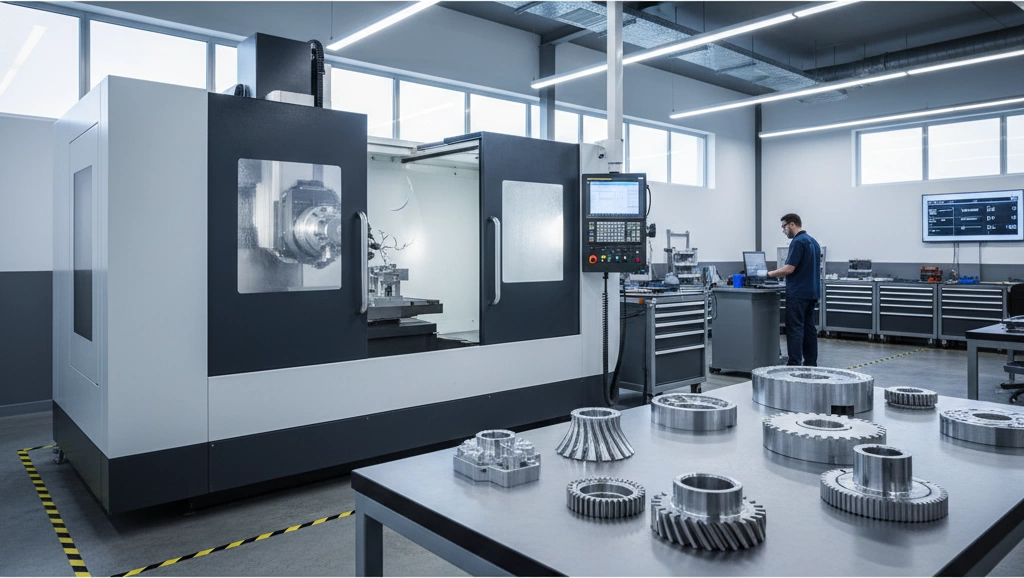
CNC machining metal is behind a lot of the critical hardware we all rely on in the U.S.—from planes and cars to medical implants and semiconductor tools. Here’s how different industries use precision metal machining and what they expect from a serious metal CNC shop.
Aerospace and Defense CNC Metal Components
Aerospace and defense are some of the toughest markets in the world for CNC machined components. Parts must be light, strong, and traceable, with zero shortcuts.
Typical CNC metal parts:
- Structural brackets and mounts (aluminum 6061, 7075)
- Actuator housings and linkages
- Landing gear and hydraulic components (steel, stainless, titanium)
- Avionics hardware, heat sinks, and enclosures
- Defense system mounts, optics housings, and precision fixtures
Here, tight-tolerance machining and 5-axis CNC machining metal are the norm, not the exception. Shops that support aerospace usually hold tight tolerances, document every step, and work under strict quality systems. If you’re sourcing for aircraft work, you need a partner with real aerospace experience, like a dedicated CNC machine shop for the aircraft industry.
Automotive and EV CNC Metal Parts
Automotive and EV manufacturers push hard on cost, volume, and repeatability. CNC machining metal is widely used for:
- Powertrain and drivetrain components (steel, aluminum)
- Battery housings, coolant blocks, and bus bars (aluminum, copper)
- Brackets, mounts, and suspension hardware
- Prototype and low-volume performance parts
For EVs, thermal management is huge—machining aluminum parts and copper parts with consistent surface finish and good flatness is critical for cooling performance. In this space, CNC machining shines in:
- Prototypes and pre-production builds
- Short-run and custom performance parts
- Tooling, fixtures, and test hardware
Medical Devices and Implant-Grade Metal Machining
Medical and dental products rely heavily on tight-tolerance metal machining and clean, consistent surfaces.
Typical CNC machined metal parts:
- Surgical instruments (stainless steel 17-4PH, 420, 440)
- Implant components (titanium Grade 5, cobalt-chrome)
- Orthopedic hardware, plates, and screws
- Precision housings for diagnostic devices
Key demands from medical buyers:
- Clean, burr-free edges and reliable surface finish
- Full traceability on material and processes
- Capability with titanium machining services and medical-grade stainless
Quality documentation (FAI, material certs, lot traceability) isn’t optional here—it’s standard.
Robotics and Automation Metal Components
Robotics, warehouse automation, and factory automation rely on precision metal machining for smooth motion and long life.
Typical CNC metal components:
- Robot arm joints and end-effectors
- Gearbox housings and motor mounts
- Linear motion blocks, brackets, and plates
- Sensor and camera housings
Most of these parts use CNC milling and turning metal in aluminum, steel, and stainless. The focus:
- Accurate fits and alignment for smooth motion
- Good surface finish on sliding and rotating parts
- Fast lead times for design changes and upgrades
Oil and Gas CNC Machined Metal Parts
Oil, gas, and energy applications need tough parts that survive harsh environments.
Common CNC machined metal parts:
- Valves, manifolds, and flanges (carbon steel, stainless)
- Downhole components and drill tooling
- High-pressure fittings and connectors
- Corrosion-resistant components in exotic alloys (Inconel, Hastelloy)
Here, customers look for:
- CNC machining steel parts that can handle pressure and fatigue
- Experience with exotic alloys and deep-hole machining
- Reliable sealing surfaces and threads
Semiconductor and Electronics Hardware Machining
Semiconductor and electronics hardware demand clean, precise, and often complex CNC machined components.
Typical parts:
- Vacuum chamber components and plates
- Precision brackets and stages
- Heat sinks, RF housings, and enclosures (aluminum, copper)
- Fixtures and tooling for assembly and testing
Key requirements:
- Flatness and parallelism on large aluminum plates
- Tight positional tolerances
- Clean, consistent surface finish, often bead blasted or anodized
For many of these applications, customers rely on dedicated aluminum CNC machining services to hit weight, flatness, and thermal performance targets.
What These Industries Expect From a CNC Metal Shop
Across aerospace, automotive, medical, robotics, oil and gas, and semiconductor, the demands are very similar:
-
Precision and repeatability
- Stable CNC machining tolerances
- Tight control over critical dimensions and GD&T
-
Material expertise
- Confidence with machining steel, aluminum, stainless, brass, copper, and exotic alloys
- Advice on material selection for strength, weight, and cost
-
Process control and quality systems
- ISO-certified CNC machining or similar quality frameworks
- Inspection reports, traceability, and consistent documentation
-
Scalability
- Ability to go from metal prototype machining to small batch to full production
- Fixtures, tooling, and process validation ready for growth
-
Communication and support
- Clear DFM feedback before cutting chips
- Realistic lead times and honest updates
- An easy path to an online CNC machining quote or quick RFQ response
If you’re sourcing CNC machining metal in the U.S., the right partner should not just “make the part.” They should understand your industry, help you pick the right material, hold the tolerances you truly need, and stand behind the work with real quality and documentation.
From Metal Prototype Machining to Production
When I talk with customers in the U.S., the big question is always the same: “How do I get from a one-off prototype to reliable production without wasting time and money?” CNC machining metal is one of the best ways to do exactly that.
How CNC Metal Prototyping Works
CNC metal prototyping is all about speed, flexibility, and learning before you commit to tooling.
Here’s how a typical CNC metal prototype run works:
- You send CAD files (usually STEP or Parasolid).
- We review for machinability, cost, and risk.
- We program the part (CAM), set up tools and workholding.
- We machine 1–10 parts in the actual metal you want (aluminum, steel, stainless, brass, titanium, etc.).
- You test fit, function, assembly, and performance.
- We iterate quickly if changes are needed.
Because CNC is subtractive and doesn’t need expensive molds, it’s ideal for metal prototype machining where designs are still changing.
If you’re not sure whether CNC or another process is better for your part, it’s worth looking at options like custom metal fabrication for larger, welded structures or stamped components, which we cover in our breakdown of why you should choose custom metal fabrication.
DFM for Machined Metal Parts
Design for manufacturability (DFM) is where you save the most money and headache.
When I review metal parts for CNC, I focus on:
- Tool access: Avoid deep, narrow pockets and undercuts unless really needed.
- Realistic wall thickness:
- Aluminum: ≥ 0.04–0.06 in
- Steel/Titanium: ≥ 0.06–0.08 in
- Standard hole sizes: Stick to standard drill diameters when possible.
- Consistent radii: Use the same fillet sizes where you can to reduce tool changes.
- Tolerances where they matter: Tight tolerance machining only on critical features—looser everywhere else.
Good DFM on CNC metal machining keeps parts strong, repeatable, and cheaper to run. If a feature will double the cost, I’ll flag it before you spend a dollar on chips.
Files and Info You Should Send for CNC Metal Quotes
If you want a fast, accurate online CNC machining quote, send all the right info upfront. Here’s what I recommend:
Required:
- 3D CAD file: STEP (.step/.stp), Parasolid (.x_t), or IGES
- 2D drawing (PDF) with:
- Dimensions and tolerances
- Critical features called out
- Thread specs (UNC/UNF/metric, class, depth)
- Surface finish requirements (e.g., Ra 63 µin / 1.6 µm)
- Material: Exact alloy and temper if known (e.g., 6061-T6, 17-4PH H900, Ti-6Al-4V)
Very helpful:
- Quantity breakdowns: e.g., 5 / 50 / 500 pcs
- Target lead time
- Special requirements:
- Heat treatment
- Coatings/finishes (anodizing, plating, passivation)
- Certification needs (material certs, RoHS, REACH, ITAR, etc.)
- End-use: Aerospace, medical, automotive, robotics, etc. (affects controls and documentation)
The more precise you are, the tighter and more realistic your CNC machining cost per part will be.
Rapid Prototyping Metal Parts: Typical Lead Times
For rapid prototyping metal parts in the U.S., here’s what I typically see:
- Simple aluminum parts:
- 1–5 pcs: 3–7 business days
- Complex 5-axis or hard steels:
- 1–5 pcs: 7–15 business days
- Exotic alloys (Inconel, titanium):
- 1–5 pcs: 10–20 business days
Lead time depends heavily on:
- Material availability
- Machine availability (especially 5-axis)
- Complexity and number of setups
- Secondary operations (anodizing, plating, grinding, etc.)
If you’re under serious time pressure, say so. There’s often a premium “expedite” route if the geometry allows it.
Bridge Production Runs vs Full Production
Once your prototype is locked in, there are usually two paths:
Bridge Production (Low-Volume CNC)
This is small-batch CNC metal machining to fill the gap while:
- You finalize design details
- You validate the product with customers
- You wait on tooling for casting, MIM, or forging (if that’s the end goal)
Typical bridge runs: 20–1,000 parts
Benefits:
- Faster start
- No big tooling investment
- Easier to tweak design if issues pop up
In some cases, especially with complex geometries or tight-tolerance metal machining, it makes more sense to stick with CNC long-term rather than jump to casting or processes like metal injection molding.
Full Production CNC
Full production CNC comes in when:
- Design is stable
- Volumes are repeatable
- Tight tolerances and premium materials demand CNC precision
Typical volumes: hundreds to tens of thousands per year, especially for high-value precision metal machining in aerospace, medical, robotics, and semiconductor hardware.
Quality Checks for CNC Machined Metal (FAI, PPAP, CMM)
For U.S. customers in aerospace, automotive, and medical, quality documentation is non-negotiable. Here’s what we usually provide for CNC machined components:
-
FAI (First Article Inspection)
- Full measurement report on the first piece (or first batch)
- Confirms the part matches drawing and CNC machining tolerances before full production.
-
PPAP (Production Part Approval Process)
- Standard in automotive and some industrial sectors
- Includes process flow, control plan, material certs, dimensional results, capability studies, and more.
- Shows the process is capable and stable for ongoing production.
-
CMM Reports (Coordinate Measuring Machine)
- Automated, high-precision measurement of critical dimensions
- Essential for tight-tolerance machining and high-precision metal parts.
Other common quality services:
- Material and heat-treatment certs
- Surface finish and coating certs
- Gauge R&R and capability (Cp/Cpk) on critical features
If you need specific standards (AS9100, ISO 13485, IATF 16949), call that out early so we align the CNC machining metal process and documentation with your industry requirements.
If you’re moving from prototype to production, the key is simple: design smart, share complete data, and demand clear quality plans. That’s how CNC machining metal goes from “one-off sample” to a stable, scalable production solution.
Cost of CNC Machining Metal in 2025
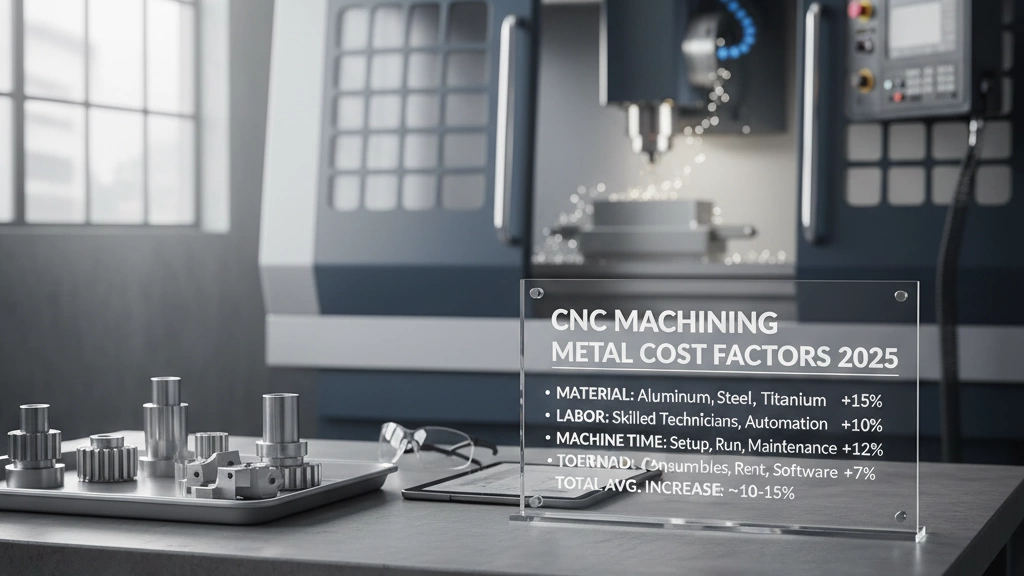
CNC machining metal is still one of the most cost‑effective ways to get strong, precise parts in the U.S., but pricing in 2025 is driven by more variables than just “shop rate.” Here’s how I look at cost so you don’t overpay for your machined metal parts.
Main Cost Drivers in CNC Metal Machining
The biggest cost buckets for precision metal machining are:
- Machine time
- 3‑axis milling is cheaper than 5‑axis.
- Heavy roughing in steel or titanium takes longer than cutting aluminum.
- Setup and programming
- New fixtures, complex setups, and custom CAM programming add upfront cost.
- One‑off prototype? Setup cost is a bigger chunk of the total.
- Material and stock prep
- Raw bar/plate cost, cutting to size, and waste (chips, offcuts).
- Tooling and tool wear
- Hard metals and exotic alloys eat tools fast.
- Small cutters and deep features increase tool consumption.
- Quality and inspection
- CMM reports, FAI, PPAP, and full traceability all add time and cost.
- Finishing and secondary ops
- Anodizing, plating, grinding, and bead blasting are separate operations.
If you’re machining a lot of hardened steels or tool steels, partnering with a shop that specializes in hardened steel machining parts can lower tool and setup costs over the long run.
Impact of Material Choice on CNC Machining Cost
Material is more than just a price per pound. It changes cutting speed, tool life, and scrap rate.
- Aluminum (6061, 7075, MIC‑6)
- Fast to machine → lower machine time.
- Lower tool wear → fewer tooling charges.
- Often the best value for prototypes and light‑duty production.
- Mild steel (1018)
- Moderately priced, machines well, but slower than aluminum.
- Good for structural parts and general-purpose components.
- Alloy steels (4140, P20, tool steels)
- Higher raw cost + slower machining + more tool wear.
- Often worth it when you need strength, wear resistance, or molds/dies.
- Stainless steels (303, 304, 316, 17‑4PH)
- 303 is easiest, 304/316 are tougher, 17‑4PH can be demanding.
- Expect more machine time and higher tooling costs than aluminum.
- Brass and copper
- Brass machines quickly; copper can be sticky and harder to handle.
- Great for connectors and thermal parts; usually mid‑range total cost.
- Titanium (Grade 2, Grade 5 Ti‑6Al‑4V)
- Expensive raw material + very slow machining + high tool wear.
- Used when weight-to-strength ratio or biocompatibility is critical.
- Exotic alloys (Inconel, Hastelloy, Monel)
- Top of the cost pyramid. Extremely slow, high tool consumption, and specialized tooling.
If you can drop from stainless to aluminum, or from titanium to a high‑strength aluminum grade, you can often cut total CNC machining cost per part by 30–60%.
How Part Geometry and Complexity Change the Price
Part design can double or triple the cost of CNC metal machining, even with the same material.
Complexity cost drivers:
- Deep pockets and thin walls
- Require multiple passes, small tools, and conservative feeds.
- Risk of chatter and distortion increases cycle time.
- 5‑axis features
- Undercuts, compound angles, and complex surfaces need 4‑ or 5‑axis CNC metal milling.
- Higher machine rates and more programming time.
- Tiny features and micro details
- Micro cutters run very slow and break easier.
- Adds both machine time and inspection complexity.
- Multiple operations
- If a part needs both CNC milling and CNC turning or multiple re‑clamps, setup cost climbs.
- Tight inside corners
- Forcing small-radius tools increases time and tool wear.
Whenever possible, I recommend:
- Larger fillets instead of sharp internal corners.
- Uniform wall thicknesses.
- Avoiding unnecessary pockets, steps, and undercuts.
These design choices keep precision metal machining prices under control without compromising function.
How Tolerance and Surface Finish Affect Cost
Tolerances and finish requirements are silent cost killers in tight‑tolerance metal machining.
- Tighter tolerances (±0.0005″ and below)
- Require slower feeds, more tool compensation, and more in‑process inspection.
- Sometimes demand dedicated fixtures and climate‑controlled machining.
- Standard tolerances (±0.002″–±0.005″)
- Much cheaper, usually suitable for brackets, housings, non‑mating parts.
- Surface finish
- As-machined: cost‑effective, typical Ra ~ 63–125 µin on milling, better on turning.
- Fine finishes (Ra < 32 µin) often need:
- Additional passes
- Polishing, grinding, or superfinishing
- Extra QC steps
Each extra decimal place and every “mirror finish” note on your drawing adds cost. Only call out tight tolerance machining and high-end finish where it truly matters: sealing surfaces, bearing fits, precision interfaces.
Volume, Repeat Orders, and Price Breaks
CNC machining metal scales better than most people think.
- One‑off prototypes
- Setup cost is spread across one part, so per‑unit cost is high.
- Small batch CNC metal machining (10–100 pcs)
- Setup cost amortizes; per‑part price drops significantly.
- Production CNC machining (100–10,000+ pcs)
- Custom fixtures, optimized toolpaths, and bulk material purchasing kick in.
- Best price breaks come with stable, repeatable orders.
Repeat orders are where you see real savings:
- Programming and fixturing are already done.
- Process is dialed in, reducing scrap and rework.
- Shops can buy material in volume and pass through savings.
If you know you’ll reorder, let your metal CNC shop know up front. It changes how we invest in tooling and process optimization.
Tips to Reduce CNC Metal Machining Costs Without Hurting Quality
You can keep quality high and still control your CNC machining cost per part with a few smart moves:
- Right-size the material
- Use aluminum where strength and heat aren’t critical.
- Use 303 instead of 304 when corrosion and chemistry allow.
- Stay away from exotic alloys unless you really need their properties.
- Relax tolerances where possible
- Separate “critical” and “non‑critical” dimensions on your drawing.
- Use standard tolerance blocks instead of tightening everything.
- Simplify geometry
- Add fillets, avoid razor-thin walls, and limit deep pockets.
- Remove cosmetic features that don’t affect function.
- Choose practical finishes
- Go with standard as-machined where you can.
- Only specify anodizing, plating, or bead blasting where needed for corrosion, wear, or branding.
- Bundle parts and orders
- Order small families of parts together to share setup.
- Plan blanket orders with scheduled releases when demand is predictable.
- Engage early on DFM
- Ask your shop for DFM feedback before you finalize your design.
- A quick review can often remove 10–30% of the cost with zero performance impact.
If you’re focusing on aluminum parts for cost‑effective production, working with a dedicated aluminum machining parts manufacturer can streamline both pricing and lead times.
In 2025, the best way to control CNC machining metal costs in the U.S. is simple: choose the right metal, avoid “over‑engineering” tolerances and finishes, and partner with a shop that’s willing to give real DFM feedback instead of just quoting what you send.
How to Choose a CNC Machining Metal Partner
Picking the right CNC machining metal partner in the U.S. can make or break your project. I’ll walk you through what I’d personally check before sending any RFQ or PO.
What to Look for in a Metal CNC Shop
Here’s what I’d expect from a serious CNC metal machining shop:
- Proven experience in metal (not just plastics)
- Real precision metal machining capability (tight tolerances, repeatable results)
- Modern equipment: 3-, 4-, and 5-axis CNC metal milling and CNC turning
- In-house engineering and DFM support
- Transparent quoting and lead times
- Traceable materials with certs (MTRs) when required
If you need complex, high-precision work, you should be looking at a shop that offers dedicated precision CNC machining services and can show real examples, not just a brochure.
Technical Capabilities to Check
Always confirm capabilities before you send production work. At minimum:
Axes & Equipment
- 3-axis CNC mills for simple prismatic parts
- 4-axis and 5-axis CNC machining metal for complex geometries and fewer setups
- CNC lathes with live tooling (mill-turn) for shafts, bushings, and turned parts
- Work envelope size that matches your largest part
Materials
Make sure they actually machine the metals you need:
- Aluminum: 6061, 7075, MIC-6
- Steels: 1018, 4140, P20, tool steels
- Stainless: 303, 304, 316, 17-4PH
- Brass & copper
- Titanium: Grade 2, Ti-6Al-4V (Grade 5)
- Exotic alloys: Inconel, Hastelloy, Monel
Tolerances & Finish
- Ask for standard machining tolerances (e.g. ±0.005″ / ±0.127 mm)
- Ask what they can reliably hold on critical features (±0.001″ / ±0.025 mm or better)
- Confirm surface finish options: as-machined, bead blast, anodizing, plating, passivation, etc.
Quality Systems and Certifications
If you’re in aerospace, automotive, medical, or defense, this matters a lot.
Key things to ask for:
- ISO 9001 certification (baseline for quality management)
- AS9100 (aerospace) or IATF 16949 (automotive) if relevant
- ITAR compliance if you’re in defense / controlled projects
- Ability to provide:
- Material certs (MTRs)
- CMM inspection reports
- FAI / PPAP documentation
- Process control plans and traceability
If they can’t show a basic quality system on paper, expect headaches later.
Questions to Ask a CNC Metal Machining Supplier
Use these questions before you trust them with real production work:
About Capability
- What metals do you machine every week?
- What tolerances do you hold every day, not just once in a while?
- What are your typical lead times for:
- Prototypes?
- Small batches?
- Larger production runs?
About Quality & Process
- Are you ISO-certified? Can I see your certificate?
- Do you have in-house CMM inspection?
- How do you handle nonconformances and rework?
- Can you support FAI or PPAP if required?
About Communication
- Who will be my main contact (engineer vs sales only)?
- How do you handle DFM feedback? On the quote or after PO?
- How often do you update on order status?
Red Flags When Outsourcing CNC Machined Metal Parts
If you see any of this, be careful:
- They won’t commit to realistic tolerances in writing
- No clear quality system or inspection process
- Quotes that are way below the market without a clear reason
- Vague answers on material sourcing or no MTRs available
- Slow or sloppy responses to technical questions
- They say “no problem” to everything but never push back or ask for clarification
- No photos or examples of actual CNC machined metal parts they’ve done
A shop that never says “this feature will be expensive” or “this tolerance is overkill” probably isn’t looking out for you.
How Communication and DFM Support Save You Money
Good communication and real DFM support are where you actually save money over the life of a project.
What strong DFM support looks like:
- They review your CAD and prints and call out:
- Overly tight tolerances
- Unnecessary surface finishes
- Risky thin walls or deep pockets
- Difficult-to-machine features that will drive cost
- They propose small design tweaks that:
- Reduce setups
- Improve tool access
- Extend tool life
- Cut cycle time and scrap
How this helps you:
- Lower part cost without sacrificing function
- Fewer surprises once you move from prototype to production
- More stable lead times and fewer quality issues
- Better long-term pricing on repeat orders
When I pick a CNC machining metal partner, I’m not just buying machine time—I’m buying process stability, predictable quality, and honest feedback. If a shop can offer that plus solid technical capabilities, that’s a partner worth keeping.
CNC Machining Metal Design Tips
Good design makes CNC machining metal parts cheaper, faster, and more consistent. Here’s how I approach metal part design so you get reliable, tight-tolerance machining without surprise costs.
Design Basics for CNC Machined Metal Parts
When I review a metal part for CNC, I’m looking for three things first: Can we hold it? Can we reach it? Can we cut it?
Keep these basics in mind:
- Design from the cutting tool’s point of view
- Avoid super deep, narrow pockets unless they’re absolutely required.
- Keep features reachable with standard-length tools when possible.
- Use consistent dimensions
- Reuse the same radii, hole sizes, thread sizes, and thicknesses across the part.
- This cuts tool changes and setup time and improves repeatability.
- Design for machining setup
- Flat reference faces (datums) make fixturing and inspection easier.
- Symmetry helps reduce setups and keeps parts more stable during cutting.
Wall Thickness, Fillets, and Feature Size
Thin walls and sharp corners are where CNC metal machining gets expensive and risky. I design to keep parts stiff and machinable.
Wall thickness guidelines (typical CNC metal machining):
- Aluminum:
- Recommended: ≥ 0.040″ (1.0 mm)
- Minimum (short walls, light load): ≈ 0.020–0.030″ with care.
- Steel / Stainless:
- Recommended: ≥ 0.060″ (1.5 mm)
- Thicker walls help avoid chatter and warping.
- Titanium:
- Recommended: ≥ 0.060–0.080″ (1.5–2.0 mm)
- Thin titanium walls get expensive fast because of low machinability.
Fillets and inside corners:
- Avoid “knife-edge” or perfectly sharp internal corners.
- Use inside corner radii ≥ tool radius, common choices:
- 0.031″, 0.062″, 0.093″, 0.125″ (1/32, 1/16, 3/32, 1/8)
- Try to use the same radius across the design to minimize tool swaps.
- If you need a sharp corner for mating parts, consider:
- Relief pockets or “dog-bone” cutouts.
- Designing the mating part to accept a radius instead.
Minimum feature sizes:
- Engraving / text: ≥ 0.020–0.030″ stroke width, depth 0.005–0.010″.
- Slots:
- Try to keep slot width ≥ 0.040–0.062″ (1.0–1.6 mm) for reasonable tool life.
- Very narrow deep slots increase cost and risk of tool breakage.
Tolerancing Strategy for Metal Designs
Tight tolerance metal machining is expensive, so I only tighten tolerances where they truly matter.
Where to use tight tolerances:
- Fits and interfaces:
- Bearing bores, shafts, press fits, slip fits.
- Alignment features (precision dowel holes, locating shoulders).
- Sealing surfaces:
- O-ring grooves, metal-to-metal seals, valve interfaces.
Typical practical tolerances for CNC machining metal:
- General non-critical dimensions: ±0.005″ (±0.13 mm)
- Most standard features: ±0.002–0.003″ (±0.05–0.08 mm)
- Tight tolerance fits (with proper notes): ±0.0005–0.001″ (±0.013–0.025 mm), depending on material and geometry.
Best practices:
- Use GD&T (true position, flatness, perpendicularity) for critical features.
- Don’t call out tight tolerances on every dimension; it drives cost up quickly.
- Tolerance patterns: make critical datums and tighten only what relates to them.
Threading and Hole Design for CNC Metal Machining
Threaded features and holes are usually straightforward, but the details matter for cost and reliability.
Hole design tips:
- Standard drill sizes are cheaper:
- Use standard inch or metric drill diameters instead of odd sizes.
- Depth:
- Try to keep hole depth ≤ 3× diameter for drilled holes when possible.
- Deeper holes are possible but slower and more prone to deflection.
- Tapped holes:
- Provide tap depth in the drawing (e.g., “0.50″ thread depth”).
- Don’t require full thread all the way to the bottom unless necessary.
Thread design tips:
- Use standard thread sizes and pitches (UNC/UNF or ISO metric).
- Through holes are cheaper than blind holes.
- For blind holes:
- Provide thread relief at the bottom if possible.
- Avoid extremely deep blind threads (over ~2–2.5× diameter) unless required.
- Call out thread type clearly:
- Example: 1/4-20 UNC-2B, M6 × 1.0 – 6H, etc.
- For soft metals (aluminum, brass):
- For frequently assembled joints, consider helicoils or inserts for durability.
Design for Chip Evacuation and Tool Life
Good feature design can dramatically improve tool life and cycle time, especially in high-precision metal machining.
Chip evacuation tips:
- Avoid extremely deep, narrow pockets with no exit path.
- If you need deep pockets:
- Add corner reliefs and generous radii to reduce tool load.
- Consider adding chip escape slots or through-holes when the design allows.
- Large-volume material removal:
- Use constant wall thickness where possible.
- Minimize “islands” that force tools to change direction frequently.
Tool life and cutting stability:
- Reduce sudden section changes; smooth transitions are easier on tools.
- Use consistent depth steps (e.g., pocket depths in multiples of tool flute length).
- Provide good clamping surfaces so we can hold the part rigidly while cutting.
Material-Specific Design Tips (Aluminum vs Steel vs Titanium)
Each metal behaves differently in CNC machining. I adjust designs depending on the material being used.
Aluminum CNC machining:
- Very machinable and forgiving.
- You can:
- Use thinner walls compared to steel or titanium.
- Push more aggressive pocketing and lighter structures.
- Great for metal prototype machining and production where weight and speed matter.
Steel and stainless steel machining:
- Stiffer but harder on tools.
- Design considerations:
- Use slightly thicker walls to avoid vibration and deflection.
- Avoid overly small internal radii in deep pockets; these hammer tools and raise costs.
- For stainless steel CNC machining, be mindful of heat buildup—large continuous cuts benefit from good cooling and moderate depths.
Titanium machining services:
- Strong, light, but tough to cut.
- To keep costs under control:
- Avoid very thin walls and extreme aspect ratio features.
- Design with short tool reach in mind.
- Use generous corner radii and avoid tiny cutters whenever possible.
- If you’re planning serious titanium work (medical, aerospace), it’s worth using a shop focused on specialized titanium machining services with the right tooling and strategies. For deeper technical work, I’d send complex Ti jobs to a team that does dedicated CNC titanium machining every day.
When I design CNC machined metal parts, my goal is simple: give you the function you need with the least amount of risk, machining time, and cost. Smart choices on wall thickness, fillets, tolerances, and material let us hit high precision without overpaying for it.
Scaling CNC Machined Metal Parts Production
Scaling CNC machining metal from one-off prototypes to steady production is where costs drop, quality stabilizes, and your supply chain gets predictable. Here’s how I look at it step by step.
Moving from Prototype to Low-Volume Metal Production
Once a prototype works, the goal is to make parts repeatable without losing flexibility.
For CNC machined metal parts, that usually means:
- Locking in a “production-ready” CAD model and drawing (with only the tolerances you truly need).
- Standardizing materials (for example, locking in 6061-T6 aluminum or 304 stainless) to avoid surprises.
- Setting initial control plans: key dimensions, critical fits, cosmetic surfaces.
- Agreeing on target volume ranges:
- Prototyping: 1–10 pcs
- Low volume: 20–500 pcs
- Bridge/production: 500–5,000+ pcs
At this stage, I’ll often suggest running a small pilot batch (10–50 pcs) to shake out machining issues before committing to larger runs.
Planning Fixtures and Tooling for Metal Machining
Good fixturing and tooling is the difference between “we can make it” and “we can make it reliably at scale.”
For CNC metal machining, I focus on:
- Custom soft jaws and fixtures:
- Designed for stable clamping without distorting thin walls.
- Allow quick loading/unloading to cut cycle time.
- Tooling strategy:
- Standard tools wherever possible to control cost and lead time.
- High-performance cutters only where they clearly pay off (tough steels, titanium, deep pockets).
- Setup reduction:
- Combining operations to reduce the number of times the part is re-clamped.
- Planning for multi-part fixtures so we can run several parts per cycle.
We typically design fixtures and process flows around our core capabilities, like our 3-axis and 5-axis CNC milling centers and dedicated turning cells, similar to what we outline in our CNC machining services overview at https://ms-machining.com/cnc-machining-services/.
Process Validation and Capability for CNC Metal Runs
Before we “hit go” on regular CNC metal production, we validate the process so you’re not gambling on every shipment.
That usually includes:
- First Article Inspection (FAI):
- Full dimensional check against your drawing for the first run.
- Capability checks:
- Running multiple parts and checking critical dimensions (Cp/Cpk) to see how stable the process is.
- Controlled cutting parameters:
- Locking in feeds, speeds, toolpaths, and tool life for each metal (aluminum vs steel vs stainless vs titanium).
- Documented setups:
- Photos, setup sheets, tooling lists, and program versions so the same result can be repeated months later.
If you need aerospace-style or automotive-style validation, we align this with your PPAP or similar requirements.
Maintaining Consistency Across Large Batches
Once you’re in the hundreds or thousands of CNC machined metal parts, consistency is everything.
To keep parts stable from batch to batch, we:
- Standardize material sources:
- Approved mills and distributors with certs (material certs, heat numbers, etc.).
- Use in-process inspections:
- Operators check key dimensions during the run, not just at the end.
- Control tool wear:
- Pre-set tool life, automatic tool offsets, and scheduled tool changes for tight-tolerance features.
- Maintain machine calibration:
- Regular calibration and preventive maintenance on mills and lathes.
- Track revisions tightly:
- Clear version control for CAD, CAM, and G-code so the shop is always cutting the latest revision.
When to Combine CNC Machining with Other Processes
For the U.S. market, especially in automotive, aerospace, and hardware, the best solution is often a hybrid approach, not just pure CNC machining.
You might want to combine CNC metal machining with:
- Casting or forging:
- Rough shape from casting/forging, CNC machining for precision features and tight tolerances.
- Metal 3D printing:
- Print complex, near-net shapes, then CNC machine critical faces and holes for accuracy.
- Sheet metal fabrication:
- Machine solid components that bolt to formed sheet metal assemblies.
- Secondary finishing:
- Anodizing, plating, passivation, bead blasting after CNC machining for corrosion resistance and aesthetics.
We’ll usually recommend this when your volumes go up and raw-block machining alone is no longer the most cost-effective option.
Long-Term Supplier Partnership for CNC Metal Components
Scaling CNC machined metal parts isn’t just about machines; it’s about the relationship. A strong long-term partnership with a metal CNC shop saves you time, risk, and money.
Here’s what I focus on building with our customers:
- Stable pricing and long-term planning:
- Forecast-based planning and blanket orders to lock pricing and capacity.
- Shared DFM and cost-down work:
- Regular design-for-manufacturing reviews to simplify parts and cut costs without hurting function.
- Backup and redundancy:
- Multiple machines and setups capable of running your job to protect against downtime.
- Fast response on design changes:
- Agile CAM programming and tooling updates so new revisions don’t stall production.
- Data and traceability:
- Lot traceability, material certs, and inspection records, especially for regulated industries.
If you’re ready to scale CNC metal machining from prototype to real production, the key is to think beyond “Can you make this?” and start asking “How do we run this reliably, every time, at the right cost?” That’s the mindset we apply on every CNC metal production program we run.