In the realm of precision manufacturing, the gap between theoretical blueprints and actual delivered parts can often introduce substantial hurdles. As an R&D engineer or procurement manager, you are likely no stranger to the constant balancing act between design optimization and manufacturing feasibility. When projects involve intricate geometries and stringent geometric tolerances, ensuring consistency across parts remains a critical technical challenge.
This article explores how a reliable 5-axis CNC machining service eliminates common quality bottlenecks from a fundamental engineering perspective, providing predictable results for your custom machining projects.
Are You Experiencing These Hidden Engineering Losses in Your Custom Machining Projects?
When evaluating your current supply chain or planning the production workflow for a new component, consider whether the following traditional machining limitations have ever compromised your project timeline or quality standards:
- Tolerance Accumulation from Multiple Setups: When complex components are processed on standard 3-axis machines, they frequently require repositioning and multiple fixture setups. If you review recent First Article Inspection (FAI) reports, dimensional deviations in Geometric Dimensioning and Tolerancing (GD&T) are often traced back to these micro-alignments during manual transfers.
- Geometric Limitations in Deep Cavities and Undercuts: Designs with deep pockets, internal undercuts, or complex organic surfaces force 3-axis setups to use extended tooling. This inevitably introduces tool deflection and chatter, resulting in substandard surface finishes or, worse, completely scrapped workpieces due to dimensional drift.
- Protracted Lead Times Driven by Complex Fixturing: The more complex the part, the more intricate the custom fixtures required for traditional machining. The time required to design, fabricate, and calibrate these fixtures delays your initial prototyping cycle, making product development timelines highly unpredictable if the first article fails verification.
How 5-Axis CNC Machining Resolves These Bottlenecks at the Source
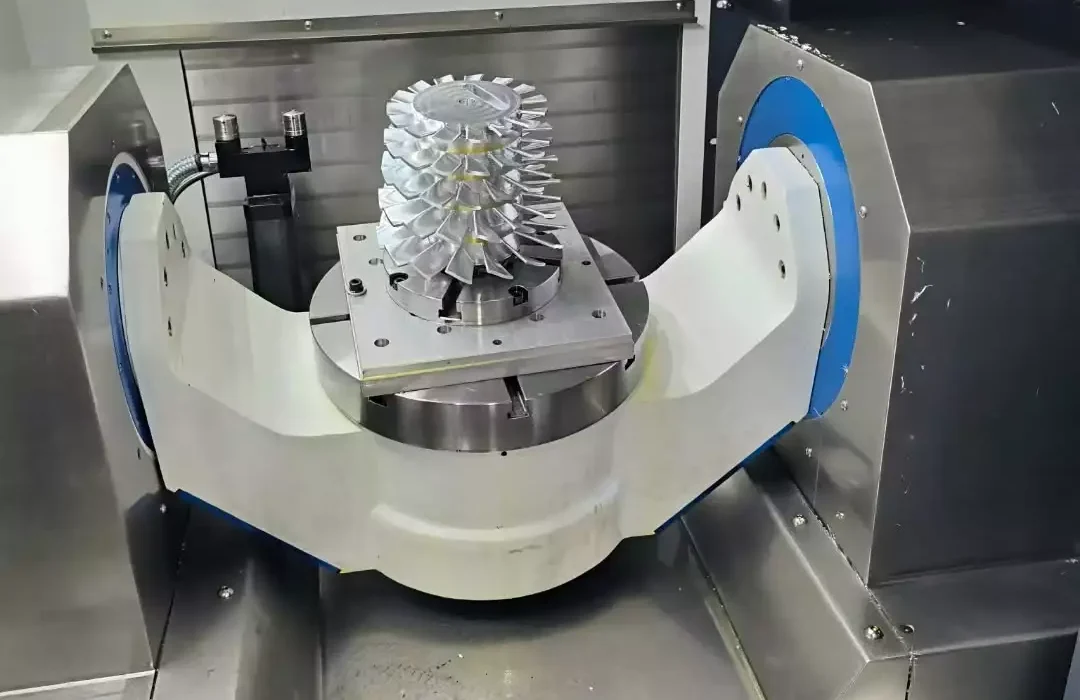
A reliable 5-axis CNC machining service does not simply add two movement dimensions; it fundamentally alters the kinematics of material removal to bypass traditional physical constraints:
- Done-in-One Multi-Sided Machining: A 5-axis machine manipulates the workpiece along three linear axes (X, Y, Z) and two rotational axes simultaneously. This allows the cutting tool to approach five sides of a component in a single setup. Eliminating setup changes removes alignment errors at the source, ensuring high dimensional consistency and tight concentricity.
- Constant Cutting Dynamics and Enhanced Surface Quality: Continuous 5-axis manipulation keeps the cutting tool at an optimal orientation relative to the workpiece surface. This allows engineers to utilize shorter, high-rigidity cutters that minimize vibration—even within deep cavities—resulting in exceptional surface roughness ($R_a$) control.
- Streamlined Process Flow and Faster Timelines: Reducing the need for complex custom fixtures and removing intermediate transfer steps compresses a multi-stage manufacturing sequence into a single, highly efficient operation. This directly translates to predictable lead times, accelerating your time-to-market.
What Can 5-Axis Machining Deliver? Specific Structural Capabilities
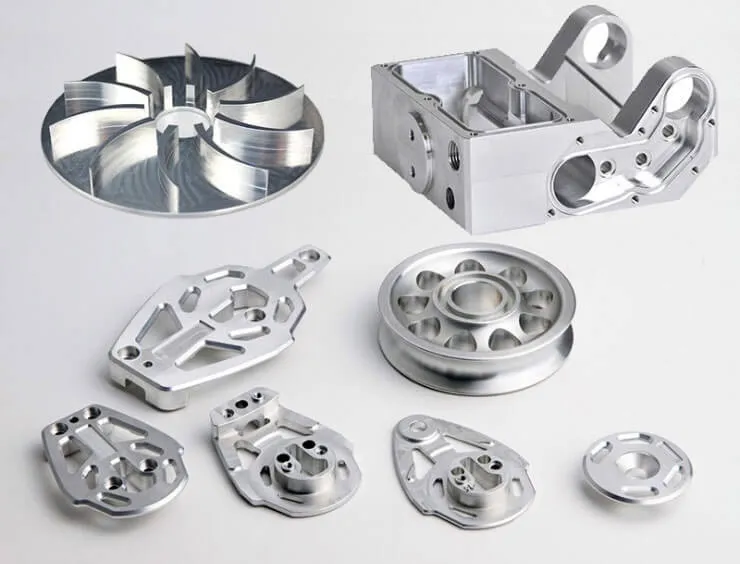
Simultaneous 5-axis machining is engineered for complex components where traditional methods struggle to maintain stability, dimensional integrity, or surface quality. It serves as a core production method across several demanding sectors:
1. Aerospace and Unmanned Aerial Vehicle (UAV) Systems
Components in this sector demand exceptional strength-to-weight ratios, often requiring thin-walled structures, deep pocketing, and aerodynamic contours.
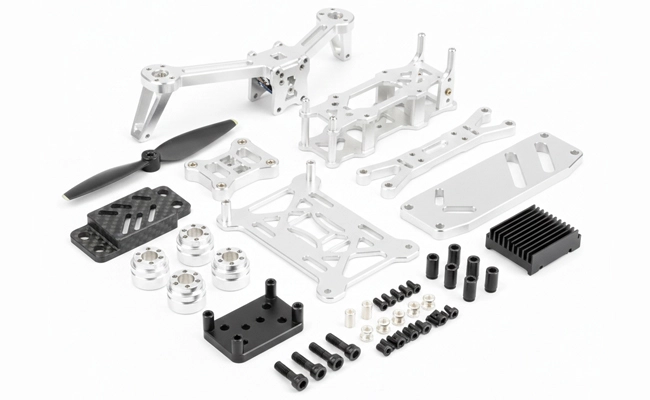
- Typical Components: UAV structural frames, integrated gimbal brackets, impellers, and variable-curvature guide vanes.
- Process Execution: By dynamically adjusting the tool path, 5-axis machining maintains consistent engagement even when milling walls thinner than 1.0 mm, preventing workpiece deformation caused by excessive cutting forces.
2. Medical Implants and Precision Surgical Instruments
The medical device sector mandates strict adherence to complex anatomical geometry, low surface roughness to prevent bio-contamination, and strict material constraints.
- Typical Components: Orthopedic joint replacements (such as knee and hip components), endoscopic instrument components, and specialized surgical guides.
- Process Execution: For organic, non-geometric surfaces, continuous 5-axis milling sweeps ball-nose cutters across complex contours smoothly. This yields a highly uniform finish that drastically reduces or eliminates manual polishing, bypassing the dimensional risks associated with hand-finishing.
3. Robotics and Industrial Automation Components
The positional accuracy of multi-axis robotic systems depends entirely on the geometric tolerances of their underlying structural and transmission components.
- Typical Components: Multi-axis robotic arm joints, high-reduction gearbox housings, specialized end effectors, and multi-faceted sensor mounts.
- Process Execution: Robotic joints typically feature multiple high-precision bearing bores and mounting faces positioned at distinct angles. 5-axis machining processes all features in a single setup, guaranteeing true position, perpendicularity, and co-axial alignment across all bores.
4. Hard Milling of Heat-Treated Materials
High-wear or heavy-load industrial components often utilize materials hardened above 50 HRC.
-
Process Execution: High-rigidity 5-axis centers equipped with advanced tool-path strategies and specialized coated tooling can machine hardened steels directly. This achieves high profile accuracy and serves as an efficient alternative to time-consuming Electrical Discharge Machining (EDM).
Robust Industrial Material Compatibility
To meet the physical and chemical performance standards of advanced engineering industries, our 5-axis systems regularly process a broad portfolio of materials:
- Lightweight, High-Strength Alloys: Aluminum alloys (such as 6061-T6 and 7075-T6, widely used in structural aerospace components and functional aluminum prototypes).
- High-Performance Metals: Titanium alloys (Ti-6Al-4V) and surgical-grade stainless steels (such as 316L and 17-4 PH), offering excellent tensile strength and corrosion resistance.
- Tool and Die Steels: Hot-work and cold-work steels like H13 and D2, processed post-heat treatment.
- Engineering Plastics: PEEK, POM (Delrin), and PTFE, for applications requiring high thermal resistance, electrical isolation, or low friction coefficients.
3-Axis, 3+2 Axis, and Continuous 5-Axis: Technical Comparison
To assist your engineering team in selecting the appropriate manufacturing routing, the table below outlines the functional boundaries of common CNC configurations:
| Technical Attribute | Traditional 3-Axis CNC | 3+2 Axis Indexing | Continuous 5-Axis CNC |
| Kinematic Principle | Tool moves strictly along linear X, Y, and Z axes. | Linear axes execute the cut while rotational axes index and lock the part between operations. | Three linear axes and two rotational axes move simultaneously during the cutting process. |
| Complex Surface Capability | Limited. Relies on closely spaced 3D tool paths with visible scallops, requiring extensive finishing. | Moderate. Excellent for prismatic parts with features oriented at multiple angles. | Superior. Tool continuously maintains optimal contact along complex, organic 3D contours. |
| Setup Frequency | High. Typically requires a unique fixture setup for every distinct face to be machined. | Low. Most multi-sided features can be reached within 1–2 indexing setups. | Minimal. Most complex geometries are completed entirely within a single setup. |
| Target Geometries | Flat profiles, vertical slots, and perpendicular bores. | Multi-sided valve bodies, electronic enclosures with inclined faces. | Aerodynamic impellers, orthopedic implants, deep undercuts, and organic surfaces. |
When Should Your Project Move to 5-Axis Machining?
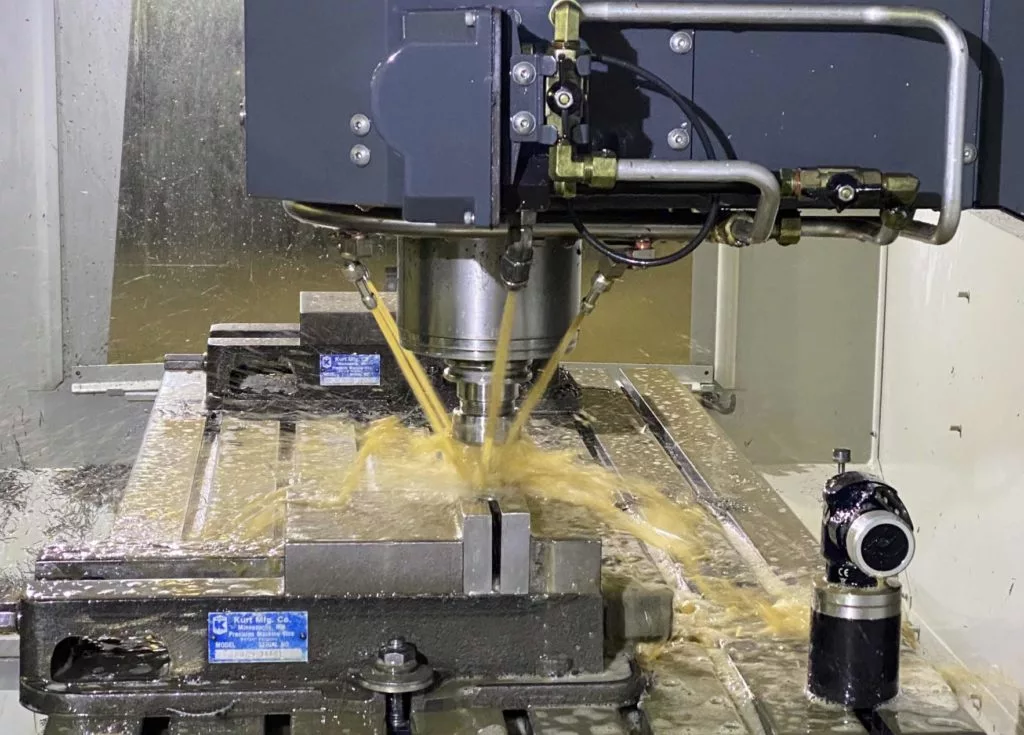
While not every custom part requires 5-axis processing, selecting it as your primary manufacturing routing yields clear cost and quality advantages when a design exhibits specific characteristics:
- Strict Geometric Relationships: When your print specifies tight true position, perpendicularity, or coaxiality requirements across multiple non-parallel faces.
- Complex Contours: When the component relies on free-form 3D surfaces where a uniform surface finish ($R_a$) is critical to part performance.
- Clearance and Interference Challenges: When a design features deep cavities or negative draft angles that would cause tool holder interference on a standard 3-axis machine without resorting to unstable, extra-long tooling.
- High-Value Raw Materials: When machining expensive or difficult materials (such as titanium or pre-hardened steels) where reducing human error during manual fixture transfers mitigates scrap risks.
Data-Driven Quality: Why Partner with Our 5-Axis CNC Service?
We understand that B2B procurement and product development rely on transparent engineering data rather than subjective claims. Our service centers on robust process controls designed to secure your production line:
- Engineering-Led DFM Analysis: Before your design hits the shop floor, our manufacturing engineers conduct an exhaustive Design for Manufacturability (DFM) review. We analyze tool clearances, optimize tolerance allocations, and plan exact tool entry paths to resolve manufacturing risks prior to machining.
- Verifiable Inspection Metrics: Our manufacturing flow couples advanced multi-axis machining with coordinate measuring machines (CMM). From First Article Inspection (FAI) to in-process dimensional audits and final delivery documentation, every critical dimension is backed by verifiable inspection data.
- Industry-Specific Competence: Having served the aerospace, unmanned systems, medical device, and robotics industries for years, we understand the specific quality standards, material behaviors, and documentation requirements unique to your field.
Quality discrepancies should not be the bottleneck that delays your product release. By opting for a technically grounded 5-axis CNC machining approach, you eliminate setup-induced errors, stabilize your component supply, and ensure that every delivered part aligns with your engineering drawings.
If you have a complex custom component or a new prototype project under review, send over your 3D CAD files (STEP/IGS format). Our engineering team will provide a comprehensive manufacturing analysis and technical feedback to support your project launch.