
What Is CNC Turning?
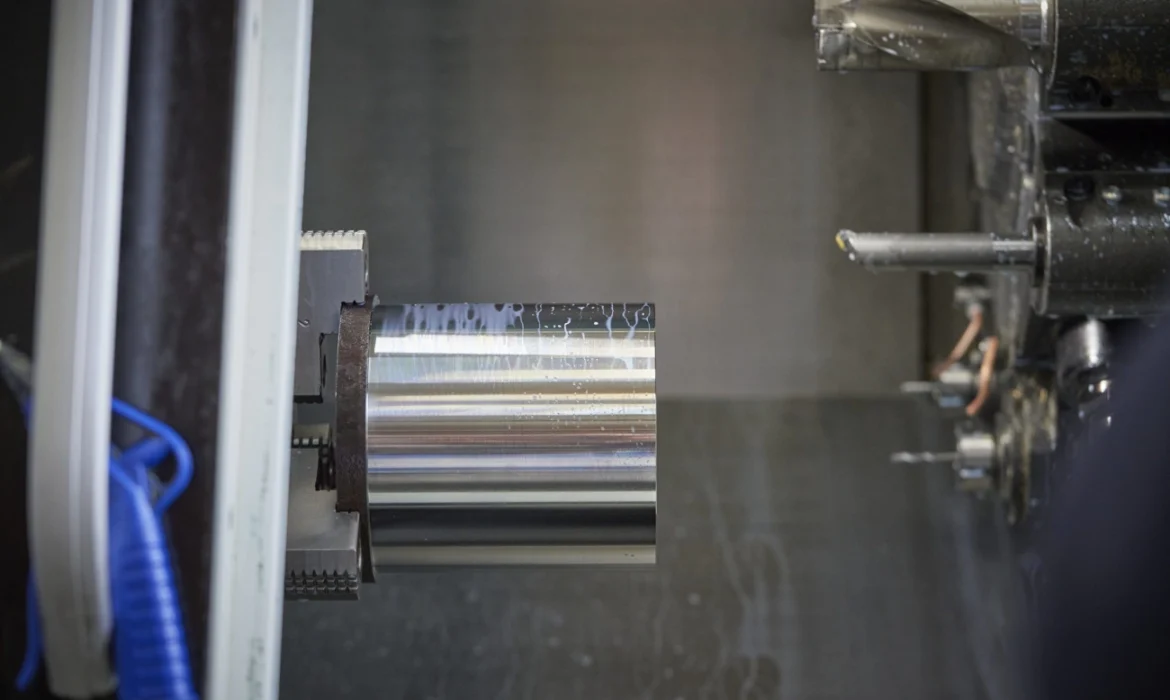
CNC turning is a subtractive manufacturing process where a rotating workpiece is shaped by a stationary cutting tool. Unlike milling, where the cutting tool moves around a fixed workpiece, turning spins the material, allowing the tool to remove material and create cylindrical parts such as shafts, bushings, and sleeves.
Key Differences: CNC Turning vs. CNC Milling
| Feature | CNC Turning | CNC Milling |
|---|---|---|
| Workpiece Movement | Rotates on spindle | Fixed in place |
| Cutting Tool Movement | Stationary or slightly moves | Moves around workpiece |
| Common Part Shapes | Cylindrical, round, conical | Flat, complex 3D shapes |
| Typical Operations | Turning, boring, threading | Drilling, slotting, contouring |
| Best for | Shafts, pins, rings | Blocks, plates, complex contours |
CNC turning excels at producing precise, symmetrical cylinders quickly, making it ideal for parts that require tight diameters and smooth surface finishes. It’s a core process in industries needing high-precision lathe work and custom CNC turning solutions.
How CNC Turning Works

CNC turning starts with designing the part using CAD (Computer-Aided Design) software. This model is then converted into a CNC program through CAM (Computer-Aided Manufacturing) software, which generates the G-code instructions. These instructions tell the machine exactly how to move and cut.
Next comes machine setup. The workpiece is securely held in place using a chuck or collet to ensure stability. Selecting the right cutting tools is crucial—they vary based on material and operation. Proper spindle alignment is also checked to avoid any runout that could affect precision.
During the machining cycle, the spindle rotates the workpiece at high speed while the stationary cutting tool feeds along it to remove material. Coolant is applied throughout to keep both the tool and workpiece cool, improving tool life and surface finish.
After machining, detailed quality control checks are performed. This includes dimensional inspections using micrometers, calipers, or coordinate measuring machines (CMM) to ensure the part meets tight CNC turning tolerances. Surface finish and thread quality are also verified as part of the process.
For a reliable partner in precision CNC turning and related services, consider MS Machining’s expert team and advanced equipment offering full support from programming to quality assurance. You can learn more about our precision CNC machining services on our CNC precision machining services page.
Common CNC Turning Operations
CNC turning covers a wide range of machining tasks that shape and finish cylindrical parts with precision. Here are the most common operations:
- External Turning: Removing material from the outside diameter to create smooth, round surfaces or specific profiles.
- Internal Turning (Boring): Enlarging or finishing holes inside a workpiece to tight tolerances.
- Threading: Cutting both external and internal threads with high accuracy for screws, bolts, and threaded fittings.
- Knurling: Creating patterned textures on a surface to improve grip or aesthetics.
- Grooving and Parting: Cutting narrow grooves or completely separating a part from the stock material.
- Drilling, Reaming, and Tapping: Adding precise holes, improving hole quality, and cutting internal threads directly on the lathe.
- Live Tooling Applications: Using rotating tools like milling cutters or cross-drills during turning, enabling complex features without moving the workpiece off the lathe.
These operations allow for versatile custom CNC turning that meets strict requirements across industries. Advanced capabilities, like live tooling, enable MS Machining to handle complex geometries efficiently while maintaining accuracy. For challenging tasks such as precision grooves for high-speed applications, exploring our detailed spiral groove bearing guide can provide valuable insights on specialized turning operations.
Types of CNC Turning Machines
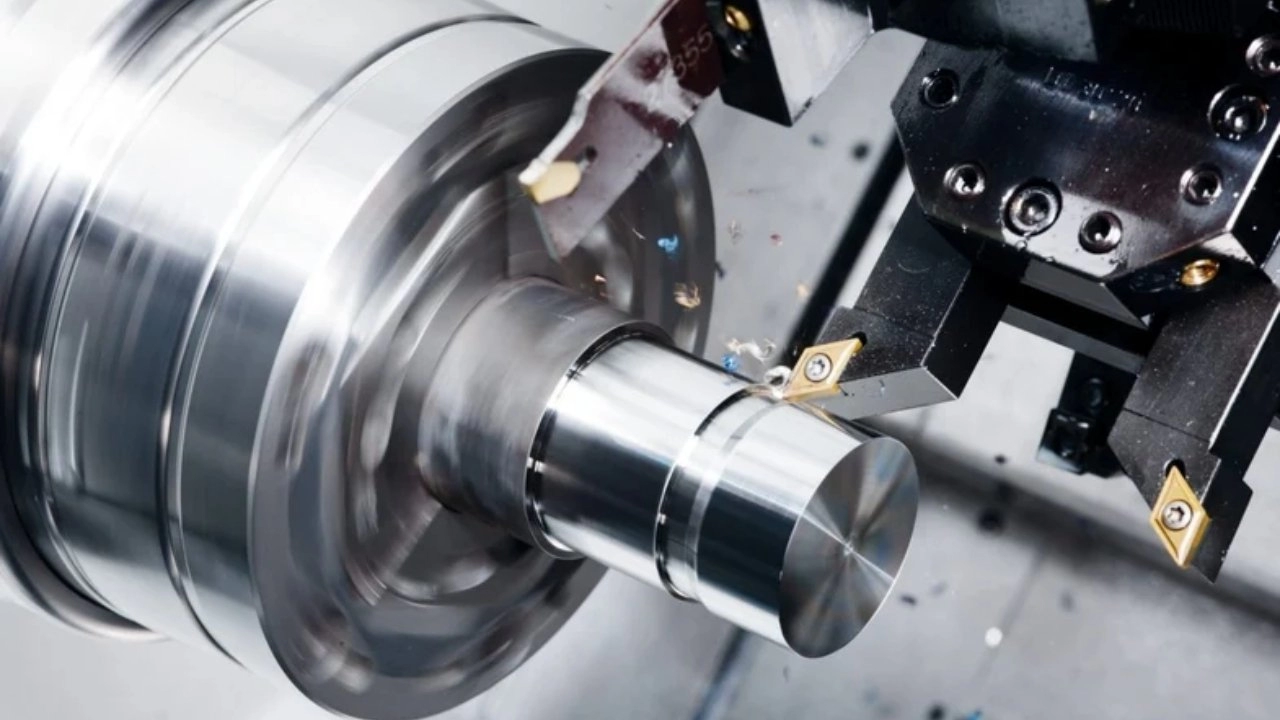
CNC turning machines come in several types based on complexity and capability:
-
2-axis CNC lathes: The most common type, featuring a rotating spindle and a single linear tool axis. Ideal for basic cylindrical parts with simple contours.
-
Multi-axis turning centers (3-5 axes): These machines add additional axes for complex geometries, enabling simultaneous milling, drilling, and contouring on turned parts. They offer greater flexibility and reduce secondary operations.
-
Swiss-type CNC lathes: Designed for small, high-precision parts, Swiss-type lathes use a sliding headstock and guide bushing to control slender parts much better than traditional lathes. Common in medical and electronics industries.
-
Vertical vs. horizontal turning centers: Horizontal lathes are standard for most parts, allowing easy chip evacuation. Vertical turning centers are often used for large, heavy, or odd-shaped components that benefit from gravity in workholding.
-
Live tooling and dual spindle setups: Live tooling allows for milling, drilling, or tapping on the lathe without moving the part to another machine, improving efficiency. Dual spindles enable simultaneous machining of two parts or both ends of a part, speeding up production.
Choosing the right CNC turning machine depends on part complexity, size, tolerance, and production volume. For complex, multi-featured parts, multi-axis turning centers or machines with live tooling are essential.
For CNC milling operations complementing your turned parts, consider our precision CNC milling services to optimize your production workflow.
Materials Commonly Used in CNC Turning

CNC turning works with a wide range of materials, each chosen based on the part’s purpose and performance needs. Metals are the most common, including aluminum, stainless steel, titanium, brass, and carbon steel. These metals vary in strength, corrosion resistance, and machinability, allowing for precise control over the part’s durability and finish.
Plastics like ABS, nylon, and POM are popular for lighter-duty or insulating parts, offering good machinability and cost-effectiveness. Additionally, exotic alloys and composites come into play when specialized properties like extreme heat resistance or added strength are critical.
When selecting materials for CNC turning, consider:
- Strength requirements: How much load or stress the part must endure
- Corrosion resistance: Especially important for aerospace or medical components
- Machinability: Materials that allow faster machining with less tool wear save time and cost
Choosing the right material upfront ensures your turned parts meet performance standards and budget needs without sacrificing quality. For specialized applications, such as aerospace components, exploring specific CNC turning machining guidelines can be valuable; see our details on CNC aerospace machining for more insight.
Advantages of CNC Turning
CNC turning offers high precision and repeatability, delivering parts with tight tolerances that meet exact specifications every time. This consistency is crucial for industries like aerospace and medical devices where accuracy matters. You also get excellent surface finishes, which reduce the need for extra polishing or finishing work.
Another big advantage is the speed of production. CNC turning handles both prototypes and large-volume runs efficiently, helping you get parts faster without sacrificing quality. It’s also cost-effective, cutting down on material waste thanks to its precise subtractive process.
With CNC turning, there’s less operator intervention, which means fewer chances for human error and improved workplace safety. Automation keeps the cutting process controlled and consistent, boosting both productivity and reliability. These benefits make CNC turning a smart choice for a wide range of machined parts.
Applications and Industries for CNC Turning
CNC turning plays a crucial role across a wide range of industries due to its precision and versatility. In aerospace, CNC turned parts like shafts, bushings, and fittings are essential for maintaining strict safety and performance standards. The automotive sector relies heavily on CNC turning for engine components, gears, and custom fittings that demand tight tolerances and durability.
Medical device manufacturing benefits greatly from precision CNC turning, producing implants and surgical instruments with exacting standards. This is supported by advanced metal CNC machining techniques tailored for biocompatible materials. The oil and gas industry uses CNC turned parts for valves and connectors that withstand harsh environments. Electronics and consumer products also depend on CNC turning for small, complex components requiring high repeatability.
Real-world case studies show how custom CNC turning has helped companies reduce lead times and improve product quality across these sectors. For detailed examples in medical manufacturing, MS Machining’s expertise in medical devices offers insights into how precision turning supports advanced healthcare solutions.
Explore how CNC turning applies to medical manufacturing devices and equipment for a closer look at its impact in healthcare.
CNC Turning vs Other Processes
When deciding on the best manufacturing method, it’s important to compare CNC turning with alternatives like CNC milling, 3D printing, and manual turning. Each process has its strengths depending on the part requirements and production goals.
| Process | Strengths | Best For | Limitations |
|---|---|---|---|
| CNC Turning | Great for cylindrical parts, high precision, fast cycles | Shafts, bushings, threaded parts | Limited to mostly round profiles |
| CNC Milling | Versatile shapes, complex surfaces | Flat/complex geometries, pockets | Slightly longer cycle times |
| 3D Printing | Rapid prototyping, complex internal features | Prototypes, low volume parts | Lower strength, surface finish |
| Manual Turning | Low cost for one-offs, simple setups | Prototyping or repairs | Lower precision, slower |
When to Choose CNC Turning
- You need high-precision cylindrical parts with tight tolerances.
- Fast, repeatable production of round or symmetrical shapes is required.
- The part calls for threading, grooving, or knurling operations.
- You want to reduce manual labor and improve consistency and safety.
Hybrid Machining for Best Results
Sometimes a combination of processes works best—for example:
- Use CNC turning for the main cylindrical features.
- Switch to CNC milling or live tooling on advanced lathes for flats, holes, or cross-drilling.
- Employ 3D printing for early prototypes before scaling up to subtractive methods.
This hybrid approach maximizes efficiency, quality, and cost-effectiveness.
For more details on precision metal part production using subtractive methods, check out our CNC metal machining services.
Choosing the Right CNC Turning Partner
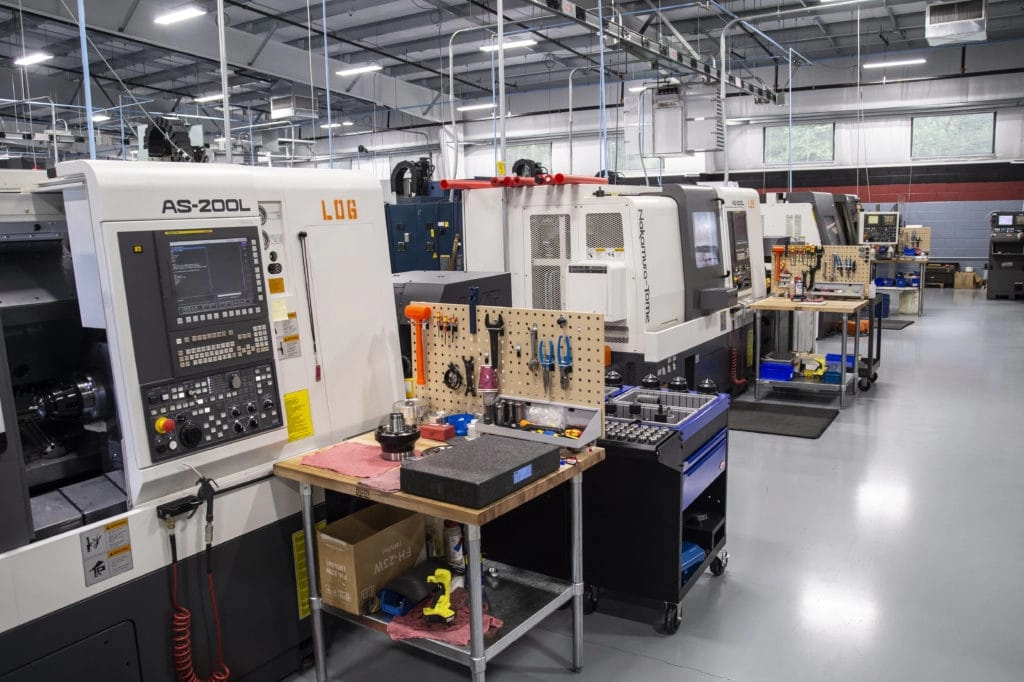
Picking the right CNC turning partner is key to getting the parts you need on time and within spec. When evaluating suppliers, focus on these critical factors:
- Equipment: Look for companies with modern, well-maintained CNC turning machines, including live tooling and multi-axis capabilities. This ensures they can handle complex geometries and tight tolerances.
- Tolerances: Verify their ability to hold the precision you require—especially important for aerospace, medical, and automotive parts.
- Lead Times: Fast turnaround can make or break your production schedule. Choose a partner known for reliability and meeting deadlines.
- Certifications: ISO and other industry certifications show a commitment to quality and consistent processes.
MS Machining stands out as a top-tier CNC turning manufacturer because of its state-of-the-art facilities and a highly experienced team committed to quality. Our ISO-certified processes guarantee precision and repeatability for every job. Whether you need prototypes or large-volume production, our custom CNC turning services adapt to your project demands with quick delivery and expert support.
By choosing MS Machining, you get a trusted CNC turning supplier who values clear communication, on-time delivery, and parts that meet or exceed your expectations. For more on our machining capabilities, check out our precision aluminum CNC machining parts and how we incorporate innovative manufacturing methods.
MS Machining’s CNC Turning Services
At MS Machining, we offer full-service CNC turning solutions, guiding you from initial design consultation all the way to finished precision parts. Whether your project involves simple cylinders or complex geometries, our advanced CNC lathe services can handle it with tight tolerances and excellent surface finishes.
Our capabilities include live tooling and custom lathe setups, allowing for milling, drilling, and other operations within the same turning cycle, which reduces production time and costs. We’re committed to delivering quality parts quickly, meeting your tight deadlines without cutting corners.
Explore our precision CNC turning services to see how we help customers in aerospace, automotive, and medical industries achieve reliable results. Real-world case studies demonstrate our ability to tackle challenging specifications and optimize manufacturing efficiency for every job.
Tips for Optimizing CNC Turned Parts
Getting the best results from precision CNC turning starts with smart design and planning. Here are some key tips to optimize your CNC turned parts:
-
Design for Manufacturability
Avoid complicated features like undercuts that increase machine time and cost. Instead, use simple radii and smooth transitions on edges to boost tool life and surface finish quality. This also helps reduce tool wear and keeps production efficient.
-
Set Realistic Tolerances
Specify tolerances based on function—tighter only where absolutely necessary. Overly tight tolerances can slow down machining and raise costs unnecessarily. Work with your CNC turning supplier to balance precision and cost-effectiveness.
-
Consider Surface Finish Requirements
Define surface finish needs early. High polish or fine finishes require specific tooling and machining parameters that impact cycle time. Communicate these clearly to get the perfect balance between quality and efficiency.
-
Prototyping Before Production
Use prototyping to catch potential issues ahead of large-scale runs. This can help refine designs, validate tolerances, and troubleshoot machining challenges. Prototypes reduce waste and ensure your parts meet specifications from the start.
-
Leverage CAD/CAM Collaboration
Share detailed CAD files with your CNC turning manufacturer so they can optimize the toolpaths and machining strategies. This collaboration helps avoid surprises and delivers parts faster with higher quality.
Following these tips can save time, reduce costs, and improve the quality of your turned parts. For detailed guidance on machining steel components with tight tolerances, check out our steel CNC machining services to see how we help clients optimize their designs for manufacturing success.
FAQs on CNC Turning
What tolerances can CNC turning achieve?
CNC turning can reach high precision with typical tolerances as tight as ±0.001 inches (±0.025 mm), depending on the material and part complexity. This makes it ideal for parts requiring consistent accuracy and repeatability.
How does CNC turning differ from manual lathe work?
| Aspect | CNC Turning | Manual Lathe |
|——————–|—————————|—————————-|
| Precision | High, consistent | Depends on operator skill |
| Repeatability | Excellent | Limited |
| Speed | Faster with automation | Slower, manual effort |
| Complexity | Handles complex geometries| Limited to simple shapes |
| Operator involvement | Low after setup | High, constant monitoring |
Which industries benefit most from CNC turning?
CNC turning is widely used across aerospace, automotive, medical devices, oil & gas, and electronics industries—anywhere precision metal or plastic parts are critical for performance and safety.
How do I start with MS Machining’s CNC turning services?
- Contact MS Machining for a design consultation
- Share your CAD files or part specs
- Get a quote and lead time estimate
- Approve prototypes if needed
- Begin production with ongoing quality checks
Our team guides you from start to finish, ensuring precision and quick turnaround. Learn more about our capabilities on our CNC machining services page.
For specialized parts or fast prototypes, MS Machining offers custom CNC turning tailored to your exact needs with industry-leading quality standards.