
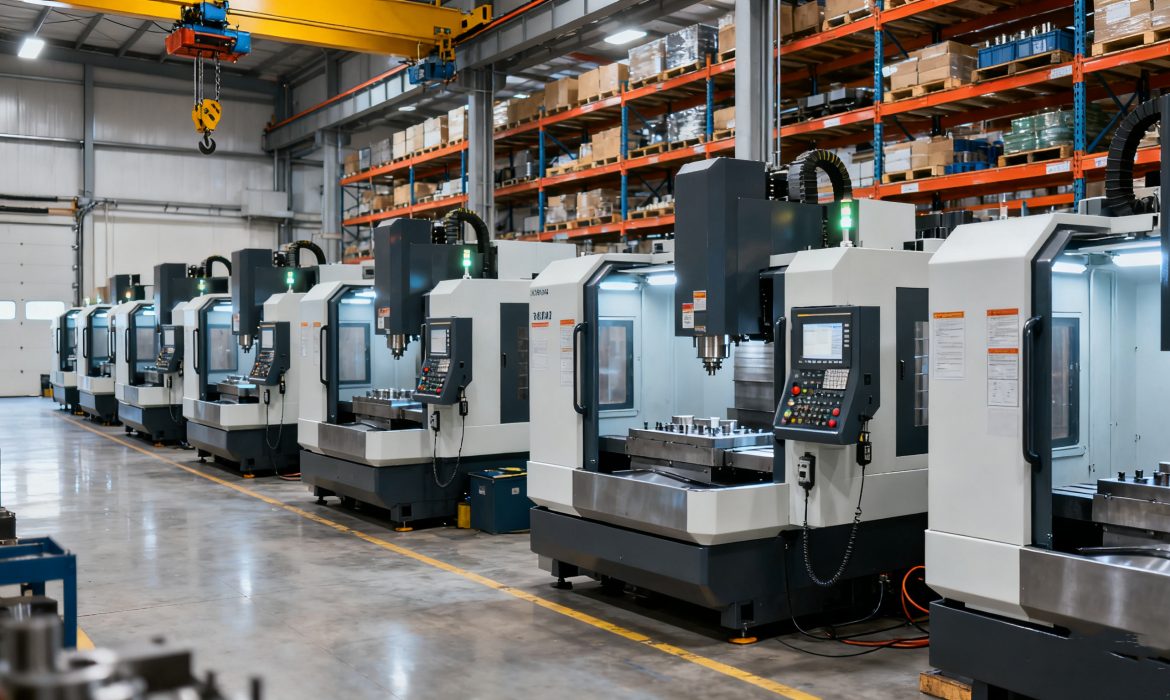
CNC milling machines are the backbone of modern manufacturing, powering over 65% of all metal removal processes worldwide today. But what exactly is a CNC milling machine, and why is it such a game-changer in 2025? Simply put, it’s a highly precise, computer-controlled tool that carves complex shapes from metal and other materials with unmatched speed and consistency. From humble beginnings as basic numeric control (NC) machines, CNC milling has evolved into advanced 5-axis and hybrid systems that redefine what’s possible on the shop floor. Whether you’re a manufacturing professional, engineer, or just curious, this guide breaks down the key features, benefits, and the remarkable ways CNC milling is transforming modern manufacturing—with insights grounded in today’s latest technology and practices. At MS Machining, we live and breathe CNC milling every day, running one of the most advanced fleets of machines in the industry, so let’s dive into what makes this technology indispensable in 2025 and beyond.
How CNC Milling Works – The Core Process Explained
CNC milling is a subtractive manufacturing process where a rotating cutting tool removes material from a workpiece to create the desired shape. Unlike turning, which spins the part against a stationary tool to cut cylindrical shapes, milling moves the tool around the fixed workpiece, allowing for more complex geometries.
CNC Milling vs CNC Turning
| Feature | CNC Milling | CNC Turning |
|---|---|---|
| Movement | Tool moves around a fixed part | Part rotates against fixed tool |
| Typical parts | Complex shapes, flat surfaces | Cylindrical, round parts |
| Axes | Usually 3-5 axes or more | Typically 2 axes |
| Complexity | High complexity and detail | Simpler, mostly rotational |
| Common industries | Aerospace, automotive, electronics | Shafts, pistons, bolts |
Step-by-Step CNC Milling Process
CAD (Computer-Aided Design)
Create a 3D model of the part using CAD software (SolidWorks, AutoCAD).
CAM (Computer-Aided Manufacturing)
Generate toolpaths and machining strategies in CAM software (Mastercam, Fusion 360).
G-code Programming
Translate CAM data into G-code, the language the CNC machine understands.
Machine Execution
Load the G-code into the CNC mill, which automatically controls cutting movement.
Subtractive vs Additive Manufacturing Comparison
| Aspect | Subtractive (CNC Milling) | Additive (3D Printing) |
|---|---|---|
| Process | Removes material | Adds material layer by layer |
| Materials | Metals, plastics, composites | Plastics, metals, resins |
| Precision | High (±0.0002″) | Lower, depends on tech |
| Surface Finish | Smooth, often requires less post-processing | May need sanding or finishing |
| Production Time | Faster for metal parts | Slower for high-volume production |
| Waste | Material waste generated | Minimal waste |
Understanding this core process is key to appreciating CNC milling’s role in modern manufacturing—offering precision, flexibility, and high repeatability for diverse applications.
Types of CNC Milling Machines Available in 2025
CNC milling machines come in various types, each suited for different precision, complexity, and production needs. In 2025, the main categories include:
3-Axis vs 4-Axis vs 5-Axis CNC Milling
- 3-Axis: The most common and budget-friendly, perfect for standard 2D and some 3D machining. Cost ranges from $60,000 to $120,000 for entry-level models.
- 4-Axis: Adds rotation on the X-axis, allowing more complex shapes like angled cuts. Ideal for medium complexity parts. Slightly higher cost, often $100,000+.
- 5-Axis: Moves on three linear axes plus two rotational axes, enabling ultra-complex geometries and undercuts in a single setup. This reduces time and improves accuracy but comes with a price tag from $250,000 up to $800,000 or more. Check out advanced 5-axis CNC milling services for high-end capabilities.
Vertical Machining Centers (VMC) vs Horizontal Machining Centers (HMC)
- VMCs: Spindle is vertical, ideal for smaller parts and straightforward operations like drilling and milling. Most flexible and common in shops.
- HMCs: Horizontal spindle orientation, better for heavier, larger parts and high-volume production because of faster chip evacuation and easier tool access.
Bed Mills, Turret Mills, Gantry/Bridge Mills
- Bed Mills: The worktable moves only on one axis; the spindle moves vertically. Good for large, heavy parts.
- Turret Mills: More versatile with the spindle moving vertically and the table moving in both X and Y axes.
- Gantry/Bridge Mills: Large-scale, heavy-duty mills designed for massive parts such as aerospace and automotive frames.
Desktop and Benchtop CNC Mills
Smaller-scale options for prototyping and educational use, benchtop CNC mills provide flexibility and precision for low-volume work or R&D. They are perfect for startups or design teams testing new concepts.
New Trends in CNC Milling Machines
The industry is seeing growth in hybrid machining systems, combining additive (3D printing) and subtractive (milling) processes to minimize waste and reduce lead times. Moreover, 6+ axis systems are emerging, offering unmatched freedom of movement for even more complex and intricate parts.
If you’re exploring multi-axis capabilities, 4-axis CNC machining services can offer a middle ground between cost and complexity for advanced precision parts.
In , choosing the right CNC milling machine depends on your part requirements, production volume, and budget—whether it’s a simple 3-axis vertical mill or a cutting-edge 5-axis system with Industry 4.0 integration.
Key Features of Modern CNC Milling Machines
Modern CNC milling machines are packed with features that boost precision, speed, and efficiency. Here’s what sets them apart today:
- High-Speed Spindles: Speeds range from 20,000 to 60,000 RPM, enabling faster cutting and smoother finishes.
- Rigid Construction: Solid frames reduce vibration and improve accuracy, essential for tight tolerances.
| Feature | Description | Benefit |
|---|---|---|
| Linear Guides | Smooth, low-friction motion | Higher precision & speed |
| Box Ways | Heavier, more durable | Better rigidity |
| Automatic Tool Changers (ATC) | Rapid swapping between multiple tools | Reduces downtime |
| Pallet Changers | Quick workpiece exchange | Increases throughput |
| Advanced Control Systems | Brands like Fanuc, Siemens, Heidenhain, Haas NGC | Reliable, user-friendly programming and monitoring |
| Probing & Tool Setters | In-process measurement and tool calibration | Maintains accuracy on the fly |
| Cooling & Chip Management | Innovative coolant delivery, chip evacuation | Extends tool life, keeps parts clean |
| IoT Connectivity & Industry 4.0 Integration | Data-driven monitoring & predictive maintenance | Less downtime, smarter repairs |
These systems also support in-process measurement with probing and tool setters, ensuring consistent quality without stopping the machine. Modern cooling techniques and chip management keep operations running smoothly to protect parts and tools.
With Industry 4.0 integration, many CNC mills connect to networks for real-time monitoring, predictive maintenance, and automated alerts—key for lights-out manufacturing.
For machining complex aerospace components or other precision parts, having such a feature-rich CNC milling machine is a game changer. You can explore precision capabilities and machining services in more detail at precision CNC milling services.
Benefits & Advantages of CNC Milling (Why Manufacturers Switch)
CNC milling offers clear benefits that explain why more manufacturers rely on it today:
- Precision & Repeatability: Achieve tight tolerances down to ±0.0002″ (5 µm), ensuring every part matches the design exactly.
- Labor & Time Savings: Automated machining cuts setup and runtime drastically, freeing staff for other tasks.
- Complex Geometries: CNC mills can create shapes and details impossible with manual methods.
- Material Versatility: Easily machine metals, plastics, composites, and exotic materials without special setups.
- Scalability: From one-off prototypes to millions of parts, CNC milling adapts seamlessly.
- Sustainability: Less waste and optimized material use improve environmental impact.
| Benefit | What It Means for Manufacturers |
|---|---|
| Precision & Repeatability | Consistent quality across all production runs |
| Labor & Time Savings | Faster turnaround with fewer hands-on hours |
| Complex Shapes | Freedom to design innovative products |
| Material Variety | Flexibility to work with diverse materials |
| Scalability | Smooth growth from prototype to large volumes |
| Sustainability | Reduced scrap improves cost-effectiveness and eco goals |
By switching to CNC milling, businesses not only improve their production quality but also enhance overall efficiency and sustainability. This makes CNC milling a vital tool in modern manufacturing workflows.
For additional insight into machining processes and material handling benefits, check our detailed comparison on plastic injection molding vs CNC machining.
How CNC Milling Is Transforming Modern Manufacturing in 2025
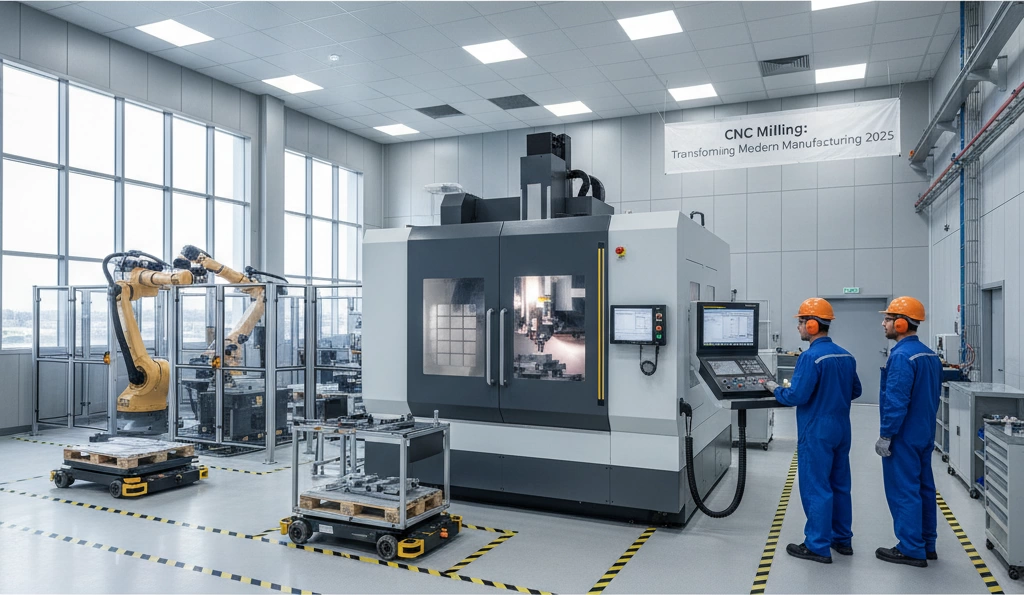
CNC milling machines are reshaping industries by enabling precision, complexity, and speed that traditional methods just can’t match. In aerospace, CNC milling allows for the production of monolithic parts—single-piece components that reduce weight and improve the buy-to-fly ratio, making aircraft lighter and more fuel-efficient. This advance helps manufacturers meet strict industry standards while cutting costs. You can see how this plays out in specialized production at MS Machining’s aerospace components division.
In the medical field, CNC milling produces custom implants and surgical instruments tailored to individual patient needs. This precision ensures better outcomes and faster recoveries, with materials and geometries impossible to achieve manually.
The rise of electric vehicles depends heavily on CNC milling for battery housings and structural parts that demand tight tolerances and durability. For insights into this rapid growth, check out the technologies supporting electric vehicle battery manufacturing.
CNC milling also plays a crucial role in defense and firearms, providing intricate parts with high repeatability, and in consumer electronics, where heat sinks and protective enclosures require complex machining to dissipate heat efficiently while maintaining sleek designs.
Beyond part production, CNC milling is a backbone of the move toward lights-out manufacturing—fully automated processes requiring minimal human intervention. Coupled with digital twin technology, manufacturers can simulate machining processes, optimize tool paths, and run predictive maintenance, all boosting uptime and reducing costs.
A real-world example from MS Machining shows how integrating 5-axis CNC milling with digital twins cut cycle times by 30% while improving part accuracy, demonstrating how this tech is not just hype but a practical game-changer for production lines in 2025.
CNC Milling vs CNC Turning vs Swiss Machining – When to Choose What
Choosing between CNC milling, CNC turning, and Swiss machining depends on your part’s shape, precision needs, batch size, and complexity. Here’s a quick breakdown to help you decide:
| Feature | CNC Milling | CNC Turning | Swiss Machining |
|---|---|---|---|
| Axes | 3 to 5+ axes (multi-directional) | Mainly 2 axes (rotational + longitudinal) | 6+ axes (high precision, complex parts) |
| Part Shape | Complex 3D shapes, pockets, contours | Cylindrical, round, simple profiles | Small, intricate, slender parts like pins, connectors |
| Batch Size | Prototypes to high volume | Medium to high volume | Small to medium volume, often for precise, tiny parts |
| Tolerance | ±0.0002″ (5 µm) precision | ±0.0004″ to ±0.001″ | Very tight, up to ±0.0001″ (2.5 µm) |
| Material Types | Metals, plastics, composites | Mostly metals (bars, rods) | Metals and plastics requiring tight tolerances |
| Cost Range | Moderate to high (varies by axes) | Lower for basic turning, higher for multi-task machines | Higher due to complexity and precision |
| Best Use Case | Complex parts with multiple faces and cavities | Round parts like shafts, bushings | Medical devices, electronics components, watch parts |
When to choose:
- CNC Milling is ideal when your parts require multi-axis machining for complicated shapes and surfaces.
- CNC Turning fits perfectly if your parts are mainly round or cylindrical and need fast, cost-effective production.
- Swiss Machining is your go-to for tiny, intricate parts requiring extreme precision, especially in medical or electronics fields.
For a deeper dive into precision and complex part manufacturing, explore our detailed precision CNC machining services to see how the right process can boost your production quality and efficiency.
Cost Considerations & ROI in 2025
When investing in a CNC milling machine, understanding the cost breakdown and calculating return on investment (ROI) is key. Entry-level 3-axis CNC mills typically range from $60,000 to $120,000, making them accessible for startups and prototyping. On the other hand, high-end 5-axis production machines can cost anywhere between $250,000 and $800,000+, reflecting their advanced capabilities and precision.
Beyond the sticker price, be aware of hidden costs such as setup, tooling, software licenses, maintenance, and operator training. However, these expenses often pay off through long-term savings like reduced labor costs, higher throughput, less material waste, and improved part quality. Using a hidden costs vs. savings calculator can help quantify your expected ROI before purchase.
Additionally, many buyers take advantage of financing options and government incentives such as Section 179 tax deductions in the U.S., which allow for accelerated depreciation and immediate write-offs, significantly lowering the upfront financial burden.
Smart budgeting and understanding these factors ensures that your CNC milling investment aligns with your manufacturing goals and financial forecasts in 2025. For a deeper dive into machining cost dynamics, also explore how CNC compares with other processes like wire EDM on MS Machining’s wire EDM vs traditional machining.
Choosing the Right CNC Milling Partner in 2025
Picking the right CNC milling partner can make or break your project’s success. Here are some key questions to ask your machining supplier before committing:
- Experience & Certifications: Do they have a proven track record with certifications like AS9100 and ISO 9001?
- Machine Capabilities: What types of CNC mills do they operate (3-, 4-, 5-axis), and do they support advanced features like lights-out machining?
- Quality Control: How do they ensure precision and repeatability? Do they use in-process probing and measurement?
- Material Expertise: Can they handle your specific material needs, including exotic metals or composites?
- Lead Times & Scalability: Are they equipped to scale from prototype to production runs efficiently?
- Technology Integration: Do they leverage Industry 4.0 tools, IoT connectivity, or digital twins for predictive maintenance and quality control?
At MS Machining, we bring over 20 years of CNC milling expertise to the table. With over 50 advanced CNC mills covering 3-, 4-, and 5-axis machining, plus lights-out manufacturing capability, we deliver precision parts that meet the highest industry standards. Our commitment to quality is backed by AS9100 and ISO 9001 certifications, making us a trusted partner for aerospace, medical, automotive, and more.
For more details on how we handle complex materials, check out our special CNC machining processes and our expertise in CNC titanium machining services. Choosing the right partner can transform your manufacturing workflow—and with MS Machining, you’re in great hands.