What Is CNC Machining? A Quick Overview
CNC stands for Computer Numerical Control, and it plays a huge role in modern manufacturing. Simply put, CNC machining is a process where computers control machine tools like mills, lathes, and routers to cut and shape materials into precise parts. Unlike manual machining, where an operator moves the tools by hand, CNC uses programmed instructions to guide the machine automatically.
This process is subtractive, meaning it starts with a solid block of material—like metal, plastic, or wood—and removes material bit by bit to create the final part. The subtractive nature of CNC machining provides major benefits:
- Higher precision and repeatability compared to manual work
- Faster production with less human error
- Ability to create complex shapes that would be tough or impossible by hand
- Improved surface finish and tighter tolerances, key for high-quality parts
In short, CNC machining streamlines production, delivering consistent, accurate parts at scale, which is why it’s so widely used across automotive, aerospace, medical, and many other industries.
Key Components That Move in CNC Machines
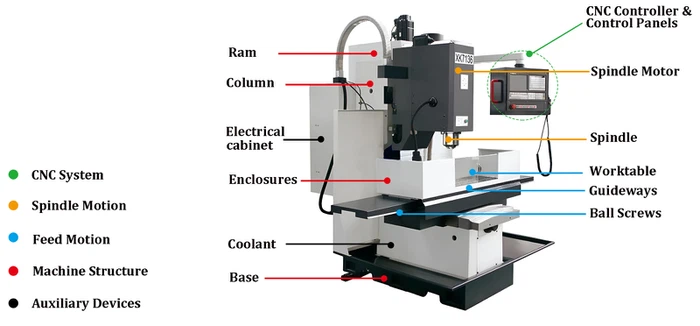
In CNC machining, motion is everything. The core idea is relative movement—either the tool moves, the workpiece moves, or both, to shape the part precisely. One of the primary moving components is the spindle, which rotates the cutting tool at high speeds to remove material efficiently.
Next, there’s the worktable, which usually moves linearly along the X and Y axes, allowing the tool to cut across the surface horizontally. The tool head or gantry often moves vertically along the Z axis, controlling the depth of the cut. Together, these three linear axes—X, Y, and Z—create the basic framework for most CNC machines.
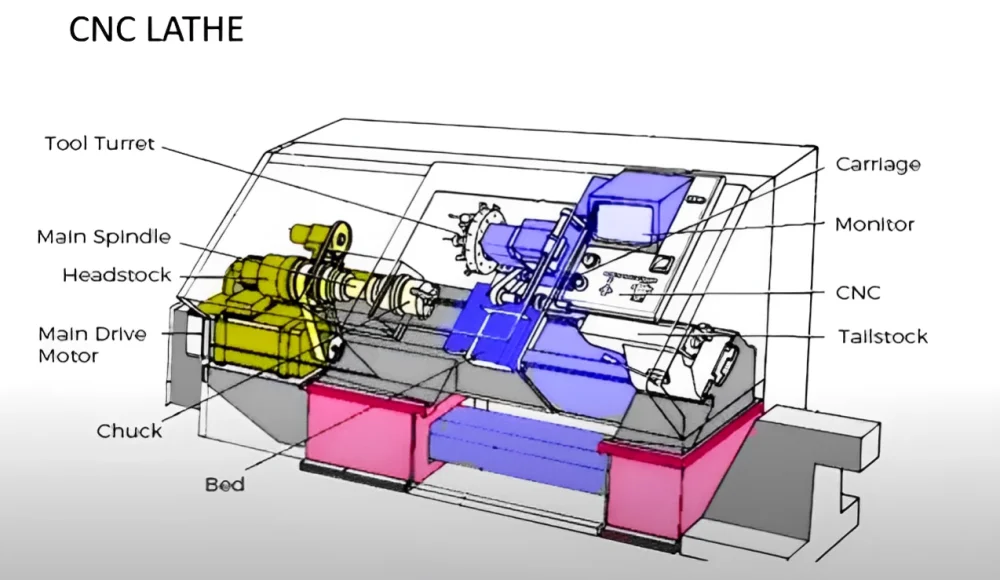
More advanced machines also include rotary axes, especially in CNC lathes and multi-axis mills. For example, lathes feature a spinning workpiece while the tool moves linearly to shape it. Five-axis machines add rotations around the X, Y, or Z axes for complex contours.
Understanding these moving parts—the spindle’s rotation, the worktable’s linear motion, tool head movements, and extra rotary axes—is key to grasping how CNC machining achieves high precision and versatility. If you want to dig deeper into how milling machines manage these motions, check out this detailed guide on CNC milling machines.
How Motion Works in Different CNC Machine Types

CNC machines move differently depending on their type and purpose. Here’s a quick breakdown:
| Machine Type | Moving Components | Motion Description |
|---|---|---|
| CNC Mills | Tool spindle, worktable (X, Y axes) | The spindle rotates the cutting tool while the worktable moves linearly along X and Y axes to shape the part. Z-axis movement adjusts tool depth. |
| CNC Lathes | Rotating workpiece, linear tool head | The workpiece spins on the spindle while a tool moves linearly (usually on Z and sometimes X axes) to cut the material. Rotary motion is on the part itself. |
| 4-Axis Machines | Adds rotary axis to X, Y, Z | Besides linear X, Y, Z movements, a rotary axis lets the part or tool rotate for more complex shapes. Useful for angled cuts or drilling. |
| 5-Axis Machines | Two rotary axes plus X, Y, Z | Adds two rotary axes allowing the tool or part to move in multiple directions, enabling intricate, precise cuts without repositioning the workpiece. |
Motion Control Components
- Servo Motors: These provide precise control over movement in all axes, ensuring accuracy and speed.
- Ball Screws & Linear Guides: Convert rotary motion from motors into smooth, accurate linear movement with minimal backlash.
- Feedback Systems: Sensors track position and speed in real-time, allowing adjustments to keep the toolpath exact.
Together, these systems let CNC machines manage complex motions that manual machines simply can’t do, enhancing precision and efficiency.
For those interested in precision parts, companies like MS Machining offer services using advanced multi-axis machining setups, ensuring tight tolerances and quality finishes. You can learn more about their work in high-accuracy machining of materials like stainless steel or bronze at their polishing and bronze machining services.
Why Understanding Moving Components Matters
Knowing which components move during CNC machining is key to getting high precision and quality parts. The way the spindle spins and the worktable moves directly affects the accuracy and surface finish of your parts. Even small issues like vibration or misalignment during motion can degrade tool life and ruin a job.
Common motion-related problems include:
- Vibration: Can cause chatter marks on the part and wear down cutting tools faster.
- Misalignment: Leads to inaccurate dimensions and poor fit on precision components.
- Backlash: Slack in the movement that reduces repeatability and tolerance control.
Different materials also need specific motion adjustments. For example, aluminum machines well with faster speeds and lighter feeds, while tougher metals like titanium require slower, more precise movements to avoid tool damage and achieve a smooth finish.
Understanding these motion factors helps tailor your CNC settings for each job, improving efficiency and quality. For insights on material effects in machining, check out our guide on CNC machining materials.
Is CNC Machining Hard to Learn?
Many people think CNC machining is super complicated, but it’s more approachable than you might expect. Sure, there’s a learning curve, but it breaks down into manageable parts. First, you get comfortable with operating the machine itself—loading materials, setting up tools, and running basic jobs. Then, you move on to programming, where you learn G-code basics and how to create tool paths, often using CAM software. Advanced skills, like multi-axis machining and fine tuning, come with experience.
To succeed, you don’t need to be a math genius, but a solid grasp of basic math, attention to detail, and problem-solving skills really help. The good news is there are plenty of beginner-friendly resources. You can start with free CNC simulation software, online tutorials, and community colleges offering courses. Entry-level roles in workshops or apprenticeships also provide hands-on learning, making the whole process much less intimidating.
By breaking learning into steps and using available tools, CNC machining becomes an accessible skill, opening doors to a strong career path in manufacturing.
Getting Started with CNC Machining
If you’re ready to dive into CNC machining, having the right tools and software is essential. Popular options include user-friendly CAM software that helps with tool path generation and G-code basics, which beginners can learn through tutorials or free trials. For hardware, starting with a basic CNC milling machine or a desktop CNC router can give hands-on experience without overwhelming complexity.
Training options are wide-ranging. Community colleges often offer CNC technician programs that cover the fundamentals, while certifications validate your skills and improve job prospects. Apprenticeships provide real-world experience by working alongside seasoned CNC operators and programmers.
The career outlook in CNC machining is strong, especially in the U.S. manufacturing sector where precision machining parts are in demand. Industries like aerospace, automotive, and medical devices continue to seek skilled CNC professionals. Building your skills through practical experience and training opens doors to roles with good pay and advancement opportunities. For example, expertise in machining specialized materials like those mentioned in CNC machining Hastelloy steel parts can make you highly valuable in niche markets.
Why Choose Professional CNC Services?
Outsourcing to professional CNC services like MS Machining can save time, reduce errors, and deliver top-quality results. Experts bring experience with complex projects, especially for multi-axis machining where precision is crucial. This means better surface finishes, tighter tolerances, and consistent part quality.
Here’s why working with professionals makes sense:
| Benefit | What It Means for You |
|---|---|
| Advanced Multi-Axis Capability | Access to 3-, 4-, and 5-axis machining for intricate parts |
| Precision & Consistency | High-quality finishes and exact dimensions every run |
| Time & Cost Efficiency | Faster production with less waste and rework |
| Expertise in Materials | Proper handling of metals like steel and brass to ensure durability (see steel CNC machining and CNC machining brass) |
| State-of-the-Art Equipment | Latest CNC machines with servo motors and ball screws for smooth motion control |
Trusting skilled services like MS Machining lets you focus on your business, while they handle the technical details and deliver precision parts that meet your specs.