

Core Definition and Fundamentals of Reverse Engineering
Reverse engineering in precision machining is the process of analyzing an existing part or component to recreate its design, improve its performance, or document its specifications. Unlike forward engineering, where a product is designed from scratch, reverse engineering starts with a physical object and works backward to derive digital models or manufacturing instructions.
What is Reverse Engineering in Machining?
- Precise analysis of an existing part’s geometry, material, and function
- Conversion of physical data into CAD modeling for reproduction or modification
- Use of tools like 3D scanning, coordinate measuring machines (CMM), and manual measurements to capture accurate data
Key Objectives
| Objective | Description |
|---|---|
| Replication | Reproduce legacy or obsolete parts without original data |
| Improvement | Optimize design for better materials, tolerances, or function |
| Documentation | Create detailed digital records for quality control and future use |
Difference from Forward Engineering
| Aspect | Reverse Engineering | Forward Engineering |
|---|---|---|
| Starting Point | Existing physical part | Concept or design specifications |
| Goal | Reproduce or improve | Create new design from scratch |
| Data Source | Physical measurements and scans | Engineering drawings and ideas |
Reverse engineering bridges the gap between physical parts and digital manufacturing, enabling manufacturers to streamline CNC toolpath generation and integrate automation efficiently. This process is critical for high-precision machining where exact replication or enhancement of a part is required.
Step-by-Step Reverse Engineering Process
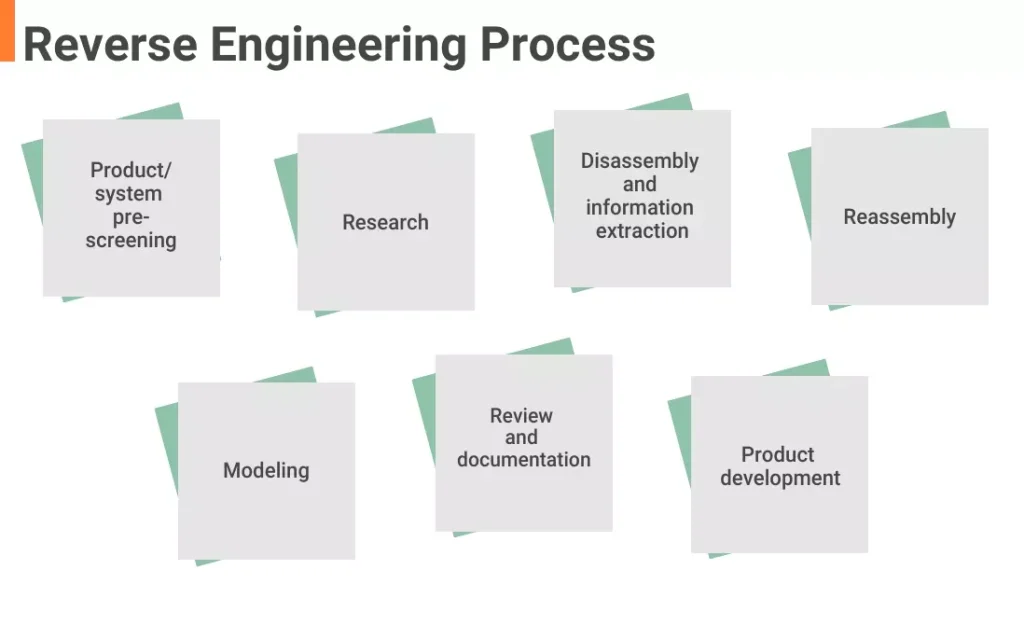
Reverse engineering starts with a thorough initial assessment of the part. This includes analyzing the material, visually inspecting the component, and understanding its function. Knowing these details upfront helps guide the data capture and reconstruction steps.
Next comes data capture, where precise measurements are key. Techniques include 3D scanning, coordinate measuring machines (CMM), and sometimes manual measurements for hard-to-reach details. These tools collect accurate point cloud data representing the part’s geometry.
The captured data is then digitally reconstructed. Point clouds from scanners or CMM convert into detailed meshes, which are refined and transformed into CAD models. This scan-to-CAD workflow is essential for creating a reliable digital twin of the original part.
Once the CAD model is complete, it undergoes validation and refinement. This step ensures all dimensions, tolerances, and material attributes match the original specifications perfectly.
Finally, the model integrates with manufacturing by generating CNC toolpaths. This prepares the design for high precision machining, guiding mills, lathes, or other CNC equipment to reproduce the part exactly. For complex projects, tools like 5-axis CNC milling machines further enhance the quality and accuracy of the manufactured parts, as detailed in our overview of advanced machining technology.
This systematic approach makes reverse engineering a powerful solution for replicating, repairing, or improving precision parts efficiently.
Essential Tools and Technologies for Reverse Engineering
Reverse engineering relies heavily on the right tools to capture and recreate precision parts accurately. Key scanning hardware includes portable coordinate measuring machine (CMM) arms and advanced 3D scanners. These devices help collect detailed point cloud data by measuring complex geometries and surfaces, making them invaluable for replicating legacy components or obsolete parts.
On the software side, CAD modeling platforms allow engineers to convert scan data into editable digital twins, while CAM programming prepares the designs for manufacturing with precise CNC toolpath generation. Advanced scan-to-CAD workflows streamline this process, turning raw 3D scans directly into CAD models ready for machining.
Quality inspection tools are also critical, providing accurate geometric dimensioning and tolerance verification throughout the process. These technologies ensure the final product meets exact specifications, supporting high precision machining and automated machining integration. With these tools, manufacturers can efficiently reproduce parts with exceptional accuracy and consistency.
Applications in Precision Machining and CNC

Reverse engineering plays a vital role in precision machining and CNC by enabling the replication of legacy or discontinued parts that are no longer available from original equipment manufacturers (OEMs). This capability is crucial for industries needing obsolete parts replication to keep machines and systems running smoothly without complete redesigns.
Custom fabrication without OEM sources becomes straightforward with reverse engineering, allowing shops to produce precise components tailored to specific needs. It also supports design optimization by refining tolerances, selecting better materials, and improving overall part performance, giving manufacturers a competitive edge.
Additionally, reverse engineering accelerates prototype development and rapid iteration. Turning a physical part into digital CAD modeling data lets engineers quickly adjust and test designs before moving to full-scale CNC manufacturing. This streamlined workflow reduces time-to-market and boosts innovation, especially for complex or high-precision projects.
For those interested in expanding their manufacturing capabilities, combining reverse engineering with advanced digital tools enhances processes like CNC toolpath generation and automated machining integration. Companies like MS Machining specialize in these services, ensuring the highest quality for custom and legacy component manufacturing. To explore more about CNC capabilities that pair well with reverse engineering, check out our detailed page on CNC machining Inconel services.
Key Benefits for Manufacturers
Reverse engineering delivers major advantages for manufacturers aiming to boost efficiency and precision in their operations. Here’s what it brings to the table:
| Benefit | Description |
|---|---|
| Reduced Downtime | Quickly replicate critical parts, minimizing production stops. |
| Cost Savings | Avoid expensive new equipment by reproducing obsolete or legacy parts. |
| Enhanced Precision | Improve quality control with precise CAD modeling and geometric dimensioning. |
| Innovation Support | Integrate reverse engineering into automated machining workflows to accelerate design improvement and prototyping. |
By using reverse engineering, manufacturers can maintain smooth production lines while cutting costs and improving part accuracy. This approach supports continuous innovation, especially when paired with CNC toolpath generation and high precision machining technologies. If you want to explore advanced options for prototype manufacturing or part reproduction, MS Machining offers tailored reverse engineering solutions to meet these needs efficiently.
Real-World Examples and Case Studies
Reverse engineering plays a crucial role in industries like automotive and aerospace, where recreating complex legacy components is often necessary. For instance, aging aircraft parts or discontinued engine components can be precisely replicated using 3D scanning and CAD modeling, extending the lifespan of expensive machinery without waiting for OEM replacements. In industrial machinery, reverse engineering helps keep assembly lines running by recreating worn or obsolete parts that are no longer available.
At MS Machining, we’ve successfully supported numerous precision shops by delivering high-precision part reproduction and CNC toolpath generation for critical components. Our expertise in scan-to-CAD workflows and automated machining integration allows us to offer rapid, accurate rebuilds that meet tight tolerances and strict material specifications. This approach has proven invaluable for clients requiring prototype manufacturing and custom fabrication without original plans.
By combining advanced technologies with skilled craftsmanship, MS Machining continues to enable manufacturers to overcome challenges in replicating legacy components while maintaining quality and efficiency. To learn more about how we integrate high-precision machining into every project, visit our 5-axis CNC machining services page.
Potential Challenges and Solutions in Reverse Engineering

Reverse engineering precision parts isn’t without its hurdles. One common challenge is maintaining accuracy in complex geometries. Intricate details can be tough to capture fully with 3D scanning or coordinate measuring machines (CMM). To overcome this, it’s essential to use high-resolution scanning tools paired with multiple data capture methods—like combining point cloud data with manual measurements—to ensure every contour is precise.
Matching the right materials and tolerances is another key issue. Since legacy parts or obsolete components often have outdated specifications, thorough material analysis is crucial to replicate the exact mechanical properties and dimensions. This ensures the final reproduction performs reliably under the intended conditions.
Intellectual property (IP) and legal considerations add another layer of complexity. When reverse engineering parts, it’s critical to respect copyrights, patents, and trade secrets. Following ethical best practices means using the process mainly for repair, maintenance, or innovation rather than copying for competitive advantage. Clear client agreements and transparency help avoid legal pitfalls.
Addressing these challenges with the right technology, skilled expertise, and strong ethical guidelines ensures successful and compliant precision part reproduction. For manufacturers focused on CNC machining and automated machining, embracing these solutions not only delivers quality but also protects their innovation and reputation.
For a deeper dive into CNC precision machining and how it supports reverse engineering, check out our detailed guide on CNC precision machining.
How MS Machining Excels in Reverse Engineering Services
At MS Machining, we specialize in delivering precise reverse engineering solutions tailored to the needs of manufacturers across the U.S. Our expertise lies in combining high precision machining with advanced CNC integration, ensuring every replicated part or prototype meets exact specifications. Using state-of-the-art 3D scanning and coordinate measuring machines, we capture detailed point cloud data to create accurate digital twins. This enables seamless scan to CAD workflows and CNC toolpath generation that match your design requirements perfectly.
Our client-focused approach means we prioritize quality and turnaround time, minimizing downtime by quickly reproducing legacy or obsolete components with the same tight tolerances you expect from original parts. Whether it’s for custom fabrication or optimizing existing designs, MS Machining’s reverse engineering services support your manufacturing goals with reliable, high-precision manufacturing solutions. Explore our expertise in complex component projects, such as those detailed in our CNC milling services for complex components, to see how we bring parts back to life efficiently and accurately.