
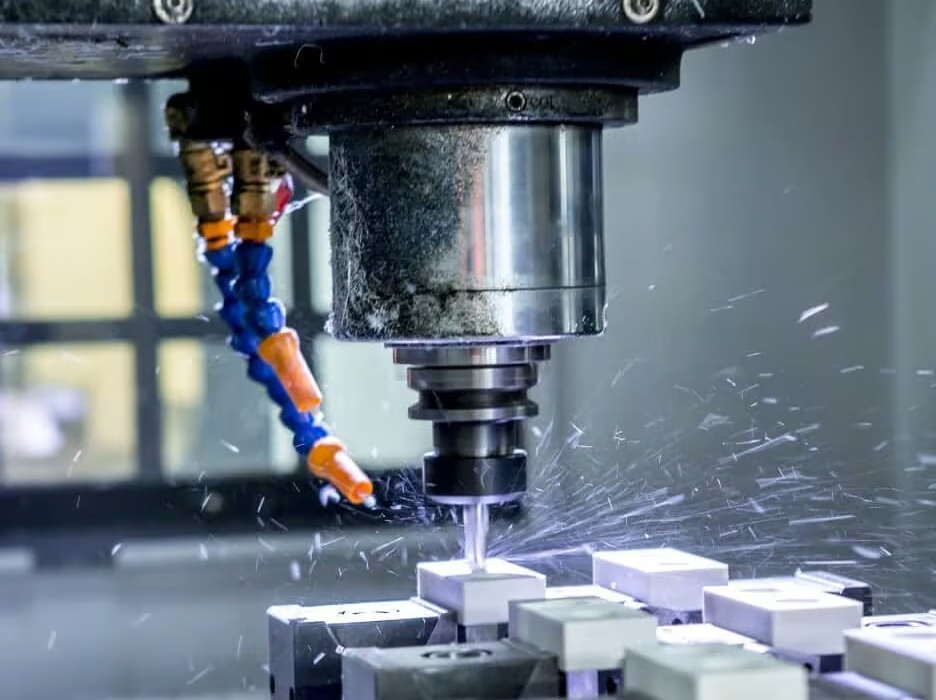
What Exactly Is Prototype CNC Machining?
Prototype CNC machining is the process of creating one-off or low-volume parts using computer-controlled machines. Unlike mass production, prototype machining focuses on fast, precise fabrication to test designs, fit, and function before committing to full-scale manufacturing.
Prototype vs. Production Machining
| Aspect | Prototype Machining | Production Machining |
|---|---|---|
| Batch Size | 1–500 pcs | Thousands to millions |
| Lead Time | Fast (days to weeks) | Longer (weeks to months) |
| Flexibility | High (design changes welcome) | Low (fixed tooling/processes) |
| Cost per Piece | Higher | Lower |
| Focus | Design validation & testing | Volume, cost efficiency |
Typical Batch Sizes
- Small quantities: 1 to 500 parts
- Ideal for testing and refining designs
- Supports multiple revisions without major cost impact
Common Industries for Prototype CNC Machining
- Aerospace: Structural components, brackets, housings
- Medical Devices: Surgical tools, implants, diagnostic parts
- Automotive: Engine parts, prototype assemblies, custom brackets
- Robotics: Precision components, end-effectors, custom mounts
- Consumer Electronics: Enclosures, connectors, heatsinks
Prototype CNC machining serves as the bridge between concept and full production, offering engineers precise, functional parts quickly and with high reliability.
The Prototype CNC Machining Process Step by Step (With Timeline)
Getting your prototype CNC machined right starts with a clear, organized process. Here’s what you can expect from start to finish:
Step 1: Design Upload & DFM Feedback (24–48 hours)
Send us your CAD files (like .step or .iges), and we’ll review them for manufacturability. This design-for-manufacturing (DFM) feedback helps catch potential issues early, saving time and cost down the line.
Step 2: Material Selection and Stock Preparation
Next, we help you pick the best material based on your part’s function and budget. Once selected, we prepare the raw stock, ensuring quality and correct dimensions to start machining.
Step 3: CAD/CAM Programming
Our programmers convert your CAD model into precise CNC code using advanced CAM software. The program accounts for tool paths, speeds, and feeds—critical for efficiency and accuracy.
Step 4: Machining (3-Axis vs 5-Axis Explanation)
Parts are then machined on our CNC mills. Simple shapes often use 3-axis machines, handling movements on X, Y, and Z axes. For more complex geometries, 5-axis machining moves the tool or part along additional rotary axes, allowing intricate cuts in fewer setups and better precision.
Step 5: Secondary Operations
After machining, some parts may need extra work like tapping holes, anodizing aluminum for corrosion resistance, heat treatment to improve strength, or other surface finishes.
Step 6: Quality Inspection
Quality control is a must. We use coordinate measuring machines (CMM) to check key dimensions and provide a first-article inspection report if needed. This ensures your prototype meets specifications before shipping.
Step 7: Express Shipping
Finally, we offer fast shipping options to get your prototype in hand quickly—critical for tight product development cycles.
For materials like metals and copper used in prototype machining, our specialized CNC machining copper services can handle even the trickiest alloys with excellent precision.
Materials for CNC Prototypes – Metals & Plastics (2026 Update)
When it comes to prototype CNC machining, choosing the right material is crucial. The options span from metals to engineering plastics, each with its own strengths, costs, machinability, and ideal applications.
Metals
-
Aluminum
Common grades like 6061, 7075, MIC-6, and Aluminum 5083 offer a great balance of strength, weight, and machinability. Aluminum prototypes are popular in aerospace, automotive, and consumer electronics for their lightweight and corrosion resistance.
-
Stainless Steel
Grades 303, 304, 316L, and 17-4PH are typical stainless steel choices. 303 is easier to machine for prototype parts, while 316L and 17-4PH provide superior corrosion resistance and strength, fitting medical devices and harsh environment applications.
-
Titanium
Titanium Grade 2 and Grade 5 stand out for strength-to-weight ratio and corrosion resistance, essential for medical implants, aerospace, and high-performance robotics.
-
Brass & Copper
Excellent for electrical components and decorative prototypes due to their conductivity and aesthetic appeal. Brass machines well, while copper can be more challenging but valuable for thermal conductivity.
Engineering Plastics
-
POM (Delrin)
Strong, stiff, and low-friction, perfect for mechanical parts that need tight tolerances.
-
PEI (Ultem)
High heat resistance and excellent strength, widely used in aerospace and medical prototypes.
-
PEEK
Top-tier high-performance plastic with great chemical resistance and strength, ideal for advanced engineering applications.
-
PTFE
Known for low friction and chemical inertness, useful in seals and insulation.
-
PC (Polycarbonate)
Tough and transparent, common in consumer electronics prototypes.
-
ABS
A cost-effective, impact-resistant option for functional prototypes.
-
Nylon (PA66+GF)
Strong and wear-resistant, often glass-fiber reinforced for added rigidity.
Quick Material Comparison
| Material | Strength | Cost | Machinability | Typical Use |
|---|---|---|---|---|
| Aluminum 6061 | Medium | Low-Medium | Excellent | Aerospace, automotive frames |
| Stainless Steel 316L | High | Medium-High | Moderate | Medical devices, corrosion-resistant prototypes |
| Titanium Grade 5 | Very High | High | Challenging | Aerospace, implants |
| Brass | Medium | Medium | Good | Electrical, decorative parts |
| POM (Delrin) | Medium | Low | Excellent | Mechanical components |
| PEI (Ultem) | High | High | Moderate | Medical, aerospace |
| PEEK | Very High | Very High | Difficult | High-performance engineering |
| ABS | Medium | Low | Easy | Consumer electronics |
| Nylon (PA66+GF) | High | Medium | Moderate | Wear parts, mechanical |
For CNC prototypes, the right material choice impacts not just the look and strength but also the cost and lead time. At MS Machining, we help you pick the best fit for your project, balancing machinability and performance. If you’re curious about machining specifics, our detailed guide on CNC machining basics can be a helpful resource.
Tolerances and Surface Finishes You Can Realistically Expect
When it comes to prototype CNC machining, understanding realistic tolerances and surface finishes helps set expectations and avoid costly surprises.
- Standard tolerance is usually around ±0.02 mm (~±0.001″). This works well for most typical parts where extremely tight precision isn’t critical.
- For higher precision, especially with 5-axis prototype machining and the right fixturing, you can achieve tolerances down to ±0.005 mm (~±0.0002″). This level is common in aerospace and medical device prototyping.
- Surface roughness typically ranges from Ra 0.8 to 3.2 μm, depending on the material and machining parameters.
Common surface finishes include:
- As-machined (natural tool marks)
- Bead blast for a matte, uniform look
- Anodizing (Type II & III) adds corrosion resistance and color options
- Passivation improves stainless steel corrosion resistance
- Powder coating for durable color and protection
- Chromate conversion coating to protect aluminum
- Electroless nickel plating for added hardness and wear resistance
Choosing the right finish depends on your application — for example, anodizing is a favorite in custom CNC prototypes used in electronics and aerospace for both protection and aesthetics.
For parts requiring specialized finishes or tighter tolerances, it’s worth discussing options early on in the design phase to balance cost and performance.
Lead Time Reality Check – From 24 Hours to 14 Days
When it comes to prototype CNC machining, lead times vary widely depending on complexity, materials, and finishing. Here’s what you can realistically expect:
- Express turnaround (1–3 days): Typically for simple aluminum parts with minimal finishing. Fast setups and common materials make this possible.
- Standard lead time (5–10 days): This fits most low- to medium-complexity jobs across typical materials like stainless steel or engineering plastics.
- Complex parts (10–14 days): Machining on 5-axis machines combined with secondary finishing—like anodizing or heat treatment—requires extra time. Inspection and tighter tolerances also extend schedules.
Several factors impact lead times:
- Quantity: Larger batches take more time, especially over 100 pcs.
- Material availability: Exotic metals like titanium or specialty plastics may delay stocking and prep.
- Finishing: Processes like anodizing, passivation, or powder coating add days.
- Inspection level: Detailed quality control, such as full CMM inspections or first-article inspections, can stretch timelines.
Understanding these timelines helps you plan better and avoid surprises on delivery. For insights on how different machining setups influence timing, check out our detailed precision CNC milling services overview.
How Much Does Prototype CNC Machining Actually Cost in 2026?
Understanding the cost of prototype CNC machining means breaking down the main factors: programming, material, machining hours, finishing, inspection, and shipping. Each one affects the final price differently depending on complexity and specs.
Typical Price Ranges in the US Market
- Simple aluminum parts: $80 to $250 per piece
- 5-axis titanium prototypes: $600 to $2,500 per piece
Factors like material choice (aluminum vs. titanium), the axis complexity (3-axis vs. 5-axis machining), and secondary operations (e.g., anodizing or heat treatment) play a big role in pricing.
8 Proven Ways to Cut Costs Without Losing Quality
- Optimize your CAD design for manufacturability (DFM). Simple features reduce machining time.
- Select common materials like 6061 aluminum or 304 stainless steel. These reduce raw material costs and lead time.
- Keep tolerances within standard limits (±0.02 mm) unless tighter precision is necessary.
- Minimize secondary operations like coatings and finishing unless critical.
- Consolidate parts where possible to reduce assembly costs.
- Plan batch sizes carefully, as larger runs lower unit cost but increase upfront expense.
- Choose 3-axis machining when 5-axis is not needed. This saves both programming and runtime hours.
- Provide complete and clear files from the start to avoid delays and extra quoting rounds.
For projects requiring specific finishing or strict certifications, expect additional costs. You can find cost-saving ideas and detailed guidance on rapid CNC machining through specialized prototype machining services offered in the US market.
Balancing quality, speed, and cost in prototype CNC machining is key—knowing your options upfront helps you make smart decisions on your next prototype.
CNC Prototyping vs 3D Printing vs Soft Tooling – Decision Matrix
Choosing the right method for prototype manufacturing often boils down to three options: CNC prototyping, 3D printing, and soft tooling. Each has its strengths depending on material needs, precision, cost, lead times, and batch size.
| Factor | CNC Prototyping | 3D Printing | Soft Tooling |
|---|---|---|---|
| Material Properties | Wide range: metals & engineering plastics, close to final product | Mostly plastics and some metals, limited strength | Materials similar to production, but lower durability |
| Tolerance | Tight tolerances (±0.02 mm to ±0.005 mm possible) | Rougher tolerances, often ±0.1 mm or more | Moderate tolerances, variable by process |
| Cost | Higher setup cost but cost-efficient for 1–500 pcs | Low cost for single parts, expensive at scale | Moderate tooling cost, higher per piece in low volume |
| Lead Time | 1–14 days depending on complexity and finishes | Often under 24–72 hours for simple parts | Weeks, due to tooling fabrication |
| Quantity Sweet Spot | Small to medium batch runs (1–500 pcs) | Prototyping, concept models, very low volume | Low to medium volume runs (100+ pcs) |
| When It Wins | Functional prototypes needing strength, precision, and real materials | Fast concept models, complex geometries, low load parts | Small production runs where tooling cost is justified |
When 3D Printing Wins
- Rapid design iterations with quick turnaround
- Complex shapes that are hard to machine
- Low mechanical strength requirements
- Budget-conscious early-stage prototypes
When CNC Prototyping Wins
- High-strength, metal or engineering plastic parts
- Tight dimension and surface finish requirements
- Functional testing under real-world conditions
- Small to medium batch runs for realistic product validation
By understanding these differences, you can pick the best prototype machining services for your project’s needs. For example, if you need a durable aluminum prototype, explore our alloy CNC machining services for reliable results.
Real Customer Case Studies (MS Machining Projects)
Our customers rely on MS Machining for fast, precise prototype CNC machining that meets tight deadlines and high standards. Here are some real examples showcasing our expertise:
-
Medical Device Titanium Housing
A leading medical device manufacturer needed a complex titanium housing prototype with demanding tolerances. We delivered the fully machined part in just 7 days from purchase order (PO) to delivery, helping them stay on track for their product launch.
-
Drone Aluminum Frame for Silicon Valley Startup
A startup in Silicon Valley required 50 CNC aluminum prototype frames with a quick turnaround. We completed production in 9 days, providing lightweight, durable parts ready for assembly and testing.
-
Robotic End-Effector in PEEK
For a robotics company, we machined a custom end-effector using PEEK plastic, achieving a tight tolerance of ±0.01 mm. This level of precision was critical for their automation system’s performance.
Our clients often share before and after photos along with testimonial snippets praising our responsiveness, quality, and attention to detail. These case studies reflect why MS Machining is a top choice for custom CNC prototypes across industries.
For similar rapid CNC machining projects, check out our rapid CNC machining services.
Quality Assurance & Certifications at MS Machining

At MS Machining, quality assurance is a top priority. We hold key certifications including ISO 9001, AS9100D for aerospace standards, and ISO 13485 for medical device manufacturing. These ensure that every prototype CNC machining project meets strict quality requirements from start to finish.
We provide comprehensive CMM inspection reports to verify dimensional accuracy, along with detailed material certifications confirming compliance with your specifications. Our processes also follow RoHS and REACH regulations, guaranteeing environmentally responsible manufacturing.
For critical projects, we offer First-Article Inspection (FAI) and Production Part Approval Process (PPAP) documentation on request, giving you extra confidence in your parts right out of the gate. These thorough checks help catch issues early and avoid costly delays.
To learn more about precision measurement and inspection techniques integral to our quality control, check out our detailed guide on metrology and precision manufacturing.
How to Get a Fast, Accurate Quotation from MS Machining
Getting a quick and precise quote for your prototype CNC machining project at MS Machining is straightforward. We accept common file types like .step, .iges, .prt, and PDF drawings to jumpstart the process. To speed things up, provide clear details such as:
- Quantity of parts needed
- Material choice (metal or plastic)
- Desired surface finish
- Any critical dimensions or tight tolerances
With this info upfront, our team usually turns around quotes in less than 8 hours, and often within just 1 to 2 hours for simpler jobs. This rapid response helps you keep your project on track without waiting around for pricing. For specialized needs like titanium parts, check out our dedicated CNC titanium machining services to ensure accurate material specs and cost estimates.
Frequently Asked Questions About Prototype CNC Machining
1. What is prototype CNC machining?
Prototype CNC machining is the process of using computer-controlled machines to create one-off or small batches of parts for testing and validation before going into full-scale production.
2. How is prototype machining different from production machining?
Prototype machining focuses on small batch sizes (typically 1–500 pieces) with a fast turnaround and flexible design changes, while production machining is geared towards larger volumes with optimized processes for cost efficiency.
3. What materials can I use for CNC prototypes?
Common materials include aluminum (6061, 7075), stainless steel (304, 316L), titanium, brass, and engineering plastics like PEEK, Delrin, and Ultem.
4. How tight are the tolerances for prototype CNC parts?
Standard tolerances are around ±0.02 mm (~±0.001”), with precision tolerances down to ±0.005 mm (~±0.0002”) achievable using 5-axis machining and proper fixturing.
5. What surface finishes are available on prototypes?
Surfaces can be as-machined, bead-blasted, anodized (Type II & III), passivated, powder coated, or electroless nickel plated depending on the needs.
6. How long does prototype CNC machining take?
Lead times range from 24 hours for simple parts to 10–14 days for complex 5-axis jobs with secondary finishing.
7. Can I get an express service for my prototype?
Yes, many shops offer express options with 1–3 day turnaround for simple parts, especially aluminum.
8. What factors affect the cost of prototype machining?
Programming, material choice, machining hours, finishing, inspection, and shipping all influence the final price.
9. How do I reduce the cost without sacrificing quality?
Optimize designs for manufacturability, choose common materials, minimize complex finishing, and reduce tight tolerances where possible.
10. When should I choose CNC prototyping over 3D printing?
Choose CNC machining when you need metal parts, high precision, functional strength, or realistic surface finishes. 3D printing suits rapid, low-strength plastic models.
11. What batch sizes are typical for prototype CNC machining?
Most projects range from a single part to about 500 pieces, fitting the low-volume niche perfectly.
12. What file formats do you accept for quoting?
Standard CAD formats like .step, .iges, .prt, and detailed PDF drawings are preferred for fast, accurate quotes.
13. How can I get a fast, accurate quote?
Provide detailed info including quantity, material, finishing, and critical dimensions to speed up the process—quotes often return in under 8 hours.
14. Can you handle special certifications for medical or aerospace parts?
Yes, many prototype CNC shops maintain ISO 9001, AS9100D, and ISO 13485 certifications along with full inspection documentation.
15. What quality control methods are used?
Shop floors use CMM machines, first-article inspections, and full material certifications to ensure your prototype meets spec.
If you want to dive deeper into CNC capabilities, check out our guide on 5-axis CNC machines to understand precision machining advantages.
These FAQs cover most common questions about prototype CNC machining to help you make informed decisions quickly. If you need specific help, don’t hesitate to ask your machine shop for details.