
You might think that simply putting a tight tolerance on a blueprint guarantees a perfect component…
But that is rarely the whole story.
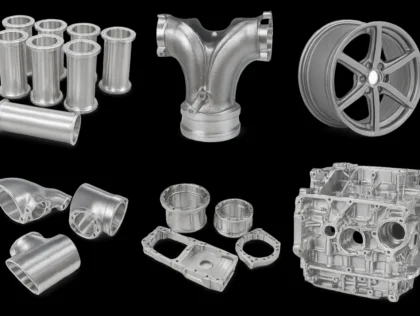
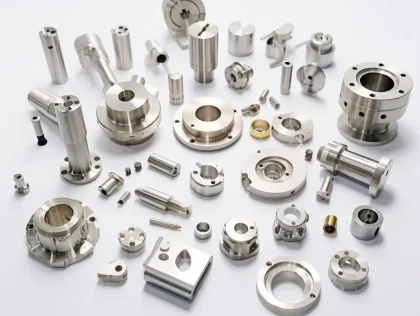
Sourcing high-quality cnc precision machined parts requires bridging the gap between your design intent and the reality of the manufacturing floor.
In this guide, we are moving beyond basic specifications. You’re going to learn exactly how process control, material stability, and smart tooling strategies define true functional accuracy.
If you are looking to ensure your components fit and perform perfectly every single time, this guide is for you.
Let’s get to work.
What Defines CNC Precision Machined Parts?

At MS Machining, we define cnc precision machined parts by more than just the numbers on a blueprint; they represent the intersection of rigorous engineering and advanced manufacturing capabilities. With over 15 years of experience serving demanding industries like Aerospace, Medical, and Robotics, we understand that true precision requires a holistic approach to manufacturing. High-quality machined components are characterized by their strict adherence to design specifications, superior surface finishes, and the ability to function reliably under stress.
Dimensional accuracy vs functional accuracy
Achieving high-quality results requires distinguishing between raw numbers and actual utility.
- Dimensional Accuracy: This is the ability to machine a feature to an exact measurement. Our facility utilizes advanced 3, 4, and 5-axis CNC machines to achieve tight tolerances as precise as +/- 0.005mm. This ensures that every dimension matches the CAD data.
- Functional Accuracy: This goes beyond simple measurements. It ensures that the part interacts correctly with other components in an assembly. A part can be dimensionally correct but functionally useless if geometric dimensioning and tolerancing (GD&T) features like flatness or concentricity are ignored.
Repeatability and process consistency
For production runs, making one perfect part is not enough; the challenge lies in replicating that perfection across hundreds or thousands of units. Our ISO 9001:2015 certified quality management system ensures that process consistency is maintained from the first article to the final shipment.
Key factors ensuring repeatability include:
- Equipment Stability: We operate 50+ advanced CNC machines that are regularly calibrated to maintain accuracy.
- Standardized Workflows: From CAM programming to final inspection, every step follows a strict protocol to eliminate variability.
- Automated Inspection: Utilizing CMM and other inspection tools guarantees that every batch meets the same high standards.
Why tolerance alone does not guarantee part performance
While tight tolerances are a hallmark of cnc precision machined parts, relying solely on them does not guarantee a successful component. Over-tolerancing non-critical features can drive up costs without improving performance.
True part performance depends on:
- Material Stability: Selecting the right material (e.g., Aluminum 7075, Stainless Steel 316, or PEEK) to withstand thermal and mechanical stress.
- Surface Integrity: Proper finishing, such as anodizing or passivation, is crucial for corrosion resistance and wear life.
- Design for Manufacturing (DFM): Our engineers provide DFM feedback to optimize geometries, ensuring parts are not only precise but also manufacturable and cost-effective.
How CNC Precision Machined Parts Are Manufactured
Design intent and CAD data preparation
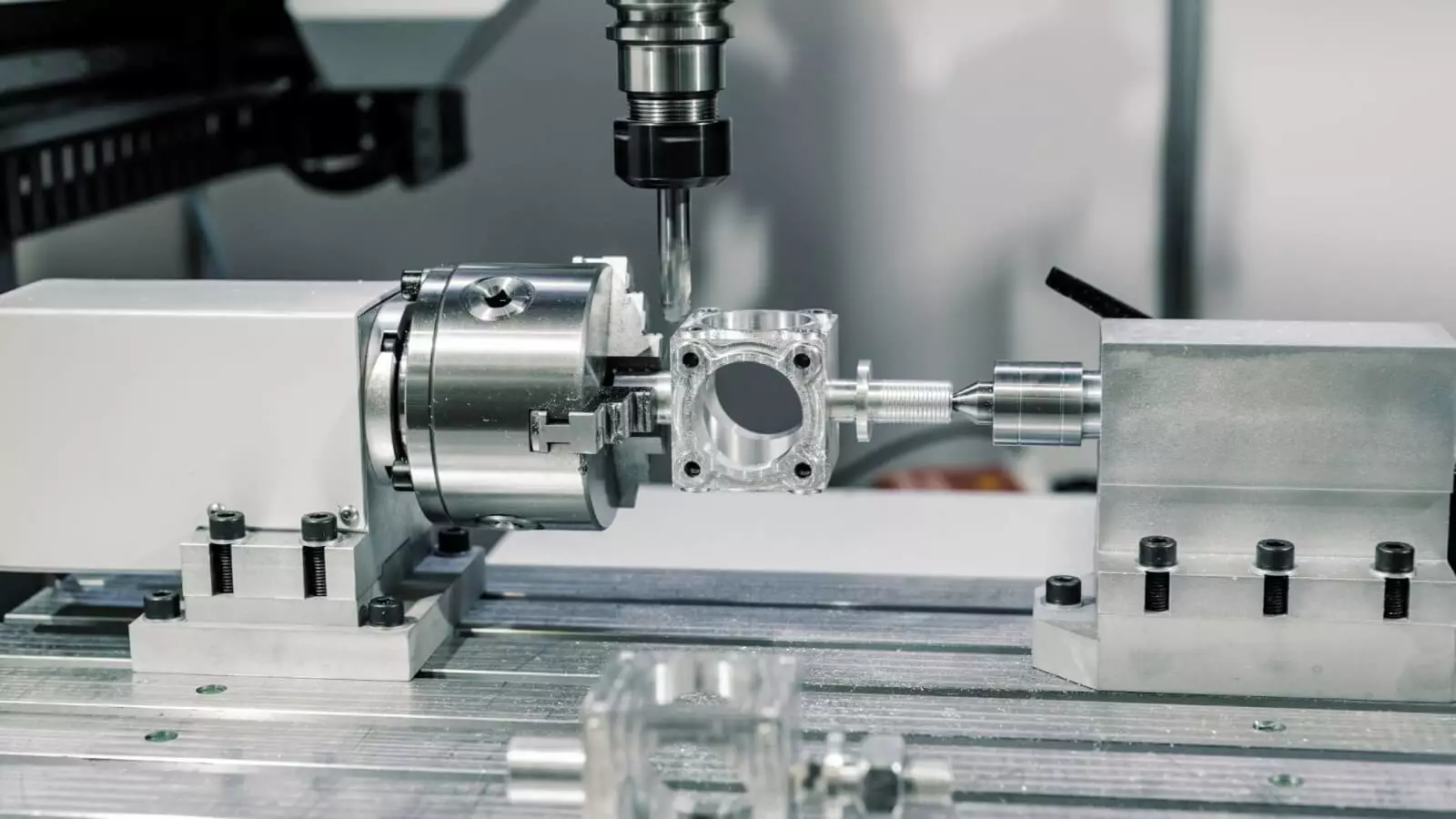
The manufacturing journey of CNC precision machined parts begins long before metal meets the cutter; it starts with the digital model. We don’t just look at the geometry; we analyze the design intent. This means understanding how the part fits into the final assembly and identifying which features are critical for function versus those that are cosmetic. We meticulously review CAD data to ensure it is watertight and optimized for machining. If a design has features that are unnecessarily expensive or risky to machine, we flag them early. For complex projects requiring specialized attention, you can contact us to have our engineering team review your CAD files for manufacturability.
CAM programming and toolpath strategy
Once the design is locked, we move to Computer-Aided Manufacturing (CAM). This is where we define exactly how the machine will behave.
- Tool Selection: Choosing the right cutter for the material to minimize deflection.
- Path Optimization: Creating toolpaths that maintain constant tool engagement, reducing shock to the part.
- Finish Passes: Programming specific finishing routines to achieve the required surface roughness ($R_a$).
A smart toolpath strategy is crucial for complex geometries. It reduces cycle time while ensuring that the stress put on the material doesn’t cause warping. We program the machine to approach critical features with care, ensuring the final dimensions land exactly in the middle of the tolerance zone.
Machine setup, fixturing, and datum control
You can have perfect code, but if the part moves, precision is lost. We focus heavily on rigid workholding and precise datum control. The “datum” is the reference point from which all measurements are taken. We ensure that the physical datum on the machine matches the digital datum in the CAD perfectly.
- Custom Fixtures: Using soft jaws machined to match the part profile for maximum grip without deformation.
- Zero-Point Systems: Allowing for quick and repeatable changeovers between operations.
- Stress-Free Clamping: Securing the part firmly without bending it, which is vital for thin-walled components.
Process stability and thermal control during machining
Consistency is the enemy of variance. During the machining of CNC precision machined parts, process stability is paramount. As tools cut metal, heat is generated, causing both the tool and the workpiece to expand. We manage this thermal growth through high-pressure coolant systems that keep temperatures stable. Additionally, we monitor the machine for vibration or “chatter,” which can ruin surface finishes and dimensional accuracy. By controlling the thermal environment and maintaining machine rigidity, we ensure that the first part off the line measures exactly the same as the last.
Key CNC Processes Used for Precision Machined Parts
To deliver cnc precision machined parts that actually fit and function as intended, we don’t just rely on one method. We mix and match specific machining processes based on the geometry and tolerance requirements of the design. Here is how we break down the manufacturing approach.
Precision CNC milling for complex geometries
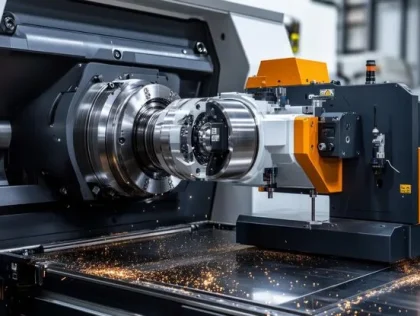
When we are dealing with non-cylindrical shapes—like brackets, housings, or manifolds—CNC milling is our primary method. The cutter rotates while the workpiece remains stationary (or moves along specific axes), allowing us to carve out pockets, slots, and intricate 3D contours. By utilizing advanced CNC milling capabilities, we can maintain tight perpendicularity and flatness across complex surfaces, ensuring the part matches the CAD model exactly.
Multi-axis machining and feature accessibility
Standard 3-axis machines are great for flat parts, but they have limits. For complex cnc precision machined parts requiring features on multiple sides, we utilize 5-axis machining.
- Single Setup: We can machine five sides of a part without unclamping it.
- Reduced Error: Fewer manual flips mean less chance of misalignment.
- Complex Angles: We can reach undercuts and angled holes that are impossible on standard machines.
CNC turning for rotational accuracy and concentricity
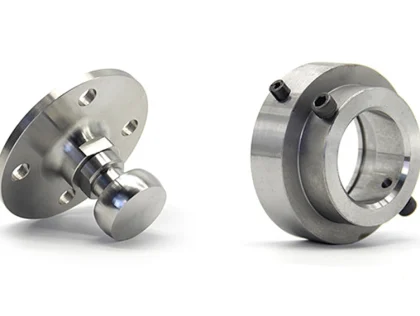
For cylindrical components like shafts, pins, and bushings, turning is the standard. Unlike milling, turning spins the workpiece against a stationary tool. This is critical for achieving high concentricity and circular runout. We select specific CNC lathe turning tools to manage chip control and surface finish, ensuring that round parts are perfectly balanced and dimensionally accurate relative to their center axis.
Drilling, boring, and hole accuracy control
Creating a hole is easy; creating a precise hole is a different story. Standard drilling often results in slight wandering or tapered walls. To guarantee accuracy in cnc precision machined parts, we use a multi-step process:
- Spot Drilling: Creates a precise starting point.
- Drilling: Removes the bulk of the material.
- Boring: A single-point tool corrects the hole’s position and straightness.
- Reaming: Finishes the hole to an exact diameter with a smooth surface finish for tight fits.
Material Selection and Its Impact on Precision CNC Machining
Choosing the right stock is just as critical as the toolpath strategy when manufacturing cnc precision machined parts. The material dictates the cutting speed, the type of coolant required, and ultimately, whether the part holds its tolerance after it comes off the machine. We see many designs where a slight material tweak could save significant cost without sacrificing performance.
Machinability versus functional requirements
There is often a tug-of-war between what the engineer needs the part to do and how easily we can cut it. A material might have incredible tensile strength but be a nightmare to machine, driving up cycle times and tooling costs. We always aim to balance the functional needs—like hardness or corrosion resistance—with machinability. Reviewing the specific materials for precision parts early in the design phase helps us optimize the manufacturing process before we even cut the first chip.
Aluminum alloys for lightweight and dimensional stability
Aluminum is the bread and butter of the precision machining world, particularly grades like 6061-T6 and 7075. It is lightweight, dissipates heat effectively, and generally allows for high-speed machining.
- 6061: Excellent corrosion resistance and weldability; the standard for most structural parts.
- 7075: High strength-to-weight ratio, comparable to some steels, making it ideal for aerospace components where weight is a penalty.
- Stability: Aluminum is relatively stable, meaning it doesn’t warp aggressively as we remove material, provided we follow proper stress-relieving protocols.
Stainless steel and deformation control during machining
Stainless steel (303, 304, 316) presents a different set of challenges. It is prone to work hardening—if the cutter rubs instead of slices, the material surface hardens instantly, destroying the tool. Furthermore, stainless steel holds internal stresses. As we machine away the outer layers, the part can warp or “potato chip.” We combat this by roughing the part, allowing it to settle, and then coming back for a final finishing pass to ensure the cnc precision machined parts remain straight and true.
Titanium alloys and heat management challenges
Titanium is a favorite in medical and aerospace fields for its biocompatibility and strength, but it is thermally non-conductive. Instead of the heat leaving with the chip, it stays in the tool and the workpiece. This heat buildup can cause thermal expansion during the cut, leading to undersized parts once they cool down. We use high-pressure coolant and specialized carbide tooling to manage this heat and maintain tight tolerances.
Engineering plastics and tolerance realism
Machining plastic is not easier than metal; it’s just different. Plastics like PEEK, Delrin (POM), and Nylon are sensitive to moisture absorption and thermal expansion.
- The Challenge: You cannot hold a +/- 0.005mm tolerance on a Nylon part that will be used in a humid environment; the material itself will grow larger than that tolerance zone just by absorbing water.
- The Solution: We recommend stable plastics like Delrin or PEEK for high-precision applications and advise customers to adjust tolerance expectations for less stable polymers.
Copper and brass for conductivity and surface finish
Copper and brass are primarily selected for electrical conductivity and aesthetic requirements.
- Brass: One of the easiest materials to machine. It chips nicely and leaves an excellent surface finish with minimal effort.
- Copper: Pure copper can be “gummy.” It tends to drag and stick to the cutter rather than shearing cleanly. We use sharp, polished tools with high rake angles to slice through copper cleanly, preventing burrs and ensuring the surface finish meets the high standards required for electrical contacts.
Tooling and Cutting Strategy Behind Precision Results
Achieving the tight tolerances required for cnc precision machined parts demands more than just a rigid machine frame; it requires a calculated approach to tooling. At MS Machining, we view the cutting tool as the critical interface between digital design and physical reality. Even the most advanced 5-axis machine cannot compensate for poor tooling choices, which is why we invest heavily in high-performance cutters and rigorous process planning.
Tool geometry and edge stability
The geometry of the cutting tool dictates how material is sheared away from the workpiece. We don’t just grab a standard end mill; we select specific flute counts and helix angles based on the material behavior.
- Aluminum: We use high-helix, 2 or 3-flute cutters to maximize chip evacuation and prevent material build-up on the cutting edge.
- Hard Metals: For stainless steel or titanium, we switch to variable helix designs that break up harmonic vibrations, ensuring the edge stays stable under heavy load.
Tool materials and surface coatings
Standard high-speed steel rarely cuts it for modern precision requirements. We primarily utilize solid carbide tooling paired with advanced surface coatings to manage heat and extend tool life. Coatings like TiAlN (Titanium Aluminum Nitride) allow us to run at higher temperatures without losing edge hardness. This is essential when machining abrasive materials, as it prevents the tool from degrading mid-cycle and compromising the dimensional accuracy of the part.
Cutting parameters and vibration control
Vibration, or “chatter,” is the enemy of surface finish and dimensional consistency. We fine-tune our spindle speeds and feed rates to find the “sweet spot” where the tool cuts cleanly without resonance. This balance is particularly critical when manufacturing small precision turned parts, where the workpiece itself may lack the rigidity to withstand aggressive cutting forces. By optimizing these parameters, we ensure that the final surface finish meets our strict aesthetic and functional standards.
Tool wear monitoring and repeatability
Tools wear down over time, and as they do, the dimensions of the machined part shift. To maintain a tolerance of +/- 0.005mm across a production run, we implement strict tool life management.
- Predictive Swaps: We replace tools before they show signs of failure, not after.
- In-Process Probing: We use automated probes to check tool length and diameter dynamically, updating offsets in real-time to compensate for microscopic wear.
- Consistent Load: We program toolpaths to maintain a constant chip load, ensuring the tool wears evenly and predictably.
Tolerance in CNC Precision Machined Parts
Tolerances are the language we use to define exactly how much room for error exists in manufacturing. In the world of cnc precision machined parts, getting this right is the difference between a functional component and expensive scrap. We don’t just look at the numbers; we look at how those numbers impact the final application.
General tolerances versus critical features
Not every surface on a part needs to be held to a micron-level standard. We separate dimensions into two categories:
- General Tolerances: These apply to non-mating surfaces, like the outer wall of a casing. Standard block tolerances (e.g., +/- 0.005″) are usually sufficient here and keep costs down.
- Critical Features: These are the dimensions that matter most—bearing bores, dowel pin holes, and sealing surfaces. We focus our machining strategy here to ensure these specific areas meet strict requirements.
GD&T and functional fit requirements
Linear dimensions (length and width) only tell half the story. To guarantee that cnc precision machined parts actually fit and function as intended, we rely on Geometric Dimensioning and Tolerancing (GD&T). This controls the form and orientation of features, such as:
- Concentricity: Ensuring two cylinders share the exact same center axis.
- Flatness: Making sure a mounting surface makes full contact.
- True Position: Guaranteeing bolt holes align perfectly with the mating part.
Achieving these complex geometric relationships often requires advanced axis CNC machining to maintain precision across multiple planes without re-fixturing, which reduces cumulative error.
Tolerance stack-up in assemblies
When you are building an assembly with multiple components, small variations add up. This is known as tolerance stack-up. If five parts are stacked and each is at the upper limit of its tolerance, the final assembly might be too long to fit in its housing. We analyze the “worst-case” and “statistical” stack-ups to ensure that even with allowable variations, the final system assembles correctly every time.
When tighter tolerances increase cost without added value
A common mistake in design is applying tight tolerances to every single feature “just to be safe.” Tightening a tolerance from +/- 0.005″ to +/- 0.0005″ can easily triple the machining time and require specialized inspection equipment. If a tight tolerance doesn’t improve the performance or fit of the part, it is simply adding unnecessary cost. We work to identify where precision adds value and where standard tolerances are more practical.
Quality Control for CNC Precision Machined Parts
Quality isn’t just a final step in our workflow; it is embedded in every stage of manufacturing. When producing cnc precision machined parts, relying solely on a final check is a recipe for failure. We operate under strict ISO 9001:2015 standards to ensure that the parts we ship match your prints exactly, whether it’s a single prototype or a production run of thousands.
In-process inspection versus final inspection
We believe in catching issues before they become expensive scrap. In-process inspection happens right at the machine. Operators and quality technicians check critical features immediately after the first cut and at regular intervals during the run. This allows us to make micro-adjustments to tool offsets in real-time.
Final inspection is the last gatekeeper. Once the part is finished, it goes to our temperature-controlled quality lab. Here, we verify that all secondary operations, surface finishes, and geometric tolerances meet the specifications before packaging.
CMM measurement and dimensional verification
For complex geometries and tight tolerances (down to +/- 0.005mm), manual calipers aren’t enough. We utilize advanced Coordinate Measuring Machines (CMM) to verify dimensional accuracy. This is particularly critical in industries where failure is not an option, such as medical device CNC machining, where verifying intricate profiles and GD&T requirements is mandatory for patient safety.
- Video Measuring Systems: For small, delicate parts.
- Surface Roughness Testers: To ensure Ra values meet requirements.
- Thread Gages: Verifying fit for assembly.
Batch consistency and process feedback
Achieving precision on one part is standard; achieving it on 10,000 parts requires rigorous process control. We use First Article Inspection (FAI) to validate the setup before full production begins. throughout the batch, we monitor tool wear and thermal expansion to maintain consistency. This rigorous approach ensures that the last part off the machine is identical to the first. You can see how this consistency plays out in our custom CNC machining real scenarios, where repeatability drives project success.
Data-driven quality improvement in CNC machining
We don’t just collect data to pass an inspection; we use it to improve. By analyzing inspection reports, we identify trends in tool life and machine performance. If a specific feature is consistently trending toward the upper limit of a tolerance band, our engineers adjust the CAM program or cutting strategy for the next run. This cycle of feedback ensures our cnc precision machined parts get better and more cost-effective over time.
Where CNC Precision Machined Parts Are Commonly Used

We see cnc precision machined parts deployed wherever “good enough” simply doesn’t cut it. These components are the backbone of systems that demand reliability, safety, and high performance. From factory floors in the Midwest to tech labs in Silicon Valley, precision machining bridges the gap between a digital design and a functional reality.
Load-bearing mechanical assemblies
In structural applications, parts must handle significant stress without yielding. We manufacture brackets, mounts, and chassis components that serve as the skeleton for heavy machinery and aircraft. In these scenarios, material integrity and dimensional accuracy are non-negotiable. For instance, an aerospace machining components manufacturer must ensure that every load-bearing strut meets exact specifications to maintain structural safety factors under extreme conditions.
High-cycle moving components
Parts that move thousands of times per minute—like gears, drive shafts, and pistons—rely heavily on precision.
- Reduced Friction: Tighter tolerances on bearing surfaces reduce heat and wear.
- Vibration Control: Perfect concentricity and balance prevent destructive vibrations at high speeds.
- Longevity: Precision parts simply last longer because they fit together exactly as intended, reducing the risk of fatigue failure.
Fluid handling and sealing systems
Hydraulic manifolds, valve bodies, and pump housings require exceptional surface finishes and flatness. If a sealing surface has tool marks or is slightly warped, high-pressure fluids will leak. We focus heavily on the surface roughness (Ra) and flatness of mating faces in these components to ensure O-rings and gaskets seal perfectly, preventing system pressure loss or environmental contamination.
Thermal-sensitive housings and enclosures
Electronics and optical systems often generate heat that must be managed efficiently. We machine heat sinks and enclosures from materials like aluminum and copper to dissipate thermal energy. The contact surfaces between the heat source and the machined part must be perfectly flat to maximize thermal transfer. Additionally, these parts often require strict dimensional stability to ensure that thermal expansion does not misalign sensitive internal sensors or lenses.
Compact assemblies requiring precise fit
As devices get smaller, the room for error disappears. In robotics, medical devices, and handheld technology, internal components are packed tightly. A deviation of just a few microns can cause interference, preventing the assembly from closing or functioning. CNC precision machined parts are critical here because they manage the “tolerance stack-up,” ensuring that when ten different parts are bolted together in a compact space, the final assembly fits perfectly without binding.
CNC Precision Machining Compared With Other Manufacturing Methods
Selecting the right manufacturing process is critical for balancing cost, speed, and quality. While cnc precision machined parts offer superior accuracy and material versatility, understanding how this subtractive process stacks up against other methods helps in making the right engineering decision.
CNC machining vs casting
Casting is often the go-to for extremely high-volume production runs where surface finish and tight tolerances are secondary. However, casting requires significant upfront investment in molds and tooling.
- Lead Time: CNC machining is faster for low-to-medium volumes because we start cutting immediately without waiting for mold fabrication.
- Precision: Cast parts often require secondary machining to achieve functional tolerances. CNC machining achieves the final dimensions in a single workflow.
- Material Integrity: Machined parts are cut from solid billet, ensuring consistent material properties without the porosity issues often found in cast components.
CNC machining vs forming processes
Forming processes, such as stamping or bending, are ideal for sheet metal components but lack the ability to create complex 3D geometries from solid blocks. When your design requires intricate features, varying wall thicknesses, or threaded holes in specific locations, CNC metal machining provides the necessary versatility. Forming is restricted by the uniform thickness of the raw sheet, whereas CNC machining allows us to sculpt the material to exact specifications, regardless of complexity.
CNC machining vs additive manufacturing
Additive manufacturing (3D printing) has gained ground in prototyping, but it still struggles to match the structural integrity and surface quality of CNC machining.
- Strength: CNC parts are isotropic, meaning they have uniform strength in all directions. 3D printed parts often have weak points between layers.
- Tolerance: We achieve tolerances as tight as +/- 0.005mm with machining. Most standard printers cannot reliably hold these limits.
- Finish: A machined surface can be polished, anodized, or plated immediately. Printed parts usually require extensive post-processing to remove layer lines.
For projects requiring complex geometries in harder metals, 5-axis machining is ideal for low-volume, high-mix manufacturing, offering a level of precision that additive methods cannot yet compete with for end-use parts.
When CNC machining may not be the optimal choice
While we specialize in high-precision output, CNC machining isn’t the solution for every single scenario. If you need millions of identical, low-tolerance plastic clips, injection molding is far more cost-effective. Similarly, for simple structural beams where tolerance is loose, standard fabrication or extrusion might be cheaper. CNC machining delivers the highest ROI when the part requires **tight tolerances**, **complex geometry**, or **high-strength materials** that other methods simply cannot handle effectively.
From Prototype to Production: Scalability of Precision CNC Machining
Moving from a single design to full-scale manufacturing requires more than just buying more material. We ensure your cnc precision machined parts transition smoothly from the engineering lab to the assembly line, maintaining quality regardless of volume.
Prototype intent versus production reality
When we handle rapid prototyping, the priority is speed and design verification. We often deliver samples in as little as 3-7 days. However, the methods used to make one part aren’t always the best for making a thousand.
During this phase, we provide DFM (Design for Manufacturing) feedback. We identify features that might be easy to machine once but will cause bottlenecks in high-volume runs. Our goal is to align your design intent with efficient manufacturing realities before you commit to a large order.
Process locking for repeatable production
Consistency is the biggest challenge when scaling up. To guarantee that every shipment matches your specifications, we implement strict process controls.
- Standardized Fixturing: We design custom fixtures that hold parts in the exact same position every time.
- Tool Life Management: We monitor cutter wear to prevent tolerance drift across long runs.
- ISO Certification: Our ISO 9001:2015 processes ensure documentation and traceability are maintained.
This approach allows us to deliver reliable custom CNC machining solutions where the final part is identical to the approved sample.
Cost control across different batch sizes
Pricing structures change drastically as you move from low-volume to mass production. In the prototype phase, you are paying primarily for engineering and setup. As volume increases, the focus shifts to reducing cycle time.
We help you manage costs by selecting the right equipment for the batch size:
- Low Volume: We use standard 3-axis or 4-axis mills to minimize setup costs.
- High Volume: We switch to automated Swiss machining or multi-fixture setups to reduce run time per part.
By optimizing the machine selection based on your quantity, we ensure you get competitive pricing whether you need 50 parts or 50,000.
Key Considerations Before Requesting CNC Precision Machined Parts
Before we start cutting metal, a few strategic checks can save significant time and money. Ordering cnc precision machined parts isn’t just about sending a file; it’s about aligning your design with manufacturing realities to ensure the final components meet your exact specifications without unnecessary costs.
Design readiness and manufacturability review
We always recommend a thorough Design for Manufacturing (DFM) review before finalizing an order. While a design might look perfect in CAD, physical machining has constraints. We look for issues like deep narrow pockets, sharp internal corners that require EDM, or thin walls that might vibrate during cutting.
- File Formats: We prefer STEP or IGS files for the most accurate analysis.
- Feature Check: Ensure all features are accessible by standard cutting tools to avoid custom tooling charges.
- Draft Analysis: If the part will eventually move to molding, incorporating draft angles now can save redesign effort later.
Tolerance prioritization and cost impact
Tight tolerances are our specialty, capable of holding +/- 0.005mm, but they should be applied strategically. Demanding micron-level precision on every single surface drastically increases machine time and inspection requirements.
- Critical Features: Apply tight geometric dimensioning and tolerancing (GD&T) only to mating surfaces or bearing fits.
- Standard Surfaces: Allow standard open tolerances for non-critical aesthetic or clearance areas.
- Cost Correlation: Remember that every decimal place of precision adds to the cycle time and final price.
Material confirmation and availability
Selecting the right material affects both the functionality and the lead time of your project. Standard materials like Aluminum 6061 or Stainless Steel 304 are readily available, allowing us to start machining almost immediately. However, exotic alloys or specific engineering plastics might require sourcing time. If you are deciding between common structural metals, understanding the differences in steel vs aluminum CNC machining is vital for balancing weight, strength, and machining costs.
Volume expectations and lead time planning
Clarity on your volume needs helps us optimize the production setup. We handle everything from rapid prototyping with samples ready in 3-7 days to full-scale production runs.
- Prototypes: We focus on speed and functional verification, often using soft tooling or quick setups.
- Production: For larger batches, we invest in multi-part fixtures and dedicated CNC stations to lower the unit price.
- Forecasting: Letting us know your estimated annual usage helps us plan raw material stock and machine capacity to guarantee on-time delivery.