
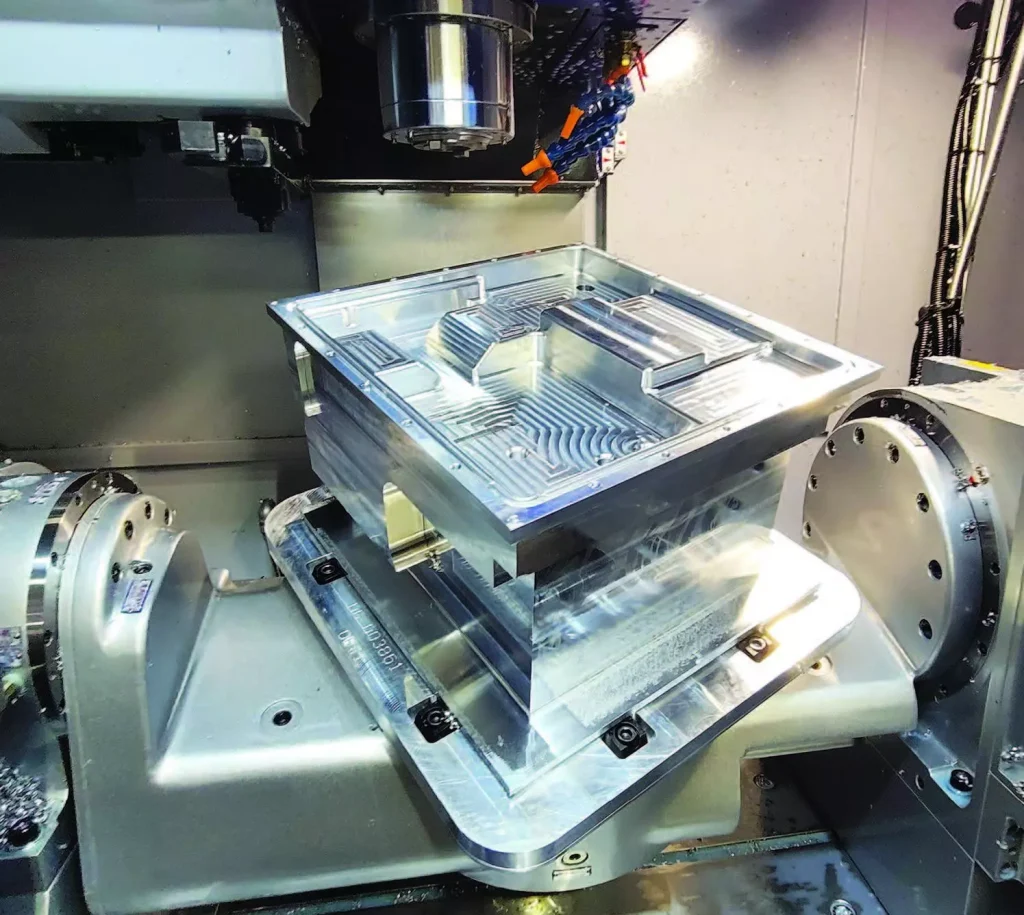
DFM Review for CNC Machining Services

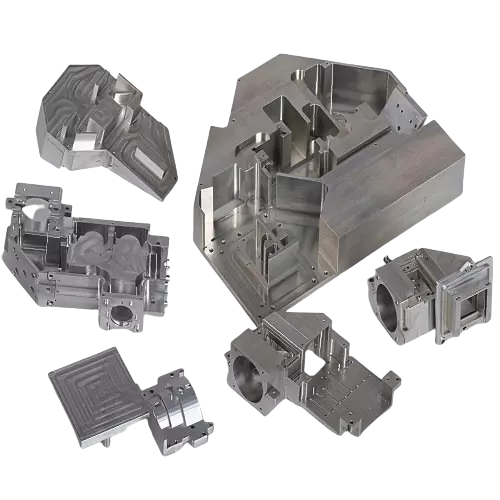
We review your CAD model and technical drawings before production to identify machining constraints, tolerance risks, setup requirements, and features that may affect manufacturability, cost, or lead time. Our feedback focuses on what can be machined as specified and where the design or process may need adjustment.

DFM Review for CNC Machining Services

Our Service

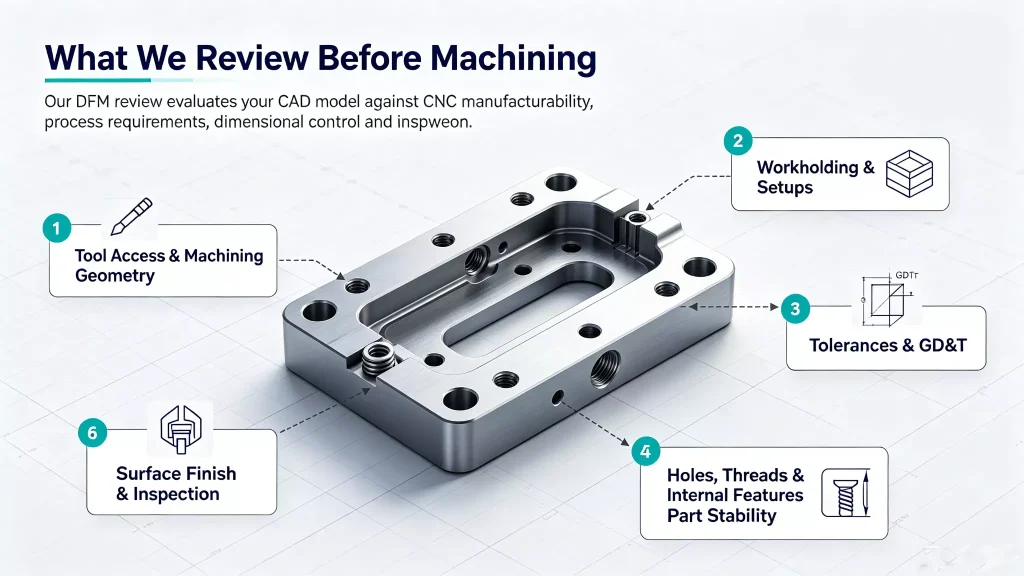
What We Review Before Machining

Our DFM review evaluates your CAD model and technical drawing against the CNC machining process required to produce the part as specified. We focus on manufacturability, process requirements, dimensional control, and inspection.

Our Service

From DFM Findings to Manufacturing Decisions

Our DFM review translates design findings into practical manufacturing decisions before machining begins. We assess whether the part can be produced as specified and identify conditions that may require different tooling, additional setups, tighter process control, secondary operations, or design adjustments. This gives your engineering team a clearer understanding of manufacturing requirements before production is released. When a potential issue is identified, we explain the constraint and discuss practical options based on the part geometry, tolerances, and planned machining process.

DFM Review for CNC Machining Services-04

Our Service

Datums, Feature Relationships & Machining Sequence

Individual dimensions do not define the entire manufacturing process. For critical features, the relationship between the feature, its datum structure, and the surfaces used to locate the part can be just as important as the dimension itself.

During a DFM review, we consider how the part can be established from its primary and secondary datums, how those references can be maintained between machining operations, and whether critical features can be produced from practical orientations. We also consider when a feature relationship may require the part to be repositioned, and how that additional setup could affect positional accuracy, concentricity, parallelism, perpendicularity, or true position.

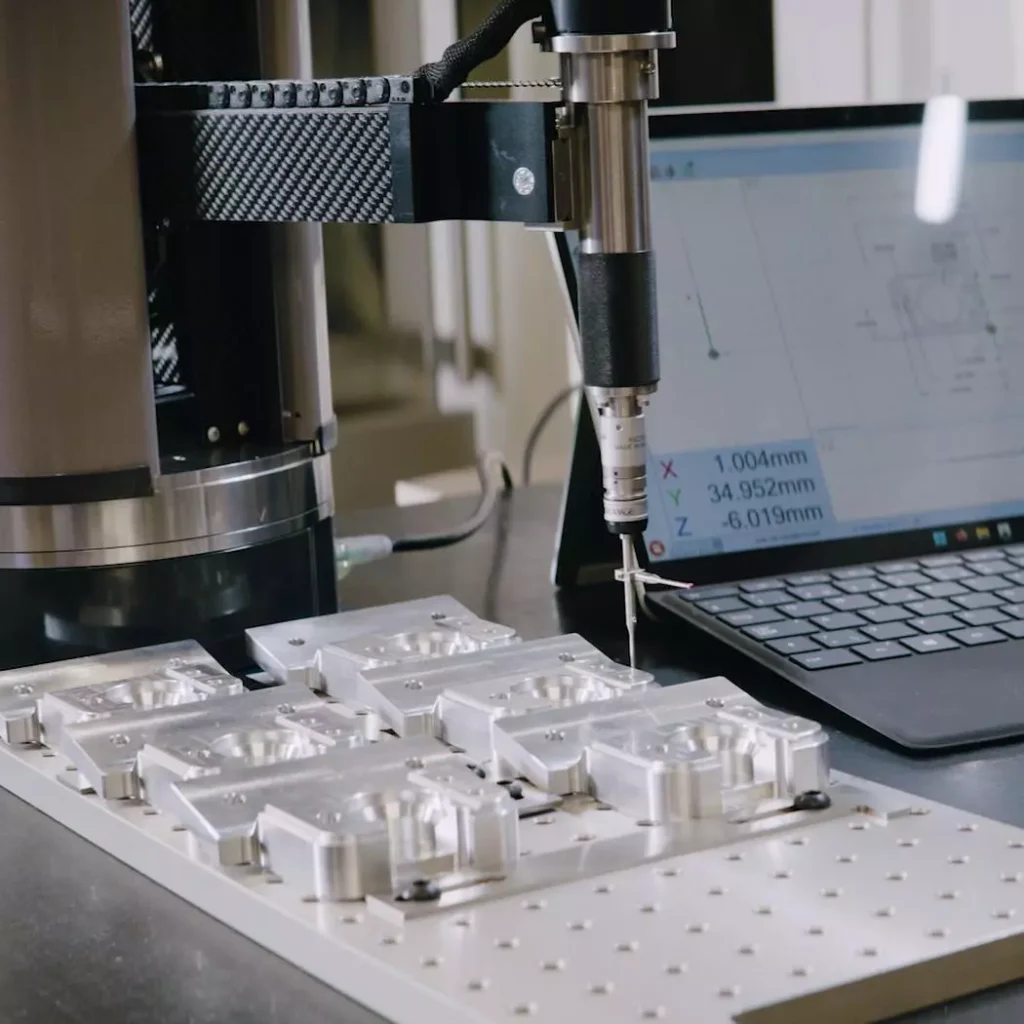
The machining sequence is reviewed together with the inspection approach. A feature may be straightforward to cut but difficult to control if its reference changes between operations or if the specified datum cannot be established consistently during machining and inspection. Where a potential issue is identified, the review focuses on the manufacturing constraint and the available options rather than simply recommending that the tolerance be relaxed.

The objective is to establish a practical relationship between how the part is located, how it is machined, and how the finished requirement is verified. This is particularly important for parts with features distributed across multiple faces, multiple datum references, or functional interfaces that depend on their relationship to one another.

Our Service

DFM from Prototype to Repeat Production

A part that is manufacturable for a prototype is not necessarily ready for repeat production. The DFM review therefore changes as the manufacturing requirement becomes more defined.

For an early prototype, the priority is to confirm that the required geometry, critical features, and functional requirements can be machined and verified. The manufacturing route may remain flexible at this stage because the design itself may still change.

During a pilot build, the focus moves from producing one acceptable part to establishing a repeatable manufacturing approach. Part location, machining sequence, tooling, workholding, and inspection need to produce consistent results across multiple parts. This stage can reveal issues that are difficult to identify from a single prototype, such as variation between setups, tool wear, dimensional drift, finishing variation, or an inspection method that is difficult to repeat.

For repeat production, the question becomes whether the approved requirements can be maintained from order to order. A process that works for a small prototype run may depend on adjustments that are not practical for recurring production. The review therefore considers whether the established machining and inspection approach can continue to control critical features and feature relationships without relying on one-off solutions.

The same principle applies when a released drawing is revised. A change to a dimension, tolerance, datum, material, feature location, or functional interface can affect the existing machining or inspection approach beyond the feature being changed. Reviewing the revision against the current manufacturing route helps determine whether the existing process can remain in place or needs to be adjusted before production continues.

DFM Review for CNC Machining Services-06
DFM Review for CNC Machining Services-MS Machining

Our Service

Manufacturing Impact of DFM Findings

A manufacturability issue does not always require a design change. Its effect depends on how the feature is produced, located, controlled, and inspected.

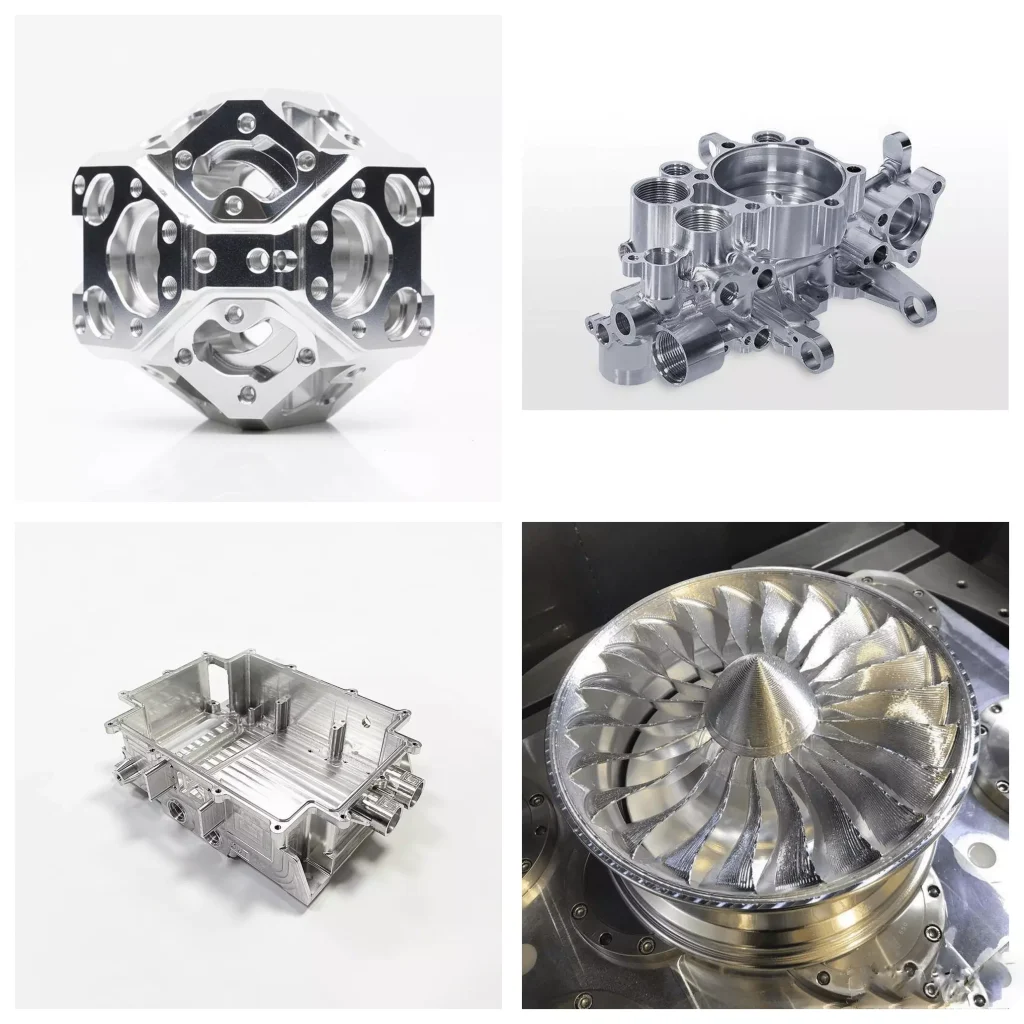
A deep internal feature, for instance, may remain acceptable if suitable tooling and sufficient tool access are available. In other cases, the same geometry may require a longer tool, an additional setup, or a different machining approach. The manufacturing impact therefore needs to be evaluated against the actual feature requirements rather than treated as a simple pass-or-fail condition.

The same applies to tight tolerances and geometric relationships. A tighter requirement can affect the machining sequence, number of setups, process control, and inspection method. A requirement that appears minor on the drawing may have a larger effect when it is combined with other dimensional or geometric requirements.

Material and surface requirements can also change the manufacturing route. Material condition, heat treatment, surface finish, plating, anodizing, or other secondary operations may introduce additional process considerations that need to be accounted for before production.

Our DFM review therefore looks beyond whether an individual feature can be machined. We consider how the requirement affects the overall manufacturing route and whether the resulting process remains practical for the intended production stage.

What We Need for a DFM Review

A useful DFM review depends on having enough information to understand both the part geometry and the requirements that must be maintained during manufacturing.

For most CNC machining projects, we review the 3D CAD model together with the latest technical drawing. The model defines the part geometry, while the drawing provides the dimensions, tolerances, datums, surface requirements, material specifications, and other manufacturing requirements that may not be fully defined by the model alone.

If a drawing is not available, the CAD model can still be reviewed for basic manufacturability and machining constraints. However, requirements such as critical tolerances, geometric relationships, surface finish, threads, or inspection criteria may need to be clarified before a complete manufacturing assessment can be made.

When a design has multiple revisions, the latest revision should be clearly identified. This allows the manufacturing review to be based on the same design definition that will be used for quotation and production.

Submit your CAD files and technical requirements for review, and we can assess the manufacturing considerations before the part moves into production.

DFM Review FAQ

What files are needed for a CNC DFM review?

A 3D CAD model and the latest technical drawing provide the most complete basis for a DFM review. The CAD model defines the part geometry, while the drawing defines dimensions, tolerances, GD&T, datums, surface finish, material specifications, and other requirements that need to be controlled during CNC machining.

Can you review a CNC design before the drawing is finalized?

Yes. Reviewing a CNC design before production release allows machining constraints to be considered while design changes are still possible. The review can cover tool access, feature geometry, workholding, machining setups, tolerances, and other requirements that may affect manufacturability.

Does every DFM finding require a design change?

No. A manufacturing constraint may be addressed through tooling, workholding, machining sequence, additional setups, or process control rather than changing the part geometry. The appropriate approach depends on the functional requirement and its effect on CNC manufacturing.

Can DFM findings affect CNC machining cost or lead time?

They can. Requirements involving additional setups, specialized tooling, tighter process control, secondary operations, or more demanding inspection may change the manufacturing route and affect the quotation or production schedule.

Can you perform a DFM review for an existing CNC part?

Yes. An existing part can be reviewed when a drawing revision, manufacturing issue, cost concern, or production requirement changes. We compare the current design requirements with the established machining and inspection approach to identify potential manufacturing impacts.

What happens if a part cannot be machined as specified?

We identify the manufacturing constraint and explain its potential effect on the CNC machining process. Where practical, we can discuss alternative tooling, workholding, setups, machining approaches, or design considerations with your engineering team. Final design decisions remain with the customer.