
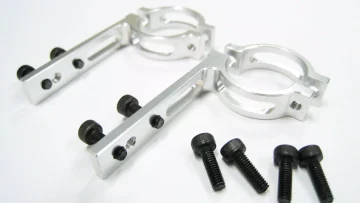
Custom CNC Machining Services for Precision Brake Pad Brackets
Race-Grade & OEM-Quality Manufacturing. Critical Tolerances Held to ±0.01 mm. Engineered for Maximum Stopping Safety.
The Critical Role of Precision in Brake Brackets
Eliminating Brake Squeal
We strictly control mounting surface parallelism within ≤0.02mm and maintain high flatness accuracy to ensure perfect alignment between the caliper and brake rotor. This significantly reduces vibration, brake squeal, and uneven pad wear, ensuring stable and quiet braking performance.
Zero-Slop Fitment
Guide pin holes are finished using high-precision boring and reaming processes, with dimensional tolerances controlled within +0.008mm. This ensures smooth assembly with zero unwanted play, improving caliper response, pedal feel, and overall braking stability.
Stress Relief Toolpaths
Our CNC machining strategies are optimized with refined corner toolpaths and cutting paths to eliminate stress concentration in critical R-radius areas. This helps prevent micro-cracks, fatigue failure, and structural damage under high-load and high-vibration conditions.
100% Verified Alloys
We use only certified OEM-grade aluminum and alloy steel materials. Every batch is fully traceable and supported by Mill Test Reports (MTRs), eliminating recycled or substandard materials and ensuring consistent strength, safety, and reliability.
Machining Specifications & Tolerances
| Parameter / Feature | Manufacturing Capability | Engineering Purpose & Automotive Context |
|---|---|---|
| Max. Part Dimensions | Up to 600 × 500 × 400 mm | Fits oversized brackets for heavy-duty commercial trucks & Big Brake Kits (BBK) |
| Min. Part Dimensions | Down to 30 × 20 × 10 mm | Ideal for lightweight racing karts, motorcycles, and ATVs |
| Critical Hole Alignment | ±0.01 mm (hole center distance) | Guarantees seamless bolt-on installation without forcing or ovalizing holes |
| Slider Pin Bore Tolerance | +0.010 / 0 mm to ±0.005 mm | For precision boring of caliper slider pins ensuring tight yet smooth articulation |
| Parallelism & Flatness | Within 0.01 mm | Critical for mating faces; prevents caliper tilting and uneven pad engagement |
| General Linear Tolerance | ±0.05 mm | Applied to non-critical external profiles to optimize machining cost |
| Threading & Tapping | M6 to M24 (Metric & UNF fine thread) | High-strength thread engagement to withstand severe shearing forces |
| Critical Surface Finish | Ra 0.4 µm (fine milling / boring) | Removes microscopic tool marks on high-stress shoulders to avoid fatigue micro-cracks |
ADVANCED PROCESSING & EQUIPMENT SUPPORT
Our production line integrates multi-axis CNC technology and smart in-process metrology to transition your engineering designs seamlessly from rapid prototyping to high-volume manufacturing, meeting rigid automotive safety specifications.
1. 5-Axis Linkage Machining (Single-Setup GD&T Control)
By utilizing simultaneous 5-axis CNC machining centers, we process mounting ear bores, high-strength threads, and clearance pockets in a single setup. This eliminated manual re-clamping, effectively controlling positional tolerances, coaxiality, and perpendicularity to prevent tolerance stack-up on critical brake bracket mounting features.
2. Weight Optimization Milling (Engineered Structural Pocketing)
We execute complex I-Beam structures and pocketing toolpaths designed to reduce unsprung mass for high-performance caliper brackets. Our CAM path planning ensures that material removal does not compromise the component’s yield strength or torsional rigidity under peak braking torque.
3. In-Process Metrology (Automated Renishaw® Probing)
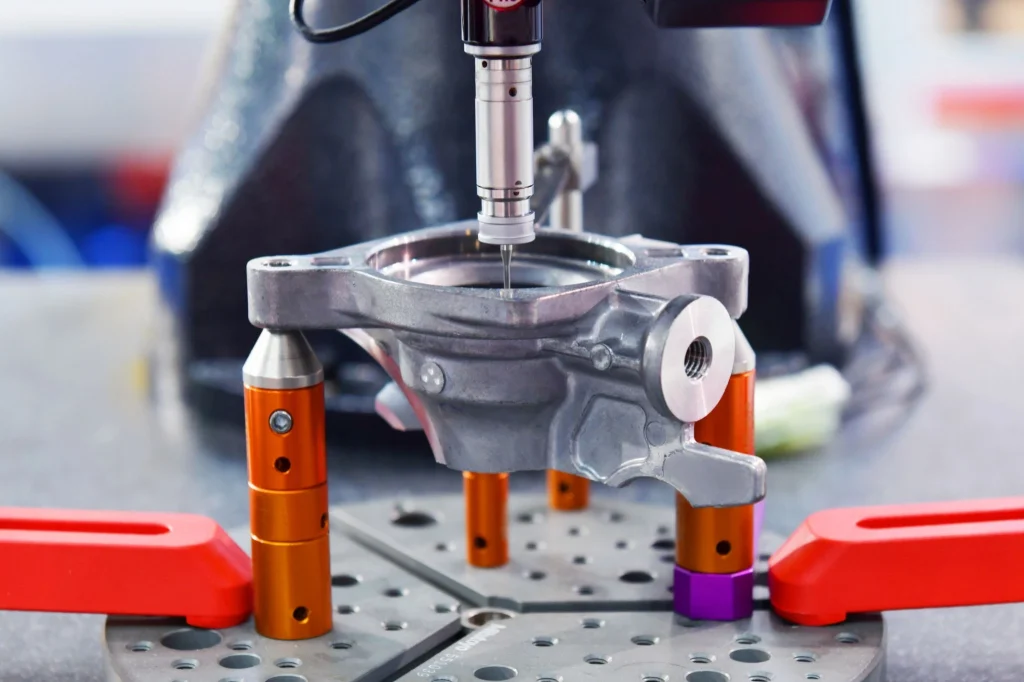
Our CNC machine spindles are equipped with Renishaw® on-machine probing systems to capture critical dimensions during the machining cycle. The system provides real-time tool offset compensation, controlling dimensional drift across mid-to-high volume production runs to maintain a high Cpk value and strict batch consistency.
Frequently Asked Questions (FAQ)
A: Thread integrity is vital for brake caliper brackets. We ensure high-strength thread engagement through two critical steps: First, we strictly control the pre-drill hole diameter and tapping speed to prevent any partial threads or micro-tearing. Second, for high-stress applications using steel (like 4140), we use pre-hardened material or apply controlled heat treatments to maximize thread shear strength, ensuring the threads easily handle standard automotive torque specifications without stripping or failing.
A: For the slider pin bores on the brake caliper bracket, we hold an ultra-tight dimensional tolerance of ±0.005 mm to +0.010 / 0 mm using precision CNC micro-boring tools. We also control the geometric cylindricality and surface roughness down to Ra 0.4 µm. This eliminates the tool marks that cause friction, ensuring a flawless, zero-slop sliding fitment that prevents brake pad taper wear and calipers from binding.
A: Yes, our engineering team provides full DFM (Design for Manufacturability) support. Generally, Aluminum 6061-T6 is the industry standard for high-performance street brake brackets due to its excellent heat dissipation, structural stability, and cost-effectiveness. However, if your project is for professional track racing or heavy-duty track use where extreme mechanical loads are constant, we recommend Aluminum 7075-T6 because its yield strength matches certain steels while remaining incredibly lightweight to reduce unsprung mass.
A: Aluminum and alloy steel can experience internal stress relief or thermal expansion during finishing, which can distort critical mounting datums. To solve this, we implement a two-stage machining process for critical caliper brackets: we perform rough machining and stress-relief aging before the final precision finish-milling and boring. This ensures that even after Type III hardcoat anodizing or zinc plating, the final dimensions and flatness remain perfectly within your drawing’s limits.
A: We fully support all automotive-standard threads, including Metric fine threads (e.g., M10x1.25, M12x1.25, M14x1.5) and UNF fine threads (e.g., 7/16-20, 1/2-20) required for classic or US-spec brake brackets. Every single threaded hole undergoes 100% manual Go/No-Go plug gauge testing before packaging to ensure smooth, zero-defect bolt installation on your assembly line.
A: We do both. For low-volume custom batches, performance aftermarket upgrades, and rapid prototyping, we machine 100% from solid billet blocks (Aluminum or Steel) for maximum structural integrity. For high-volume OEM automotive production, we partner with certified foundries to provide sand casting or investment casting, and then perform all high-precision finish CNC milling and boring in-house to drastically lower your unit costs.