
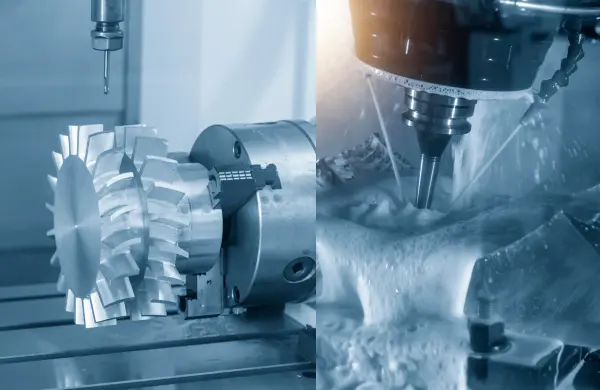
You might be wondering if your design actually requires the high-end capabilities of multi-axis milling.
It’s a decision that can make or break your production budget.
Stick with the standard, or upgrade to 5 Axis CNC Machining Services?
In this post, I’m going to show you exactly how to decide.
We are breaking down 5 Axis CNC Machining Services vs 3 Axis: Key Differences for Complex Parts to help you achieve tighter tolerances and faster cycle times.
If you are looking to optimize your manufacturing strategy, this guide is for you.
Let’s dive in.
What Is 3 Axis CNC Machining?

For decades, 3 Axis CNC Machining has served as the backbone of industrial manufacturing. It is the most common form of subtractive manufacturing, offering a reliable and cost-effective solution for producing cnc precision parts with relatively simple geometries. At MS Machining, we utilize high-performance 3-axis centers equipped with Fanuc and Haas controls to deliver consistent quality for projects ranging from rapid prototyping to low-volume production.
How 3 Axis CNC Machining Works
In a standard 3-axis setup, the workpiece remains stationary on the machine bed while the cutting tool moves along three linear axes:
- X-Axis: Moves left to right.
- Y-Axis: Moves front to back.
- Z-Axis: Moves up and down.
The cutting tool engages with the material to remove stock, but it can only approach the workpiece from a single direction (usually the top). To machine features on the sides or bottom, the part must be manually removed, re-oriented, and clamped again.
Typical Parts Suitable for 3 Axis Machining
This method is ideal for parts that do not require multi-sided machining in a single operation. It is the preferred choice for prismatic components where features are located primarily on one or two flat surfaces. Common applications include:
- Flat Plates and Brackets: Components made from Aluminum 6061 or Stainless Steel 304.
- Simple Housings: Enclosures requiring drilling and tapping on a single face.
- 2D Profiles: Parts that require cutting out shapes from flat stock.
Advantages of 3 Axis CNC Machining
When applied to the right designs, 3-axis machining offers significant benefits in terms of cost and speed:
- Cost-Efficiency: Lower machine hourly rates and simpler programming requirements make it budget-friendly for simple parts.
- High Rigidity: The stationary nature of the workpiece allows for heavy material removal, making it effective for harder materials like Titanium and Steel.
- Speed for Simple Geometries: For planar surfaces and shallow pockets, 3-axis mills can achieve rapid cycle times.
Limitations of 3 Axis Machining for Complex Parts

While effective for standard components, 3 Axis machining hits a wall when faced with complex geometries. The inability to rotate the tool or the part creates several bottlenecks for intricate designs:
- Multiple Setups Required: Machining a part on all six sides requires manual repositioning. This increases labor costs and extends lead times.
- Cumulative Error: Every time a part is unclamped and re-fixtured, the risk of misalignment increases, making it difficult to hold tight tolerances like ±0.005mm.
- Limited Tool Access: 3-axis machines cannot reach undercuts or angled features. Deep pockets often require long tools, which can vibrate and degrade the surface finish (failing to meet Ra 0.4 standards).
For parts requiring intricate contours or multi-sided access, these limitations often necessitate a shift toward 5 Axis CNC Machining Services.
What Is 5 Axis CNC Machining?

When we talk about high-end manufacturing, 5 Axis CNC Machining represents the pinnacle of precision and capability. Unlike traditional setups that move linearly, 5-axis machines utilize two additional rotary axes, allowing the cutting tool to approach the workpiece from virtually any direction. At MS Machining, we rely on advanced 5-axis centers from brands like Mazak and Fanuc to handle geometries that are simply impossible—or too costly—to produce on standard equipment. This technology is the standard for producing complex cnc precision parts where tight tolerances are non-negotiable.
How 5 Axis CNC Machining Works
The “5” in 5-axis refers to the number of directions in which the cutting tool can move. In a standard setup, the tool moves along the X, Y, and Z linear axes. A 5-axis machine adds two rotary axes, typically labeled A and B.
- Linear Movement: The tool moves side-to-side (X), front-to-back (Y), and up-and-down (Z).
- Rotational Movement: The machine table or the spindle head rotates (A and B axes), allowing the cutter to tilt and turn.
This simultaneous movement allows the cutter to maintain optimal contact with the part surface at all times. By tilting the tool, we can reach deep pockets and undercuts without the tool holder colliding with the workpiece. This capability is essential for achieving the strict surface roughness standards (up to Ra 0.4) and tolerances (±0.005mm) that we guarantee at our facility.
Why 5 Axis Machining Changes the Manufacturing Approach
The biggest shift 5-axis technology brings to the table is the “Done-in-One” philosophy. In traditional CNC Machining, producing a complex part often requires multiple setups. You machine one side, stop the machine, unclamp the part, flip it, re-fixture it, and machine the next side. Every time you move that part, you risk losing alignment and accuracy.
With 5 Axis CNC Machining, we can machine five sides of a part in a single setup. This drastically changes our production workflow:
- Reduced Setup Time: We eliminate the downtime associated with manually flipping parts.
- Higher Accuracy: Since the part stays clamped in one position, the relative accuracy between features is maintained perfectly.
- Better Tool Life: We can use shorter, more rigid cutting tools because the head can tilt closer to the work. This reduces vibration and increases cutting speed.
Typical Applications for 5 Axis CNC Machining
Because of its ability to handle intricate contours and tight angles, 5-axis machining is the go-to solution for industries requiring high-performance components. We frequently utilize this technology for parts that demand exceptional geometric complexity and structural integrity.
Common applications include:
- Aerospace Components: Turbine blades, impellers, and airframe structures that require complex curves and lightweighting. Our experience as an aerospace machining components manufacturer highlights how critical 5-axis capabilities are for flight-ready parts.
- Medical Devices: Surgical implants and prosthetics machined from Titanium or Stainless Steel (316) that must match organic shapes.
- Automotive Performance Parts: Ported cylinder heads and engine housings.
- Energy Sector: Rotors and stators that require precise balancing.
Whether we are cutting aluminum 7075 or tough titanium alloys, 5-axis technology allows us to deliver precision cnc machining results that standard 3-axis machines simply cannot match.
5 Axis vs 3 Axis CNC Machining: Key Differences for Complex Parts
When we look at the shop floor, the battle between 5 Axis CNC Machining and standard 3 Axis setups isn’t just about “more is better.” It is about matching the right tool to the specific geometry of the part. While 3 axis machines are the workhorses of the industry, they hit a hard wall when designs get intricate. Here is how they stack up when tackling complex manufacturing challenges.
Part Geometry and Design Flexibility
The most obvious difference lies in movement. A 3 Axis machine moves along the X, Y, and Z axes. It is perfect for prismatic parts—think blocks with holes drilled into the top or simple contoured surfaces. However, if your design has features on the sides or undercuts, a 3 axis machine requires manual repositioning.
5 Axis CNC Machining adds two rotational axes (A and B). This allows the cutting tool to approach the workpiece from virtually any direction.
- 3 Axis: Best for flat surfaces, shallow cavities, and simple profiles.
- 5 Axis: Essential for impellers, turbine blades, and aerospace components with organic, flowing shapes.
If you are designing parts with complex curves or features on multiple faces, 5 axis offers design freedom that 3 axis simply cannot match without extensive, risky workarounds.
Machining Accuracy and Dimensional Consistency
Accuracy is where the “Done-in-One” philosophy of 5 axis machining shines. In 3 Axis machining, working on multiple sides of a part means taking it out of the vise, flipping it, and clamping it down again. Every time we re-fixture a part, we introduce a margin of error. Even with the best operators, stacking tolerances across multiple setups kills precision.
With 5 Axis CNC Machining, the part stays clamped in a single position while the machine rotates around it. This maintains a single datum (zero point) for all features. For high-stakes projects requiring tight tolerances, such as CNC engineering for precision metal and plastic parts, this single-setup approach ensures superior dimensional consistency and geometric alignment.
Surface Finish and Tool Accessibility
Surface finish is often dictated by tool rigidity. In 3 Axis machining, reaching deep into a cavity or down a steep wall requires a long cutting tool. Long tools are prone to vibration and deflection, which leads to “chatter” marks on the surface and poor accuracy.
5 Axis machines solve this by tilting the tool or the table. This allows us to use shorter, stiffer cutting tools.
- Reduced Vibration: Shorter tools cut smoother and faster.
- Better Access: The head can tilt to avoid collisions with the part holder.
- Superior Finish: Using the side of the tool (swarf milling) rather than the tip results in a much cleaner surface on contoured parts.
Setup Time, Programming, and Hidden Manufacturing Costs
This is where the economics get tricky. 3 Axis machines are simple to program. However, the hidden cost lies in the manual labor required to flip parts and build custom fixtures for every new angle. If a part needs six different setups, the machine sits idle while the operator works, driving up lead times.
5 Axis CNC Machining has higher upfront programming costs because the CAM strategies are complex. However, once the machine starts, it runs continuously until the part is finished. The reduction in manual handling and fixture costs often makes 5 axis cheaper for complex runs, despite the higher hourly machine rate.
Comparison of Operational Factors:
| Feature | 3 Axis CNC Machining | 5 Axis CNC Machining |
|---|---|---|
| Setups Required | Multiple (for complex parts) | Single (Done-in-One) |
| Fixture Cost | High (needs custom jigs per setup) | Low (standard workholding) |
| Tool Life | Lower (long tools vibrate more) | Higher (short, rigid tools) |
| Programming Time | Fast and Simple | Complex and Time-Consuming |
| Best For | Simple, flat parts | Precision CNC parts with complex geometry |
Cost Comparison: When Is 5 Axis CNC Machining Worth the Investment?

Deciding between machining processes often comes down to the bottom line. While 5 Axis CNC Machining Services generally carry a higher hourly rate, looking at the sticker price alone can be misleading. We need to evaluate the total cost of production, including setup time, fixtures, and potential errors.
Why 5 Axis CNC Machining Services Typically Cost More
The premium price on 5-axis work isn’t arbitrary. These machines are significantly more expensive to purchase and maintain compared to their 3-axis counterparts. Additionally, the skill level required to operate them is higher.
Key cost drivers include:
- Machine Cost: A 5-axis center is a massive capital investment.
- Programming Complexity: CAM programming for simultaneous 5-axis movement requires advanced software and highly skilled engineers.
- Maintenance: More moving parts mean more rigorous calibration to ensure cnc precision parts remain within tolerance.
When 3 Axis CNC Machining Is the Better Choice
If your design is straightforward, sticking with 3 Axis machining is usually the most economical route. For parts that only require work on one or two flat surfaces, 3-axis mills are faster to set up and cheaper to run.
3 Axis is ideal when:
- You have simple features like holes and slots on a single face.
- You are learning how to create a prototype with basic geometry for fit-checking.
- High-volume production runs where the part design allows for simple fixturing.
- Budget is the primary constraint and tolerances are standard.
When 5 Axis CNC Machining Is the Smarter Option
5 Axis CNC Machining becomes the smarter financial option when complexity increases. While the machine rate is higher, the ability to machine five sides of a part in a single setup (“Done-in-One”) drastically reduces total manufacturing time and fixture costs.
Choose 5 Axis when:
- Complex Geometry: Parts with organic shapes or compound angles.
- Tight Tolerances: Moving a part between multiple fixtures in 3-axis machining introduces cumulative errors; 5-axis eliminates this.
- Hard Materials: Improved tool orientation allows for shorter, more rigid tools, which is crucial when you need to manufacture hardened steel machining parts efficiently.
- Speed: Reduced setup time means faster turnaround for urgent orders.
| Feature | 3 Axis CNC | 5 Axis CNC |
|---|---|---|
| Machine Hourly Rate | Lower | Higher |
| Fixture Costs | High (for complex parts) | Low (single setup) |
| Programming Time | Fast | Slower/Complex |
| Accuracy | Good (decreases with flips) | Excellent (single setup) |
| Best For | Simple, flat parts | Complex, multi-sided parts |
How to Choose Between 3 Axis and 5 Axis CNC Machining
Deciding between 3 Axis and 5 Axis CNC Machining isn’t just about picking the fancier machine; it is about matching the manufacturing process to your specific design requirements and budget. We often see clients default to the most advanced option when a simpler setup would suffice, or conversely, struggle with quality issues because they tried to force a complex geometry onto a 3-axis mill.
Key Questions Engineers and Buyers Should Ask
Before sending out an RFQ, you need to evaluate the part’s DNA. Asking the right questions upfront saves time and prevents costly design revisions later.
Here is a quick checklist to guide your decision:
- How complex is the geometry? Does the part feature deep cavities, undercuts, or compound angles? If you are designing intricate aluminum CNC machining parts with features on multiple faces, 5-axis is likely the smarter route to avoid multiple setups.
- What are the tolerance requirements? If your cnc precision parts require tight positional tolerances between different sides (e.g., bore alignment on opposite faces), 5-axis machining maintains accuracy by holding the part in a single setup.
- What is the production volume? For high-volume runs of simple parts, 3-axis is generally more cost-effective. However, for low-volume complex prototypes, the reduced setup time of 5-axis often offsets the higher machine hourly rate.
- Is surface finish critical? 5-axis machines can use shorter cutting tools, which reduces vibration and chatter. This results in a superior surface finish without manual polishing.
Decision Matrix: 3 Axis vs. 5 Axis
| Feature | 3 Axis CNC Machining | 5 Axis CNC Machining |
|---|---|---|
| Part Complexity | Low to Medium (Prismatic shapes) | High (Contoured surfaces, undercuts) |
| Setup Count | Multiple setups for multi-sided parts | Single setup for 5 sides |
| Accuracy | Good, but cumulative error risks in flips | Excellent (GD&T is easier to hold) |
| Cost Efficiency | Best for simple, flat parts | Best for complex, multi-sided parts |
Common Mistakes When Selecting CNC Machining Axis Types
We frequently encounter misconceptions that lead to inefficient manufacturing strategies. Avoiding these pitfalls ensures you get the best value for your precision cnc machining investment.
- Over-Specifying Simple Parts: Requesting 5 Axis CNC Machining for a simple flat plate with holes is a waste of money. If the part can be cut from above without rotating, stick to 3-axis.
- Ignoring Fixturing Costs: Buyers often look at the machine rate but forget the labor. A 3-axis job might look cheaper per hour, but if it requires custom fixtures and manual flipping five times, the labor cost skyrockets.
- Underestimating Tool Access: Designing deep pockets with tight corners is a nightmare for 3-axis machines using long tools (which vibrate). 5-axis machines can tilt the tool to reach deep areas with shorter, stiffer cutters, ensuring better quality.
- Focusing Only on Machine Rate: Don’t just compare the hourly rate. Compare the total cycle time. A 5-axis machine might cost more per hour but finish the part in 30 minutes, whereas a 3-axis process takes 2 hours due to handling and realignment.
By understanding these distinctions, you can source CNC Machining services that align with your project’s technical needs and financial constraints.
From a CNC Machining Supplier’s Perspective
How Suppliers Evaluate Parts Before Choosing 3 Axis or 5 Axis Machining
When we receive a CAD file or a print, we don’t just guess which machine to use. We analyze the part’s geometry to find the most efficient manufacturing route. If a part is essentially a flat plate with holes and pockets on one side, putting it on a 5-axis machine is overkill and a waste of money. In those cases, standard 3 Axis milling is the clear winner.
However, we look closely for features that require multiple setups. If we have to manually flip a part five or six times to reach every face, the risk of tolerance stacking errors skyrockets. That is when we switch to 5 Axis CNC Machining. It allows us to hit five sides of the part in a single clamping operation. We also evaluate the production volume. For high-volume custom machining projects, optimizing a fixture for a 3-axis machine might be cheaper per unit, whereas low-volume complex prototypes are almost always faster on a 5-axis setup because it eliminates the need for custom jigs.
Key Evaluation Factors:
- Geometry Complexity: Are there undercuts or compound angles?
- Setup Count: Can we make it in one go, or does it need flipping?
- Tolerances: Does the part require tight GD&T that manual repositioning might ruin?
- Volume: Is it a one-off prototype or a production run of thousands?
Why Axis Count Alone Does Not Determine Machining Success
There is a misconception in the US market that “more axes” automatically means “better quality.” That is simply not true. You can produce scrap on a million-dollar 5-axis machine just as easily as you can on a basic mill if the process isn’t dialed in. Precision cnc machining relies more on the skill of the programmer and the rigidity of the setup than just the machine’s capabilities.
Success in manufacturing cnc precision parts comes down to the entire ecosystem:
- CAM Strategy: Efficient toolpaths that minimize air cutting and tool deflection.
- Workholding: Keeping the part rock-steady, regardless of the machine type.
- Tooling: Using high-quality end mills and drills suitable for the material.
If a supplier relies solely on the machine to do the work without skilled engineering behind it, the results will be inconsistent. We focus on matching the right machine to the job. Sometimes, a well-planned 3-axis process produces a better surface finish and dimensional accuracy than a poorly programmed 5-axis job. It is about using the right tool for the specific application, not just the most expensive one.