
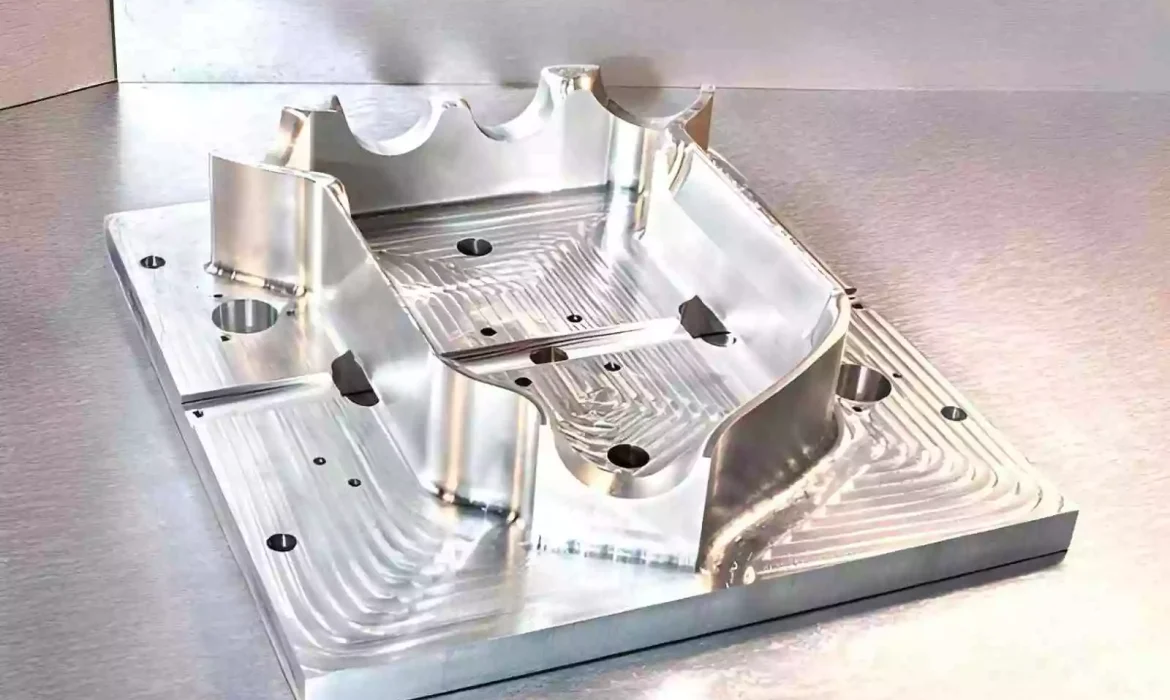
In CNC machining, thin-wall complex machined parts are widely recognized as the most prone to dimensional deviations. Compared with solid components, these parts have lower structural rigidity and high material removal rates. During precision machining, as material is gradually removed, internal residual stresses are released and overall stiffness decreases, making bending, warping, or dimensional drift highly likely. In advanced manufacturing, controlling dimensional stability is not only a matter of quality—it directly affects assembly accuracy and long-term reliability.
Structural Characteristics and Rigidity Evolution of Thin-Wall Parts
Thin-wall complex parts often feature high aspect ratios, multi-cavity hollow sections, and alternating thin regions with reinforcing ribs. In full milling operations, material removal rates can exceed 60%, and in some aerospace components, even reach 80% or more.
As material is progressively removed, the section modulus decreases significantly. According to beam bending theory, deflection is proportional to applied load and inversely proportional to section stiffness. When wall thickness drops to millimeter-scale, bending resistance falls sharply, and even minor cutting forces or residual stress release can produce measurable deflection.
This evolution of stiffness forms the fundamental reason why thin-wall parts are so sensitive to deformation during CNC machining.
Key Mechanisms Behind Thin-Wall Part Deformation
Residual Stress Release and Redistribution
Residual stresses from forging, rolling, or heat treatment create internal self-equilibrating stress fields. When CNC machining removes material, this equilibrium is disrupted, and stresses redistribute along directions of lowest rigidity.
For parts with high material removal rates, such stress redistribution is often asymmetric. Thin-wall areas, with low bending stiffness, are particularly vulnerable. Even if dimensions appear correct while the part is clamped, bending or warping can occur immediately upon release. From a mechanical perspective, this is a structural relaxation driven by residual stress, not a simple machining error.
Interaction of Cutting Forces and Low Structural Stiffness
During machining, cutting forces apply periodic loads to the workpiece. Thin-wall structures, due to low bending stiffness, experience immediate elastic deflection under these loads.
If deflection exceeds allowable tolerances, dimensional errors occur. In some areas, if the stress surpasses elastic limits, permanent deformation results. For complex parts, stiffness varies locally, so the effect of cutting forces is amplified in certain regions, especially at cavity edges or intersections of thin ribs. Precision machining often relies on reducing axial depth, radial load, and feed rates to mitigate this risk.
Thermo-Mechanical Effects and Heat-Induced Deformation
High-speed machining generates significant heat at the tool-workpiece interface. Poor cooling or low thermal conductivity materials can develop temperature gradients, causing non-uniform thermal expansion.
Thin-wall parts are especially sensitive to these effects, as low stiffness magnifies the structural response to heat. Upon cooling, contraction may cause surface deviations or local warping. In materials like titanium alloys, the combination of thermal input and low rigidity is a critical factor in dimensional changes.
Dynamic Stability and Vibration Response
Thin-wall structures have low natural frequencies, making them susceptible to resonance with spindle or tool vibrations. Vibrations can alter instantaneous chip thickness, affecting wall thickness consistency and surface finish.
From a system perspective, the machine, tool, and workpiece form a complete rigidity chain. Any weak link reduces dynamic stability, emphasizing the importance of optimizing spindle speed and toolpaths for vibration control.
Material Influence on Thin-Wall Machining

Different materials respond differently to machining-induced deformation due to variations in modulus of elasticity, thermal expansion, and thermal conductivity.
- Aluminum alloys have low modulus and are prone to bending but require relatively low cutting forces, making them suitable for aerospace and automotive lightweight components. Symmetrical material removal and staged stress management are critical.
- Titanium alloys have high strength but poor thermal conductivity, increasing susceptibility to heat-induced distortion.
- Stainless steels have higher rigidity but higher cutting forces and work-hardening effects; inadequate fixturing can still lead to local deflection.
Material selection and process parameters must be coordinated to ensure dimensional stability.
Engineering Strategies for Controlling Deformation
Effective control requires a system-level approach integrating structural design, machining process, and machine system stability.
- Staged machining gradually releases residual stress, preventing concentrated deformation.
- Symmetrical toolpaths maintain balanced structural loading, reducing stress concentration.
- Optimized cutting parameters limit elastic deflection and heat input.
- High-rigidity fixtures and multi-point support increase structural stiffness during machining, minimizing transient deflection.
- Machine system optimization ensures vibration stability, reducing dynamic amplification effects.
Only by considering material behavior, structural stiffness, and cutting dynamics together can deformation in complex thin-wall parts be effectively managed.
Practical Implications in Engineering Applications
- Aerospace components: Aluminum frames and ribbed structures are often fully milled with high material removal rates. Improper stress management can compromise assembly precision.
- Medical implants: Titanium thin-wall implants require light-weight design and biomechanical compatibility. Uncontrolled deformation affects fit and long-term stability.
- High-power electronics: Thin-wall heatsink fins are sensitive to cutting forces; even slight bending reduces thermal efficiency.
- Automotive lightweight structures: Thin-wall components must maintain strength while reducing weight. Machining-induced deformation can concentrate assembly stress, shortening service life.
Conclusion
Deformation of thin-wall complex machined parts arises from a combination of residual stress redistribution, cutting force effects, thermo-mechanical coupling, and dynamic vibration. As structural rigidity decreases with material removal, even minor external loads can lead to measurable dimensional changes.
In CNC and precision machining, controlling these factors through systematic process design, optimized cutting parameters, and robust fixturing is essential to ensure both dimensional stability and component reliability in real-world applications.