

The ideas of conductivity and insulators are essential in physics and materials science. These characteristics determine how materials react to heat energy, electric currents, and other forces. Making wise decisions in electronics, buildings, or everyday living requires understanding insulators and conductivity. This guide explores the definitions of conductivity and insulators, their main distinctions, and their uses in various industries.
What is Conductivity?
Conductivity is a material’s ability to permit the movement of heat energy or electric current. It gauges how readily heat or electrons may pass through a material. Low conductivity indicates resistance to the movement of heat or electricity, whereas high conductivity indicates that the material easily allows this flow.
Types of Conductivity
Below, I will describe the types of conductivity:
Conductivity of Electricity
This assesses a substance’s capacity to carry electricity. Because of their free electrons, metals like copper, silver, and gold are good electrical conductors.
Conductivity of Heat
This measures a material’s ability to conduct heat. Because of their excellent thermal conductivity, materials like diamond and aluminium are valuable in applications that require heat dissipation.
Conductivity of Ionics
Conductivity results from ion movement in ionic solutions. For instance, seawater conducts electricity because the dissolved salt produces ions that are free to move.
Superconductivity
Superconductivity is the ability of some materials to conduct electricity with no resistance at very low temperatures. Advanced technology, such as particle accelerators and MRI scanners, uses this phenomenon.
What is an insulator?
An insulator is anything that prevents heat or electricity from moving through it. In contrast to conductors, energy cannot flow through insulators because their firmly linked electrons are immobile. Because they contain direct currents, insulators are essential to the efficiency and safety of electrical systems.
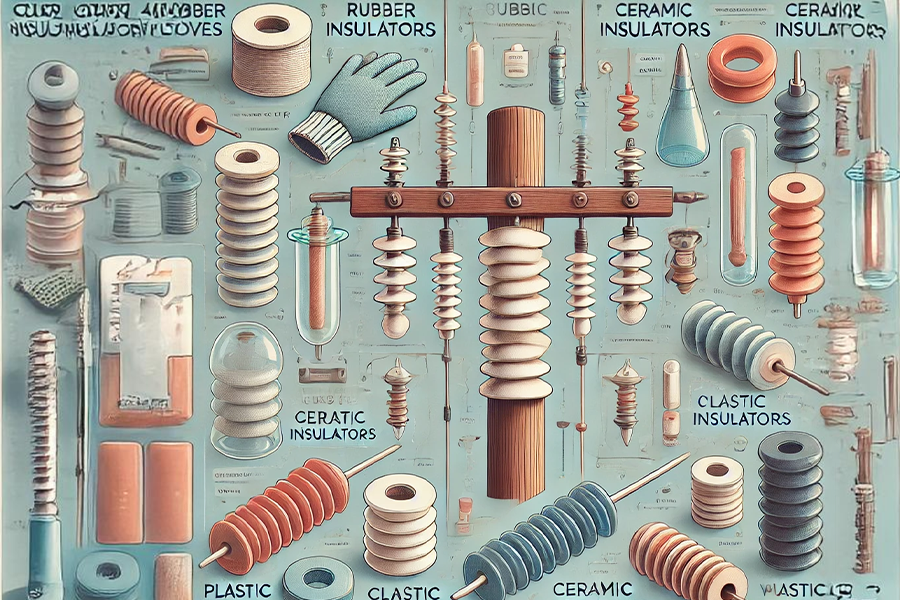
Common Insulating Materials
Below, I will describe the common insulating materials:
Rubber
Used to prevent electric shocks in electrical wiring and equipment.
Glass
Power lines and other high-voltage applications frequently employ it.
Ceramics
Utilised in electronics and space shuttles, among other applications needing heat and electricity resistance.
Plastic
extensively utilised in wiring insulation, appliances, and consumer electronics.
Air
A naturally occurring insulator that stops the transfer of heat and electricity. Air gaps are used to provide insulation in double-glazed windows.
Uses for Insulators and Conductors
Both conductors and insulators play crucial roles in many different fields. Due to their unique features, they are appropriate for specialised applications.
Uses for Conductors
Below, I will describe the following explanation:
- Electronic devices: Circuit boards and wiring both use conductors like copper and aluminium.
- Transmission of Power: Overhead electricity lines use materials with high conductivity, such as aluminium.
- Applications of Heat: Heat sinks and cooling systems use materials with high thermal conductivity, such as aluminium and silver.
- Industrial Procedures: Chemical manufacturing, welding, and electroplating all involve conductive materials.
Uses for Insulator
Below, I will describe the following explanation:
- Electrical Security: Wiring and safety gear both require insulators like rubber and plastic.
- Construction of Buildings: Glass and foam are utilised to achieve thermal insulation in structures.
- Electronic devices: Transistors and capacitors are two examples of components that use ceramic insulators.
- Systems at High Voltage: Power line insulators are made of materials like porcelain and glass.
Factors Affecting Conductivity
Several factors influence the conductivity of a substance:
Composition of the Material
Because they have fewer electron-scattering mechanisms, pure metals are more conductive than mixtures.
Temperature
Higher temperatures tend to decrease conductivity in conductors because of increased electron scattering. Conversely, at greater temperatures, some insulators turn into better conductors.
Contaminants
A material’s conductivity can be decreased by impurities interfering with the electron flow.
Physical Condition
Conductivity depends on the material’s condition (solid, liquid, or gas). Ionic substances, for instance, conduct electricity when they are liquid but not when they are solid.
Crystal Structure
How atoms are arranged in a material can affect how well it conducts heat or electricity.
How to Measure Conductivity
Below, I will describe the measure of conductivity:
1. Conductivity of electricity
It is measured with instruments such as a conductivity meter or a multimeter. Siemens per metre (S/m) is the unit of measurement.
2. Conductivity of Heat
Measured using approaches such as transient or steady-state methods. The measurement unit is W/m·K or watts per meter-kelvin.
3. Conductivity of Ionic
Measured in solutions with a conductivity meter. Microsiemens per centimetre, or µS/cm, are frequently used to express the results.
Current Developments in Insulation and Conductivity
Here, I will describe the Current Developments in Insulation and Conductivity:
Graphene
It is an innovative substance with remarkable thermal and electrical conductivity. It can be used for everything from sophisticated batteries to flexible electronics.
Aerogels
Aerogels are highly light materials used in building and aerospace with superior insulating qualities.
Super-insulators
Materials with a very high electrical current resistance that are helpful in advanced electronics and quantum computing.
Nanotechnology
Nanomaterials are being created to improve insulation and conductivity for specific uses.
FAQs
1. What is the most effective electrical conductor?
Because of its excellent electron mobility, silver is the best electrical conductor. However, copper is utilised more frequently in real-world applications due to its lower cost and superior conductivity.
2. Can a substance be both an insulator and a conductor?
Indeed, depending on external factors like temperature, voltage, or doping, certain materials, such as semiconductors, can display both conductor and insulator characteristics.
3. What is the significance of insulators in electrical systems?
Insulators shield people from electric shocks and guarantee electrical systems’ safe and effective operation by preventing undesired current flow.
4. How does temperature impact conductivity?
In general, temperature increases electron scattering, which reduces metal conductivity. However, some semiconductors and insulators become more conductive as the temperature rises.
Conclusion
Modern science and engineering depend on an understanding of conductivity and insulators. In systems, insulators offer safety and control, while conductors facilitate the effective transfer of heat and electricity. Thanks to developments in materials science, new conductive and insulating materials are opening up new technological and innovative possibilities. These characteristics are crucial for forming the environment we live in, whether in technology, construction, or daily life.
Looking for Precision CNC Machining Services
MS Machining delivers top-quality custom machining solutions with accuracy and efficiency. Visit ms-machining.com and contact us today for a free quote and take your project to the next level!