

Key Challenges of Welding Aluminum in Thin-Wall and Precision Applications
Ever tried welding a soda can without melting it entirely? That is the level of difficulty we face with thin-wall aluminum welding. While aluminum is prized for being lightweight and corrosion-resistant, it is notoriously difficult to join without ruining the part. We frequently see manufacturers struggle with warping, burn-through, and weak joints because they underestimate the material’s unique behavior.
Here is why achieving precision aluminum welds is so tough:
- Rapid Heat Spread: Aluminum conducts heat incredibly fast. This high thermal conductivity pulls heat away from the weld zone, leading to significant distortion in high precision aluminum components.
- High Reflectivity: The material acts like a mirror, bouncing laser energy away rather than absorbing it. This causes energy loss and results in unstable, inconsistent welds.
- The Oxide Layer Trap: Aluminum instantly forms a tough oxide skin. This layer melts at a much higher temperature than the base metal inside, often trapping gas and promoting porosity or cracking.
- Burn-Through Risk: In delicate sections—especially those under 1mm—there is zero margin for error. A split second of excess heat leads to immediate burn-through.
Traditional Methods vs. Thin Aluminum
Many shops still rely on TIG or MIG, but for delicate assemblies, these methods are often too aggressive. When comparing laser welding vs TIG aluminum, the limitations of traditional arcs become obvious.
| Feature | Traditional Welding (TIG/MIG) | Impact on Thin Aluminum |
|---|---|---|
| Heat Input | High and widespread | Large Heat Affected Zone (HAZ) and warping |
| Control | Manual/Variable | High risk of melting through delicate parts |
| Finish | Heavy bead / Spatter | Requires extensive grinding and polishing |
Using high-heat methods on laser welded aluminum parts often turns a quick welding job into a long post-processing nightmare, costing us time and money on grinding and straightening.
How Laser Welding Overcomes Aluminum Welding Challenges
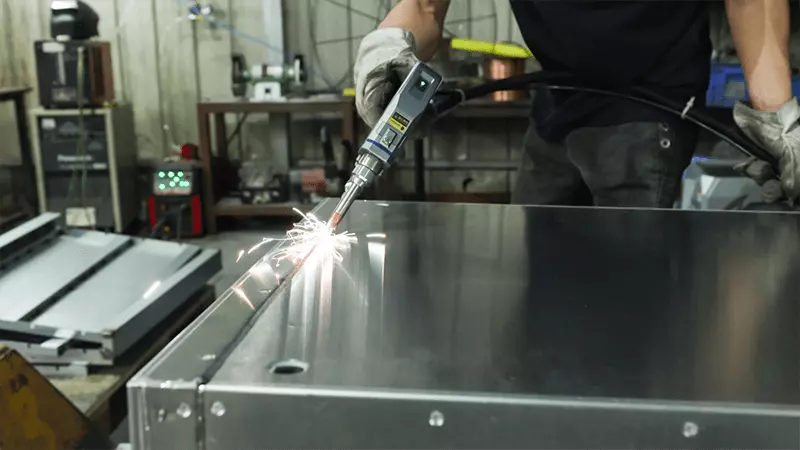
At MS Machining, we tackle the inherent difficulties of aluminum fabrication head-on using advanced aluminum laser welding processes. Traditional methods often struggle with aluminum’s high thermal conductivity and reflectivity, but modern laser technology changes the game by providing the control needed for precision aluminum welding. By leveraging our specialized equipment, we turn potential manufacturing headaches into reliable, high-quality results.
Here is how our laser welding capabilities address common aluminum issues:
- Focused Energy Delivery: We concentrate energy into a microscopic spot size to achieve controlled melting. This prevents excessive heat spread, which is critical for thin-wall aluminum welding where warping is a major risk.
- Overcoming Reflectivity: Our setup utilizes advanced laser sources, including fiber laser aluminum systems and pulsed (QCW) modes. These technologies effectively penetrate highly reflective surfaces without the energy loss or instability often seen in older welding methods.
- Porosity and Oxide Management: Through precise parameter optimization, we manage the stubborn oxide layer that causes defects. This control minimizes gas entrapment, allowing us to consistently produce porosity-free aluminum joints.
- Solutions for Crack-Sensitive Alloys: For alloys prone to hot cracking, we fine-tune our approach, incorporating filler materials when necessary to stabilize the weld pool and ensure the structural integrity of the component.
Core Advantages of Laser Welding for Thin-Wall Aluminum Components
At MS Machining, we rely on laser welding to deliver superior results for delicate aluminum assemblies. This process addresses the specific thermal and structural challenges of working with lightweight alloys, ensuring that we meet the rigorous standards of the aerospace and medical industries.
Here is why laser welding is our preferred method for thin-wall and precision applications:
- Minimal Heat-Affected Zone (HAZ): The focused energy of the laser limits thermal spread, which significantly prevents warping. This allows us to maintain strict dimensional accuracy, even on parts where thermal distortion would typically be a failure point.
- Exceptional Precision and Repeatability: Our CNC-integrated laser systems offer high repeatability for intricate geometries. We achieve precision aluminum welds that hold tight tolerances across large production runs, ensuring every part matches the specification perfectly.
- Reduced Distortion and Burn-Through: For components with wall thicknesses under 1mm, reduced distortion welding is essential. The laser’s precise control eliminates the risk of burn-through, preserving the structural integrity of delicate sections.
- High-Speed Processing: Laser welding is significantly faster than traditional methods. This high-speed processing boosts our overall manufacturing efficiency while minimizing the time the material is exposed to heat, preserving the aluminum’s mechanical properties.
- Clean, Aesthetic Welds: We deliver clean aesthetic aluminum welds with minimal spatter. This results in a high-quality surface finish right out of the machine, reducing the need for extensive post-weld grinding or polishing.
Advantages for Precision Components
When manufacturing critical parts for industries like aerospace and medical, structural integrity is non-negotiable. At MS Machining, we utilize laser welding aluminum processes to deliver superior strength through deep, narrow penetration. This focused energy ensures that the joint is robust without compromising the surrounding material, a common issue with broader heat sources.
For precision aluminum welds, the benefits extend beyond just strength:
- Consistency and Scalability: Our facility operates 5+ specialized laser welding machines, allowing us to maintain identical standards across high-volume production runs. This compatibility with automation ensures that every laser welded aluminum part meets the same tight tolerances, eliminating the variability found in manual welding.
- Minimal Post-Processing: Because the laser creates a clean, aesthetic seam with little to no spatter, the need for grinding or polishing is drastically reduced. This streamlines the workflow, much like the efficiency found in rapid CNC machining applications, saving both time and production costs.
- Preserved Material Properties: Thin-wall aluminum welding requires a delicate touch to maintain the metal’s natural corrosion resistance. The low heat input of laser welding prevents the degradation of the alloy’s microstructure, ensuring the final component performs exactly as intended in harsh environments.
Laser vs. Traditional Welding Methods: A Direct Comparison
When we handle thin-wall aluminum fabrication, the choice of welding method defines the final quality. While traditional methods have their place, laser welding aluminum offers distinct advantages for precision components that TIG and MIG simply cannot match.
Heat Input and Distortion Levels
Traditional TIG and MIG processes apply significant heat to the workpiece to create a melt pool. On thin aluminum sheets, this high thermal input often leads to warping, buckling, or even burn-through. In contrast, our laser welding systems utilize a highly focused beam. This results in reduced distortion welding by minimizing the Heat-Affected Zone (HAZ), ensuring your parts maintain their original dimensions and tight tolerances.
Speed, Precision, and Post-Processing
Speed is a critical factor in manufacturing efficiency. Laser welding vs TIG aluminum comparisons consistently show that laser processes are much faster and easier to automate. TIG welding is manual and slower, often leaving a large bead that requires extensive grinding and polishing. Laser welds are clean, aesthetic, and precise, often eliminating the need for secondary finishing.
For projects requiring complex preparation before joining, our CNC machining services ensure that every edge is perfectly aligned to maximize the precision of the laser weld.
Comparison Matrix: Laser vs. TIG vs. MIG
| Feature | Laser Welding | TIG Welding | MIG Welding |
|---|---|---|---|
| Heat Input | Low (Focused energy) | High (Broad heat spread) | Medium/High |
| Distortion Risk | Minimal (Ideal for thin walls) | High (Prone to warping) | Moderate |
| Processing Speed | High (Rapid, automated) | Low (Manual, slow) | Medium |
| Weld Precision | Excellent (Fine detail) | Good (Skill dependent) | Fair (General purpose) |
| Post-Processing | None/Low (Clean finish) | High (Grinding required) | High (Spatter removal) |
Real-World Efficiency Gains
Switching to laser welding for delicate assemblies allows us to reduce defect rates significantly. By removing the variability of manual welding and the risk of thermal distortion, we deliver consistent, high-strength joints for industries like aerospace and medical devices. This efficiency translates directly into lower costs and faster turnaround times for your production runs.
Practical Applications in Industry
At MS Machining, we leverage our 20+ years of manufacturing experience to apply laser welding across sectors where failure is not an option. Our facility is equipped to handle the strict demands of aerospace aluminum welding and other critical applications, ensuring that thin-wall components maintain their structural integrity and performance.
Aerospace and Defense
In the aerospace sector, reducing weight without sacrificing strength is the primary goal. We utilize laser welding to join lightweight frames, fuel tanks, and structural assemblies. This process eliminates the need for heavy mechanical fasteners and creates seamless joints that withstand extreme pressure. Our integrated CNC precision machining services often prepare these complex geometries prior to welding, ensuring a perfect fit for flight-critical hardware.
Medical Devices
Cleanliness and precision are non-negotiable for medical device aluminum components. We manufacture parts for sophisticated equipment, such as Gas Blood Analyzers, where welds must be smooth, pore-free, and hermetic to prevent contamination. Laser welding provides the control needed to join delicate enclosures and instruments without introducing excess heat that could warp the assembly.
Automotive and EV Components
The shift toward electric vehicles relies heavily on thin-wall aluminum fabrication. We apply laser welding to battery housings, heat exchangers, and thin chassis components. The minimal heat input is crucial here; it prevents distortion in large, flat aluminum sheets, ensuring that protective housings remain dimensionally accurate and perfectly sealed against the elements.
Electronics and Thermal Management
For electronics, thermal sensitivity is a major challenge. We produce housings and heat sinks where precision aluminum welds are essential for maintaining thermal conductivity. Laser welding allows us to seal protective casings around sensitive electronics without damaging internal components, providing a durable solution for high-performance tech.
Best Practices and Parameters for Optimal Results
At MS Machining, we know that achieving consistent, high-quality results in thin-wall aluminum welding requires more than just high-end equipment; it demands precise control over every variable. With over 20 years of manufacturing experience, we fine-tune our laser welding aluminum processes to handle the specific challenges of reflectivity and thermal conductivity found in delicate components.
Selecting the Right Laser Mode
Choosing between pulsed and continuous wave modes is the first step in controlling heat input and ensuring precision aluminum welds.
- Pulsed Laser Welding: This is our go-to for thin aluminum sheet welding. By delivering energy in rapid, controlled bursts, we allow the material to cool slightly between pulses. This significantly reduces the heat-affected zone (HAZ) and prevents distortion in parts with walls under 1mm.
- Continuous Wave (CW): We use this for applications requiring deeper penetration and faster travel speeds on slightly thicker sections. It provides a smooth, continuous seam but requires strict speed management to avoid overheating.
Critical Welding Parameters
To overcome issues like burn-through or porosity, we adjust four main settings on our 5+ specialized laser welding machines.
| Parameter | Function | Impact on Aluminum |
|---|---|---|
| Power Density | Controls energy concentration | Must be high enough to break through the tough aluminum oxide layer instantly. |
| Focus Position | Determines spot size | precise focus ensures the energy is applied exactly where needed for thin-wall aluminum fabrication. |
| Shielding Gas | Protects the weld pool | Argon or Helium is used to prevent oxidation and ensure porosity-free aluminum joints. |
| Travel Speed | Regulates heat input | Faster speeds prevent burn-through on thin sheets; slower speeds ensure fusion on thicker joints. |
Surface Preparation for Consistency
Even the best fiber laser aluminum setup cannot compensate for poor surface conditions. Aluminum forms a natural oxide layer that absorbs moisture and leads to defects. Before welding, we ensure that all mating surfaces are free of oils, grease, and heavy oxides.
Proper joint fit-up is just as important as the weld itself. Our precision CNC machining services ensure that component edges are perfectly aligned before they ever reach the welding station. Tight tolerances in the machining phase allow for seamless automated welding, ensuring a clean, aesthetic finish without the need for heavy post-processing.
Why Choose MS Machining for Your Aluminum Laser Welding Needs
At MS Machining, we understand that precision aluminum welding requires more than just heat and metal; it requires a controlled environment and decades of expertise. Since 2004, we have established ourselves as a premier manufacturing partner, operating a 30,000+ square foot climate-controlled facility dedicated to producing high-quality components for global markets.
We utilize 5+ specialized laser welding machines integrated directly into our manufacturing lines. This setup allows us to seamlessly transition parts from our aluminum CNC machining parts production capabilities directly to welding and assembly. By controlling the entire process in-house, we eliminate the risks associated with moving delicate thin-wall parts between multiple vendors.
The MS Machining Advantage
Our team of 200+ skilled machinists and engineers specializes in serving mission-critical industries. Whether it is aerospace aluminum welding or complex assemblies for medical gas blood analyzers, we deliver results that meet strict international standards.
| Feature | Benefit for Your Project |
|---|---|
| Advanced Equipment | 5+ Laser Welding Machines and 30+ CNC Centers ensure capacity and consistency. |
| Rigorous QC | 3 dedicated QC lines guarantee that every weld meets tight tolerances. |
| Industry Expertise | Proven track record in Aerospace, Defense, Medical, and Power Generation. |
| Turn-Key Solutions | From R&D and prototyping to full-scale assembly and surface finishing. |
We pride ourselves on offering stable, efficient, and high-quality manufacturing services. Our ability to handle everything from material selection and fabrication to the final laser welded aluminum parts ensures you receive a finished product ready for immediate implementation. When you need reliable aluminum laser welding services that prioritize structural integrity and cosmetic perfection, MS Machining is your trusted partner.
Frequently Asked Questions (FAQs)
Why is laser welding better than TIG for thin aluminum?
Laser welding vs TIG aluminum comes down to heat control. TIG welding typically dumps significant heat into the part, which causes warping and burn-through on thin materials. Laser welding delivers highly focused energy, resulting in a minimal heat affected zone (HAZ). This allows us to weld thin aluminum sheet welding applications without distorting the component’s shape, ensuring the high dimensional accuracy required for aerospace and medical parts.
Does laser welding aluminum require filler material?
Not always. For many precision aluminum welds, we use autogenous welding (welding without filler) to create a seamless, clean joint, provided the fit-up is tight. However, for certain alloys prone to cracking or where gap bridging is necessary, we can introduce filler wire to ensure structural integrity.
How do you prevent porosity when laser welding aluminum?
Achieving porosity-free aluminum joints requires strict process control. Aluminum’s oxide layer absorbs moisture, which releases hydrogen during welding, causing bubbles. We mitigate this by:
- Thoroughly cleaning surfaces to remove oxides and contaminants.
- Optimizing shielding gas coverage to protect the melt pool.
- Adjusting power density and speed to manage the rapid solidification of high reflectivity aluminum solutions.
What is the minimum thickness for laser welding aluminum parts?
We specialize in thin-wall aluminum fabrication and can handle material thicknesses well under 1mm, often down to foil gauges depending on the geometry. Our pulsed laser capabilities allow us to weld delicate electronics and medical components without thermal damage. If you have specific thickness requirements for your project, contact us to discuss feasibility with our engineering team.