Why Combine Investment Casting with CNC Machining? The Hybrid Approach Explained
If you’re in manufacturing, you already know investment casting delivers complex, near-net-shape parts with excellent surface finish. But relying on casting alone often falls short when tight tolerances and precision features are critical. That’s where combining it with CNC machining becomes a game-changer. This hybrid approach is gaining serious traction across aerospace, medical, automotive, and defense industries—anywhere performance and precision can’t be compromised.
By the end of this article, you’ll understand exactly why leading manufacturers choose to pair investment casting with CNC machining to unlock better accuracy, reduce costs, and accelerate production—outperforming either method alone.
The Core Strengths (and Limitations) of Investment Casting Alone
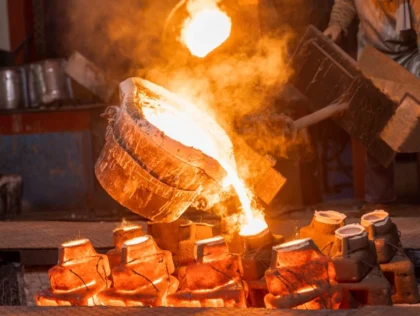
Investment casting offers outstanding near-net-shape capability, producing parts very close to final dimensions with minimal material waste. This process excels at creating complex geometries and fine details like thin walls that other methods struggle to achieve cost-effectively. Surface finish straight out of the mold is also superior, typically ranging between Ra 3.2 and 6.3 μm, reducing the need for heavy post-processing.
However, investment casting alone has limitations that often require CNC machining to meet exact specifications:
- Dimensional variations can reach ±0.005 in/in, which can be too loose for critical features
- Draft angles and core shift can cause slight shape distortions
- Minimum wall thickness must be thicker than some applications demand for structural integrity
These factors mean that while investment casting produces excellent near-net-shape parts, it often needs precision CNC finishing for tight tolerances and critical functional surfaces.
Where Precision CNC Machining Takes Over
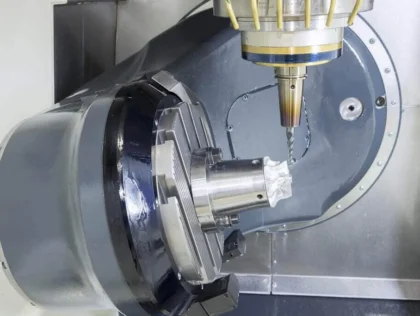
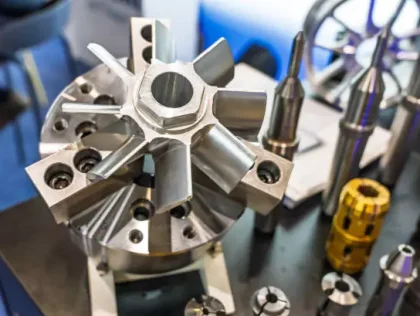
CNC machining steps in where investment casting reaches its limits. It can hit tight tolerances as close as ±0.0005″ (±0.012 mm), making sure critical parts meet exact specs. This process cleans up the casting by removing draft angles, flash, and parting lines that the mold leaves behind. CNC machines also handle essential features like threads, holes, sealing surfaces, and mounting faces that need precision beyond what casting alone can provide.
On top of that, CNC machining adds value with post-casting surface finishing options such as mirror polish, anodizing, and passivation. These finishes improve both the look and durability of the parts, which is often crucial for aerospace, medical, and other high-standard industries. Combining investment casting with CNC finishing gives you the best of both worlds: complex shapes from casting plus precise, clean details from machining.
10 Key Benefits of Combining Investment Casting + CNC Machining

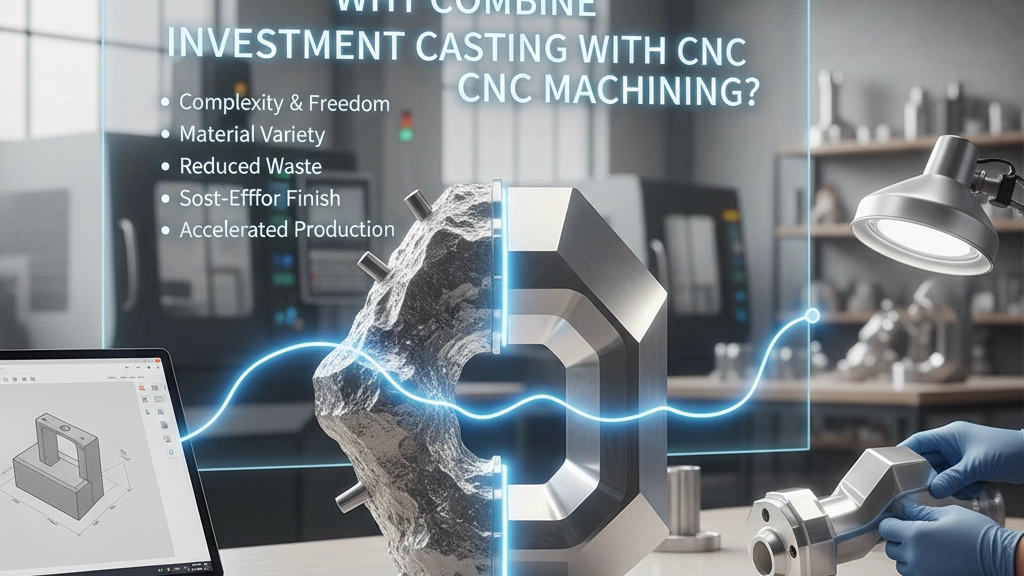
Combining investment casting with CNC machining brings huge advantages that can cut costs, save time, and improve quality. Here’s why this hybrid manufacturing process works so well:
| Benefit | What It Means for You |
|---|---|
| Cost Reduction vs. Billet Machining | Spend less than machining parts from solid metal |
| Weight Savings vs. Solid Bar | Lighter parts by casting near-net-shape, not hogging out material |
| Selective Precision | Tight tolerances where needed—no costly over-machining |
| Shorter Lead Times | Faster delivery than multi-piece weldments or forgings |
| Better Mechanical Properties | Strong cast parts + stress-relieved, machined surfaces |
| Economical Use of Tough Alloys | Work easily with Inconel, titanium, stainless 17-4PH |
| Fewer Secondary Operations | Cuts out extra finishing or assembly steps |
| Scalable Production | Smooth transition from prototypes to 100,000+ pieces |
| Reduced Assembly Part Count | Combine features into single parts, saving assembly time |
| Consistent Repeatability | Perfect for regulated industries like AS9100 and ISO 13485 |
By blending the near-net-shape advantages of investment casting with the precision of CNC machining, you get cost-effective precision castings that meet today’s demanding standards without breaking the bank or slowing down production.
Material-Specific Advantages
Combining investment casting with CNC machining works differently depending on the metal you use. Here’s how it breaks down for key materials:
Stainless Steel & Tool Steels
These metals are tough but machinable, making them perfect for precision cast and machined parts. Investment casting handles the complex shape, while CNC finishing nails the tight tolerances needed for critical features. Ideal for medical devices and industrial tools where durability and surface finish matter.
Aluminum and Magnesium
Lightweight and corrosion-resistant, aluminum and magnesium castings are great for aerospace and automotive parts. The near-net-shape casting reduces machining time, and CNC machining cleans up surfaces and machines holes or threads with precision — all while keeping costs down.
Nickel-Based Superalloys (Inconel 718, Hastelloy)
These alloys are tough to machine but excel in high-temperature environments. Investment casting shapes complex geometries in Inconel or Hastelloy economically. CNC machining then applies tight tolerance finishing on critical areas like sealing surfaces or mounting points, perfect for aerospace and oil & gas applications.
Titanium and Cobalt-Chrome
Titanium’s strength-to-weight ratio and corrosion resistance make it a favorite for aerospace and medical implants. Casting gets you close to the final shape, while CNC machining ensures the precise fit and finish required. Cobalt-chrome alloys benefit similarly, offering excellent wear resistance once they’re cast and finely machined.
In all cases, this hybrid approach cuts down on material waste and machining time, making tough-to-machine metals cost-effective without sacrificing quality or precision.
Industry Applications & Success Stories
Combining investment casting with CNC machining fits perfectly across several industries here in the U.S., where quality and precision can’t be compromised.
- Aerospace: Think turbine blades and structural fittings that require complex geometry and tight tolerances. Our hybrid manufacturing process provides precise, reliable parts that meet strict aerospace standards like AS9100, reducing lead times and costs.
- Medical: Orthopedic implants and surgical instruments benefit from the superior surface finish and tight control only this combo offers. From wax pattern to finished part, we deliver consistent, biocompatible components essential for medical device manufacturing.
- Defense/Firearms: Receivers and optic mounts need exact threading and durability. Investment casting with CNC finishing ensures parts are to spec and repeatable, cutting out costly rework.
- Oil & Gas: Valve bodies and pump components take advantage of near-net-shape machining to save material and machining time, especially in tough alloys like stainless steel and Inconel.
Real-World Wins
- A Midwest aerospace supplier cut their lead times by 30% and reduced costs by 25% after switching to this hybrid process for structural fittings.
- A medical device maker improved surface finish on implants, eliminating secondary treatments and slashing production time by 40%.
- An oil and gas company boosted part reliability with stress-relieved castings and CNC-machined critical sealing surfaces, extending component lifespan in harsh environments.
These success stories reflect how investment casting combined with CNC machining drives cost-effective precision castings with consistent quality across various high-demand sectors.
When You Should NOT Combine Investment Casting with CNC Machining
While combining investment casting with CNC machining offers many benefits, it’s not always the best choice. Here are situations where you might want to skip the hybrid manufacturing process:
Very high-volume, simple geometries: If your parts are basic shapes and produced in huge quantities, other methods like stamping or forging might be more cost-effective.
Extremely tight tolerances across the entire part: When your design demands ultra-precise dimensions throughout every feature, full CNC machining from solid billet can deliver better consistency.
Budget constraints outweigh performance needs: If cost is your top priority and you can accept looser tolerances or simpler finishes, investing in separate casting and machining might not make financial sense.
In these cases, sticking with a single process or alternative manufacturing methods could save time and money without sacrificing quality.
How MS Machining Executes This Hybrid Process Perfectly
At MS Machining, we handle the entire hybrid manufacturing process in-house, ensuring top quality and full control from start to finish. It all starts with wax pattern verification, where we check every detail before moving to investment casting. Once the parts are cast, we perform a full 3D scan to catch any dimensional variations early.
Our multi-axis CNC machining then takes over, refining critical features with tight tolerances down to ±0.0002″. This precision cast and machined parts approach guarantees parts meet even the toughest specs. We also provide certified surface finishing and passivation, so your metal parts are ready for use right out of our shop.
With MS Machining’s one-stop responsibility, you won’t have to worry about finger-pointing between foundry and machine shop. We’re committed to delivering consistent, cost-effective precision castings, tailored perfectly for your application—whether aerospace, medical devices, or industrial uses.