
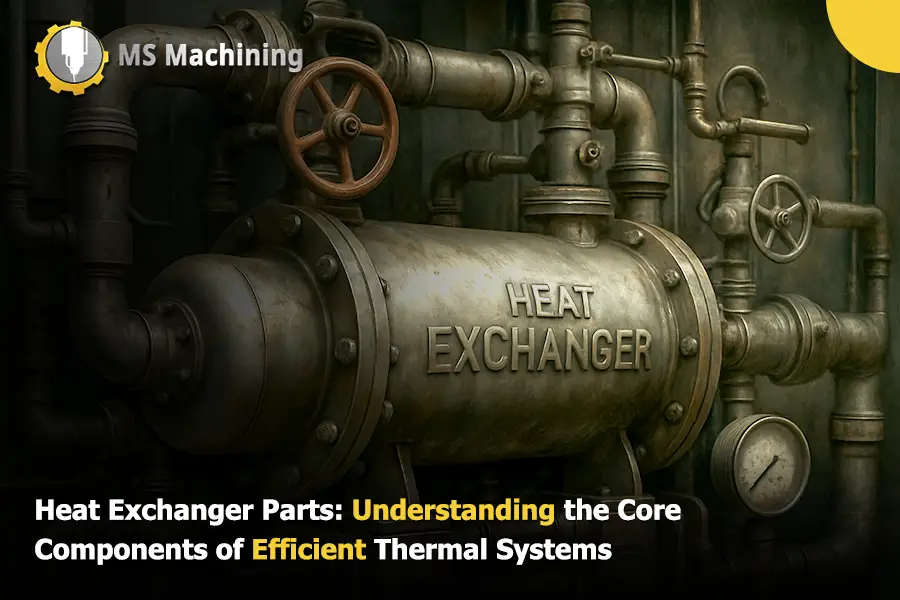
Numerous sectors, including HVAC, chemical processing, oil and gas, food manufacturing, and power generation, rely on heat exchangers. These devices control energy efficiency by transmitting heat between two or more fluids without mixing them. However, the inside pieces of the heat exchanger make the process function well.
This article will cover the primary components of heat exchangers, their materials and purposes, typical failure points, and maintenance advice.
What Is a Heat Exchanger?
A heat exchanger is an apparatus that permits heat transfer from one fluid (gas or liquid) to another. This exchange occurs through conduction on solid surfaces, often metal, without direct touch.
- Process fluids can be heated or cooled using heat exchangers.
- Evaporate or condense liquids.
- Keep industrial systems at a constant temperature.
- Recover waste heat to save energy.
Essential Heat Exchanger Components and How They Work
Every part of a heat exchanger is made to handle particular fluid types, pressures, and temperatures while maximizing heat transfer.
1. Plates or tubes
These serve as the main surfaces for heat transfer. In shell-and-tube designs, the fluid flows inside tubes; in plate heat exchangers, it flows between plates.
- Function: Heat transmission between fluids is its function.
- Standard components: It includes titanium, copper, and stainless steel.
- Designs: Corrugated (to increase surface area), finned, or smooth
2. Sheets of tubes
A tube sheet is a metal plate that divides fluids and retains tubes in place.
- Function: Secures tube bundles and blocks fluid pathways.
- Features: Accurately drilled holes for the installation of the tube
- Material selections: For compatibility, often the same as the tube material
3. The shell
The shell is the large outer vessel that contains the tube bundle in shell-and-tube heat exchangers. Its purpose is to hold one of the process fluids.
- Material: Depending on temperature and pressure, steel, stainless steel, or other alloys
- Crucial: Needs to manage internal pressure and offer sufficient room for turbulence and flow.
4. Baffles
Internal plates called baffles control the fluid flow on the shell side.
Function:
- Increase turbulence to improve heat transmission.
- Tubes for support and spacing to reduce vibration
Placement: Variously positioned within the shell
Benefit: Increase the heat transfer coefficient to boost performance.
5. End covers or headers
These are found at either end of the heat exchanger and are referred to as channel heads or bonnets.
Function:
- Evenly distribute the fluid into the tubes.
- Gather the fluid that is leaving the tubes.
- Types include floating, detachable, and fixed head designs.
Use case: Detachable designs make cleaning and maintenance simpler.
6. Gaskets
Gaskets are necessary to seal component joints.
- Function: Stop fluid from leaking around the tube sheet or between plates.
- Materials: Elastomers, graphite, PTFE, or rubber
- Must-have qualities: Essential qualities include flexibility, heat tolerance, and chemical resistance.
7. Fluid Connections and Nozzles
Fluids can enter or depart the heat exchanger through nozzles.
- Function: Its function is to connect the unit to external pipe systems.
- Design considerations: threaded or flanged according to fluid type and pressure
- Impact: Exchanger efficiency and flow dispersion are impacted by placement.
8. Growth Compensators or bellows
Parts expand and compress in high-temperature conditions—Bellows aid in controlling this motion.
- Function: Reduce mechanical stress and absorb thermal expansion.
- Design: Flexing corrugated metal in response to temperature variations
- Benefit: Avoid weld failure, misalignment, or cracking.
9. Mounts and Support Brackets
External supports hold the unit in place, and tube supports inside the shell avoid vibration.
- Function: Preserve structural integrity when in use
- Types: Types include feet, brackets, and saddles.
- Why it matters: Failure and misalignment can occur due to inadequate support.
Heat exchanger types and component variations
Although different applications require different designs, they all have specific essential components. Parts differ according to the type of heat exchanger:
Heat exchangers with shell and tube
- Use gaskets, headers, baffles, shells, and tube bundles.
- Perfect for situations requiring high temperatures and pressures
- extensively utilized in refineries and chemical industries
Heat exchangers with plates
- composed of gasket-sealed stacking plates
- Small and highly effective in transferring heat
- prevalent in the food and HVAC sectors
Air-cooled heat exchangers
- Utilise fans and finned tubes to use ambient air to cool fluids.
- Add plenum chambers, tube bundles, and fan assemblies.
- When water is costly or unavailable, this is helpful.
Heat exchangers with two pipes
- One pipe inside another in a straightforward design
- Utilized in single-pass or small-scale applications
- Economical for low heat and flow loads
Choosing Materials for Heat Exchanger Components
Performance and longevity are ensured by choosing the appropriate material for each component:
- Stainless Steel: Stainless steel is suitable for everyday usage and is resistant to corrosion.
- Copper: Perfect for HVAC systems due to its high thermal conductivity
- Titanium: Great for corrosive fluids or seawater
- Inconel/Hastelloy:High-performance alloys for harsh conditions are Inconel and Hastelloy.
Essential things to think about:
- Type of fluid: corrosive or non-corrosive
- Temperature and pressure at operation
- Frequency and accessibility of maintenance
- The trade-off between cost and life expectancy
Advice for Heat Exchanger Component Maintenance
Regular maintenance prevents expensive shutdowns and increases longevity. What to monitor is as follows:
- Fouling: Regularly clean tubes or plates to avoid deposit accumulation.
- Gasket wear: Check for cracking, swelling, or hardening in the gasket.
- Corrosion: Examine metal surfaces for indications of pitting or thinning due to corrosion.
- Pressure drop: Keep an eye out for sudden variations that may indicate obstructions.
- Leakage: Look for early indicators close to tube ends, headers, or gaskets.
Take the following precautions:
- To cool water, use water treatment.
- Put in strainers to keep material out.
- Observe a predetermined inspection schedule.
- Have extra parts (plates, tubes, and gaskets) on hand.
Many Reasons Why Heat Exchanger Parts Fail
You can prevent failure modes by being aware of them:
- Thermal fatigue: Temperature cycling is the cause of thermal fatigue.
- Corrosion: frequently brought on by improper material selection or incompatible fluids
- Mechanical vibration: particularly in systems that are poorly constructed or lack support.
- Improper cleaning: Poor cleaning can harm fragile plates or tubes.
Solutions:
- Align the substance with fluid chemistry
- Make use of supports and vibration dampeners.
- Use the appropriate cleaning techniques (mechanical vs. chemical).
- Swap out worn parts for precisely CNC-machined ones.
Significance of High-Quality Components
Purchasing well-crafted, well-made parts leads to:
- Increased effectiveness: Better heat transfer
- Lower downtime: Reduced downtime means fewer malfunctions and easier maintenance.
- Savings: Longer part life and less energy use
- Safety: Keep vital systems from leaking or overheating.
Even minor problems with a gasket or tube might result in significant losses in demanding sectors. Avoid taking shortcuts.
FAQs
1. How frequently should the gaskets on heat exchangers be replaced?
The type of exchanger and the operating environment determine this. Generally speaking, gaskets must be examined at least once a year and replaced if wear, hardness, or chemical damage is evident.
2. Is it possible to replace heat exchanger tubes separately?
Indeed. It is possible to replace individual tubes in many designs. This is usually done when only a few tubes are damaged to avoid having to replace the entire bundle.
3. What is the most frequent cause of heat exchanger component failure?
Fouling and rust are the most common culprits. Both can be reduced with the right fluid treatment, maintenance plans, and material selection.
4. Are off-the-shelf parts inferior to custom CNC-machined parts?
Custom CNC parts provide better performance, accurate fits, and compatibility with legacy systems. They are beneficial when working with unusual or antiquated heat exchanger models.
Conclusion
Knowing the functions of various heat exchanger components aids in system design, troubleshooting, scheduling maintenance, and replacing parts. Each part, from shells and nozzles to gaskets and tubes, is essential to the apparatus’s effectiveness and security.
Purchasing high-quality, precise parts and maintaining a regular maintenance plan helps any company that relies on reliable thermal management improve performance, reduce operating costs, and extend system life.
Elevate Precision: Contact MS-Machining Today!
Do you need professional assistance with heat exchanger parts? Our staff can assist you with tube replacement, gasket upgrades, or locating unique CNC parts. Experience the efficiency and precision our CNC machining services bring to your projects.
Visit ms-machining.com and head to our ‘Contact Us‘ page to get started!