If you’re looking to boost accuracy and efficiency in your shop, understanding the power of a CNC lathe machine is a game changer. These computer-controlled lathes transform traditional turning by automating complex tasks with precision and speed that manual tools simply can’t match. Whether you’re prototyping the next big part or scaling up production, knowing how a CNC lathe machine works—and choosing the right one—can save you time, reduce errors, and open new doors in machining innovation. Ready to cut through the noise and unlock what these machines really offer? Let’s dive into everything you need to know about CNC lathe machines for your modern workshop.
What Is a CNC Lathe Machine? Breaking Down the Basics
A CNC lathe machine is a modern tool used in subtractive manufacturing that automates shaping metal or other materials. At its core, it relies on G-code — a programming language that controls spindle rotation and tool movements to precisely cut, drill, or shape a workpiece. Instead of manual handling, everything runs through computerized instructions, making the process faster and more accurate.
This tech evolved from traditional manual lathes where machinists controlled every move by hand. Now, thanks to CAD/CAM integration, designs come straight from digital blueprints to the machine, reducing human error and boosting repeatability. This shift has transformed shop floors worldwide.
The advantages are clear:
- Consistent quality with minimal variation between parts
- Increased speed for both prototyping and high-volume runs
- Handling a wide range of materials from soft plastics to hardened steel
At MS Machining, we know downtime is the enemy of productivity. Our CNC lathe setups are optimized for automatic runs and quick tool changes, helping local fabricators keep jobs moving smoothly without delays. This means faster turnaround and happier customers.
Anatomy of a CNC Lathe: Essential Components and Their Roles
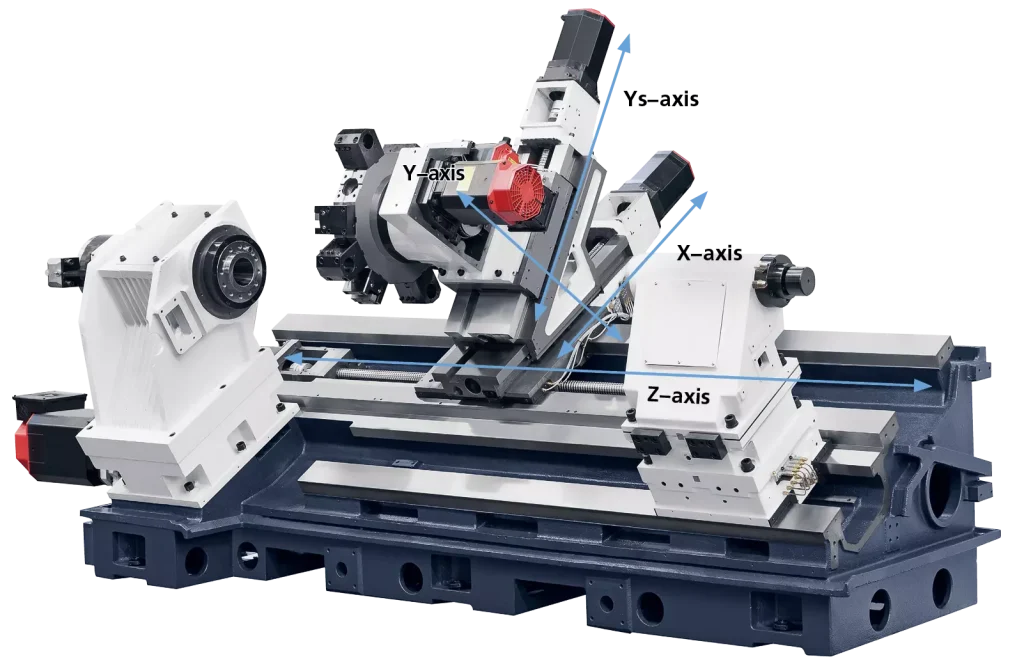
A CNC lathe machine is made up of several key parts that work together to deliver precise, automated turning operations. Here’s a quick breakdown of the major components and what they do.
Headstock and Spindle
The headstock houses the spindle motor, which’s at the heart of the machine. Spindle motors vary in power depending on the machine size, offering speed ranges typically from a few hundred to several thousand RPM for stable, consistent rotation. The spindle holds the workpiece using different CNC chuck types—like three-jaw or four-jaw chucks—ensuring it’s gripped tightly and rotated smoothly during machining.
Bed and Carriage System
The bed provides a solid foundation for the lathe, supporting smooth axis travel. You’ll see two main types: slant-bed and flat-bed. Slant-bed designs help with chip evacuation and stability, while flat-bed lathes are simpler and easier to maintain. The carriage travels along the bed, guiding cutting tools precisely. Many setups include a tailstock, which supports longer workpieces to reduce deflection and improve accuracy.
Tool Turret and Live Tooling
The tool turret holds multiple cutting tools and indexes quickly to switch between them, minimizing downtime. Advanced CNC lathes come with live tooling options that allow milling, drilling, and tapping right on the lathe, boosting productivity. Some even feature a Y-axis to add lateral movement for complex multi-axis cutting.
Control Panel and Software
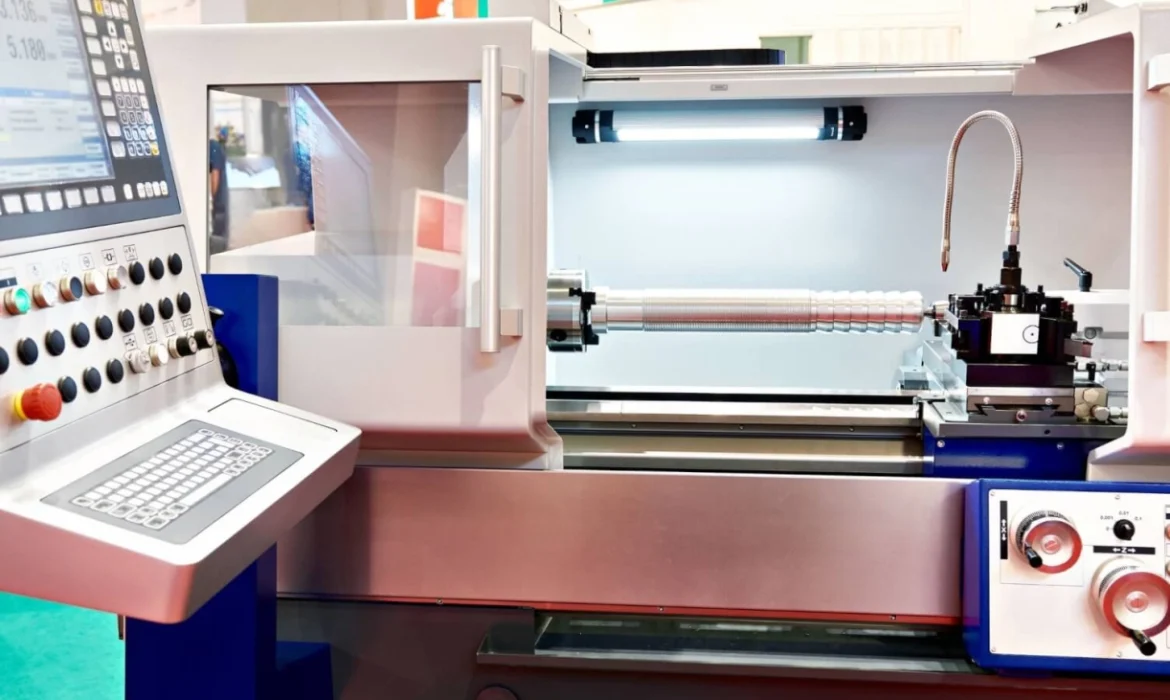
The control panel is where operators program and manage the CNC lathe. It runs CNC controllers that interpret G-code and M-code—commands that control tool paths, speeds, and auxiliary functions. Modern machines integrate CAD software for design imports and CAM for generating precise toolpaths, streamlining the entire programming workflow.
For local fabricators looking to expand beyond turning, exploring advanced CNC mill solutions like 4-axis CNC mills can complement lathe work with complex milling operations.
How Does a CNC Lathe Machine Work? Step-by-Step Operation
Programming Workflow
CNC lathe machines start their work with a digital design, usually created in CAD software. This design is imported into CAM software, where it’s translated into G-code—the language the machine reads to control spindle speed, tool movement, and cutting paths. Common machining cycles like threading, grooving, and drilling are programmed here to automate repetitive tasks efficiently.
Machining Process
Once programmed, the workpiece is securely loaded into the chuck or collet. The CNC lathe executes the tool path as instructed by the G-code, shaping the material by cutting away excess. Coolant is often applied during cutting to reduce heat and extend tool life. After machining, finished parts are ejected, either manually or automatically, depending on the setup.
Safety Protocols
Safety is crucial in CNC lathe operations. Emergency stop buttons allow immediate halting of all machine movements if something goes wrong. Physical guards protect operators from flying debris and accidental contact with moving parts. The machine also uses axis homing to establish safe starting positions before each job begins, preventing collisions or errors.
Common Pitfalls
Vibration during cutting can affect the surface finish and precision, so controlling machine stability and tool balance is key. Monitoring tool wear regularly is essential to avoid poor-quality cuts and unexpected downtime—replacing worn tools on schedule keeps everything running smoothly.
For more on how CNC machines operate, you can explore detailed steps in this guide to how CNC machining works.
Types of CNC Lathe Machines: Choosing the Right One for Your Needs
When picking a CNC lathe machine, it’s important to match the type to your specific work. Here’s a breakdown to help you decide:
2-Axis Basic Lathes:
These handle straightforward outside diameter (OD) and inside diameter (ID) turning. Great for prototyping and simple parts where basic cuts suffice.
3-Axis with C-Axis:
Adds angular positioning for drilling and tapping on the turning center. Ideal for mid-volume production with more complex features like holes or threads on curved surfaces.
Multi-Axis Turning Centers (4/5-Axis):
Designed for complex shapes and mill-turn operations. Perfect for aerospace or automotive industries demanding tight tolerances and contoured parts.
Vertical vs. Horizontal:
Vertical lathes excel at heavy, large-diameter parts, offering easy access and stable support. Horizontal CNC lathes are more common for general cylindrical jobs and offer faster setup and cycle times.
Swiss-Type Lathes:
Specialized for precision micro-parts, often used in medical or electronics fields where tiny, complex features are critical.
Selection Factors to Consider
- Shop Size and Workflow: Smaller shops often benefit from simple 2- or 3-axis lathes, while larger operations may require multi-axis centers for volume and complexity.
- Material Types: Different lathes handle materials like brass, steel, or exotic alloys better based on spindle power and tooling options.
- Budget Constraints: Balance upfront machine cost with expected productivity gains.
MS Machining’s expertise can guide you through this selection process to ensure the best fit for your local needs and applications. For example, our experience with manufacturing hardened steel machining parts demonstrates the value of choosing the right lathe for tougher materials.
Choosing correctly upfront saves downtime and boosts overall efficiency on your shop floor.
Applications of CNC Lathe Machines: From Prototypes to High-Volume Production

CNC lathe machines play a crucial role across various industries, delivering precision and efficiency from one-off prototypes to large-scale manufacturing.
- Automotive Sector: CNC turning centers are essential for producing shafts, bushings, and engine parts with consistent repeatability. These machines help local fabricators meet tight delivery schedules without sacrificing quality.
- Aerospace and Defense: The need for tight tolerances in turbine blades, fittings, and structural components makes multi-axis CNC lathes the go-to solution. They ensure components meet stringent aerospace standards for safety and performance.
- Medical and Electronics: CNC lathes manufacture implants, connectors, and precision gears with biocompatible finishes, playing a vital part in reliable medical devices and compact electronics assemblies.
- Custom Parts at MS Machining: We provide quick-turnaround, precision fittings tailored for local clients. Our CNC machining capabilities support custom specifications and small batch runs, helping businesses reduce downtime and optimize workflows.
- Emerging Uses: Hybrid manufacturing workflows are becoming popular—integrating CNC lathe machining with additive processes to create complex parts faster and with less waste. This approach is gaining traction across industries aiming for innovation and efficiency.
For those interested in precision work, our experience with rapid CNC machining and speed-accuracy optimization can be a valuable resource to explore.
CNC Lathe Machine Parts: Critical Components for Peak Performance
To get the most out of your CNC lathe machine, understanding its key parts is a must. Let’s break down the essentials that keep your operations smooth and precise.
Workholding Essentials
Secure gripping starts with the right chucks, collets, and bar feeders. These components hold your workpieces firmly in place, preventing slippage during high-speed rotation. Different chuck types suit specific jobs, so selecting the right one affects your machining accuracy and repeatability.
Cutting Tools
The heart of any CNC lathe involves quality indexable inserts, drills, and thread mills. These tools are optimized for various feeds and speeds, helping you achieve clean cuts and longer tool life. Using the right cutting tools also reduces downtime caused by wear or breakage.
Drive Systems
Precision motion relies on reliable drive systems like ball screws and servo motors. These components provide smooth, backlash-free movement along the axes, critical for maintaining tight tolerances and surface finishes.
Maintenance Must-Haves
Keeping your CNC lathe running requires more than just parts—it needs proper support gear like coolant pumps to manage temperatures and chip conveyors for efficient waste removal. Together, these maintain stability and prevent damage during long production runs.
Sourcing Tip
For local fabricators looking for OEM-grade quality, partnering with a trusted supplier like MS Machining ensures you get parts designed for top performance and durability. Their expertise in CNC parts fabrication can help minimize downtime and keep your shop running at full speed.
For insight on custom fittings essential for precision applications, check out MS Machining’s resources on custom CNC machining parts manufacturing.
Programming a CNC Lathe: Essentials for Efficient Operation

Programming a CNC lathe revolves around mastering G-code, the language that controls every move. Key commands like G00 (rapid positioning), G01 (linear cutting), and circular interpolation commands G02/G03 allow precise tool paths. Canned cycles simplify repetitive tasks such as threading or drilling, letting you save time and reduce errors.
Alongside G-codes, M-codes manage machine auxiliaries—spindle start/stop, coolant on/off, and automatic tool changes. Knowing these commands ensures smooth coordination between movements and functions during operations.
For software, many local fabricators start with Fusion 360, which offers CAD/CAM integration and beginner-friendly programming tools. It also includes advanced simulation features that help spot potential crashes before running the actual machine, saving costly downtime.
Best practices to keep your programming efficient include:
- Using parametric programming to easily adjust dimensions without rewriting code.
- Running dry runs or simulations before actual machining to catch errors early.
- Keeping your code clean and well-commented for easier troubleshooting and revisions.
Mastering these programming essentials boosts productivity and minimizes risks, giving you full control over your CNC lathe operations.
For deeper insights into toolmaking and precision workflows, you might also want to explore resources like MS Machining’s guide on tool and die making, which connects closely to effective programming and machining techniques.
Benefits and Challenges: Maximizing ROI on Your CNC Investment
Investing in a CNC lathe machine can transform your shop’s productivity, but it comes with its own set of pros and cons.
Key Benefits
- 24/7 Operation: Run automated turning operations around the clock with minimal supervision.
- Faster Cycle Times: Boost throughput on precision machining lathe tasks.
- Scalable Solutions: Start small and expand—CNC lathes fit everything from prototyping to full production runs.
Common Challenges
| Challenge | Description | Tip for Overcoming |
|---|---|---|
| Setup Costs | Initial equipment and software investment | Consider phased upgrades or leasing |
| Programming Skills Gap | Need for trained operators on G-code and CAD CAM integration | Use MS Machining consulting for training support |
| Calibration & Maintenance | Regular checks needed for spindle speed control and tool turret indexing | Implement scheduled CNC lathe maintenance |
Cost-Saving Strategies
- Energy Efficiency: Use modern servo drives and variable-speed spindle motors.
- Predictive Maintenance: Employ IoT sensors to monitor tool wear and avoid unexpected downtime.
MS Machining Value
Local fabricators benefit from MS Machining’s expertise to shorten the learning curve. We provide hands-on consulting to optimize your CNC lathe machine setup and maintenance—helping you get the most from your precision machining lathe investment.
For insights on materials and parts, consider exploring our detailed machined metal parts materials guide to complement your CNC lathe capabilities.
Maintenance and Troubleshooting: Keeping Your CNC Lathe Running Smoothly
Regular maintenance is key to getting the most out of your CNC lathe machine. Daily and weekly checks should include:
- Lubrication: Keep ball screws, ways, and bearings well-lubricated to avoid wear and ensure smooth motion.
- Axis Alignment: Verify X, Z, and any additional axes are properly aligned to maintain accuracy.
- Filter Cleaning: Clean or replace coolant and air filters regularly to prevent clogging and overheating.
Common issues you might face include:
- Spindle runout: Causes poor surface finishes and can be fixed by checking spindle bearings and balancing the chuck.
- Coding errors: Mistakes in lathe programming G-code may lead to crashes or incorrect cuts. Always run simulations or dry runs first.
- Uneven finishes: Usually due to tool wear or improper feed rates; timely tool replacement and adjustment solve this.
For long-term care, schedule annual audits to inspect mechanical and electrical systems thoroughly. Keep your control software up to date to improve performance and avoid glitches.
Pro Tip: Partner with MS Machining’s on-site support team to minimize downtime and get expert help right when you need it. Their local presence helps keep your production lines running without interruption.