

Struggling to decide between CNC machining brass vs stainless steel for your next precision component?
It’s a classic engineering dilemma.
Choose brass, and you unlock incredible machinability and rapid cycle times. Choose stainless steel, and you gain unmatched tensile strength and corrosion resistance.
Make the wrong choice, and you risk inflated production costs or catastrophic part failure.
In this guide, you’re going to get a direct, data-driven comparison based on real manufacturing experience. We’ll break down exactly how these materials stack up in terms of price, performance, and application suitability.
Let’s dive right in.
Overview of Materials: Brass and Stainless Steel Basics
At MS Machining, we handle thousands of custom projects annually, and the choice between brass and stainless steel often dictates the success of a component. While both are staples in CNC precision machining, they serve vastly different engineering roles. Understanding their composition and grade specifics is the first step in selecting the right material for your OEM or ODM project.
Defining Brass: The King of Machinability
Brass is an alloy primarily composed of copper and zinc, renowned for its excellent machinability and conductivity. In our facility, we frequently utilize free-cutting brass grades like C360 and C3604, as well as H59.
- Composition: A blend of copper (approx. 60%) and zinc (approx. 40%), often with trace amounts of lead to improve chip formation.
- Common Grades:
- C360/C3604: The industry standard for high-speed machining, offering minimal tool wear and superior surface finishes.
- H59: A high-strength brass often used for structural components requiring durability.
- Why We Use It: Brass allows for rapid production cycles. Its self-lubricating properties permit higher cutting speeds, making it ideal for intricate electrical connectors and precision fittings.
Defining Stainless Steel: The Industrial Workhorse
Stainless steel is defined by its chromium content, which forms a passive oxide layer that prevents rust. This material is significantly harder than brass, requiring advanced thermal management and rigid tooling setups—capabilities we have refined over 20+ years of operation.
- Composition: Iron-based alloy with Chromium and Nickel.
- Popular Grades at MS Machining:
- 304: The most versatile grade, offering excellent chemical resistance.
- 316: Contains molybdenum for superior corrosion resistance, essential for marine and medical applications.
- 17-4PH: A precipitation-hardening grade delivering high strength and hardness for aerospace components.
- Why We Use It: When a part faces harsh environments or high mechanical stress, stainless steel is non-negotiable. We achieve ±0.005mm accuracy on these tough alloys using 5-axis machining centers to maintain geometric integrity.
Key Advantages in Custom Manufacturing
Selecting the right metal impacts everything from machining cost to part longevity. Here is how we categorize their primary strengths:
| Feature | Brass (C360, C3604) | Stainless Steel (304, 316, 17-4PH) |
|---|---|---|
| Machinability | High: Fast cycle times, low tool wear. | Moderate/Low: Requires rigid setups and coolant control. |
| Corrosion Resistance | Good (tarnishes over time). | Excellent: Resistant to acids, salts, and oxidation. |
| Conductivity | High thermal and electrical conductivity. | Low conductivity; acts as a thermal insulator. |
| Strength | Moderate tensile strength. | High tensile and yield strength. |
For clients needing custom metal parts machining, the decision usually comes down to the environment the part will inhabit. We recommend brass for low-friction, electrical applications, while stainless steel is the standard for structural and sanitary requirements.
Machinability and Efficiency: Speed vs. Precision
When we tackle CNC material selection, the difference in how brass and stainless steel behave under the cutter is significant. Understanding these differences is critical for optimizing production schedules and managing costs.
Comparing Machinability Ratings and Cutting Speeds
Brass is widely recognized for having a high brass machinability rating. It is often the benchmark material (100% rating) against which others are measured. Because it is softer and chips easily, we can run our CNC machines at much higher spindle speeds and feed rates. This makes brass an excellent candidate for high-volume CNC production where cycle time is money.
In contrast, stainless steel—especially grades like 304 and 316—is tougher and tends to work-harden if not machined correctly. We have to run at lower cutting speeds with higher cutting pressure to prevent the material from hardening ahead of the cut.
Impact on Tool Wear and Cycle Times
The physical properties of these metals directly impact our tooling and timelines:
- Brass: Causes minimal tool wear in CNC operations. Cutters stay sharp longer, reducing downtime for tool changes. This allows for extremely fast cycle times and lower operational costs per part.
- Stainless Steel: Generates significant heat and friction. To maintain precision, we must manage tool life carefully, often using specialized coatings and high-pressure coolant systems to evacuate heat.
Our team utilizes advanced CNC engineering services to calculate the optimal balance between speed and tool longevity, ensuring that even tough stainless projects remain cost-effective.
Achieving Tight Tolerances in Soft vs. Hard Metals
Despite the differences in hardness, we achieve the same high-precision standards for both materials. Whether we are machining soft brass or rigid stainless steel, our facility maintains dimensional accuracy within ±0.005–0.01mm.
- Soft Metals (Brass): The challenge here is preventing deformation. We use precise clamping pressure to hold the part without distorting it.
- Hard Metals (Stainless): The challenge is tool deflection. We utilize rigid setups and robust 5-axis machining centers to cut complex geometries without vibration.
By adjusting our approach based on the material, we ensure that every component meets strict ISO 9001:2015 quality standards, regardless of the alloy.
Mechanical Properties: Strength, Hardness, and Weight
When comparing brass vs stainless strength, the distinction is clear. Stainless steel, particularly the grades we machine like 304, 316, and 17-4PH, offers significantly higher tensile and yield strength compared to copper-based alloys. For applications requiring high fatigue resistance and structural integrity under load, stainless steel is the superior choice. Brass is softer and more malleable, which makes it excellent for ease of machining but less suitable for high-stress mechanical environments.
Processing these harder materials demands advanced capabilities. We frequently utilize our 5-axis CNC machining services to handle the rigidity requirements of stainless steel, ensuring that its hardness does not lead to tool deflection or compromised tolerances.
Density and Weight Considerations
A common misconception in precision CNC machining metals is that the stronger metal is always heavier. In reality, brass is generally denser than stainless steel.
- Brass Density: Approximately 8.4–8.7 g/cm³
- Stainless Steel (304) Density: Approximately 7.9–8.0 g/cm³
While brass parts will be heavier by volume, stainless steel provides a much higher strength-to-weight ratio. This allows engineers to design thinner, lighter components using stainless steel (like 17-4PH) that still outperform bulkier brass counterparts in durability. We recommend stainless steel when weight reduction combined with high strength is critical, and brass when mass or specific conductivity properties are required.
Environmental Performance: Corrosion and Conductivity
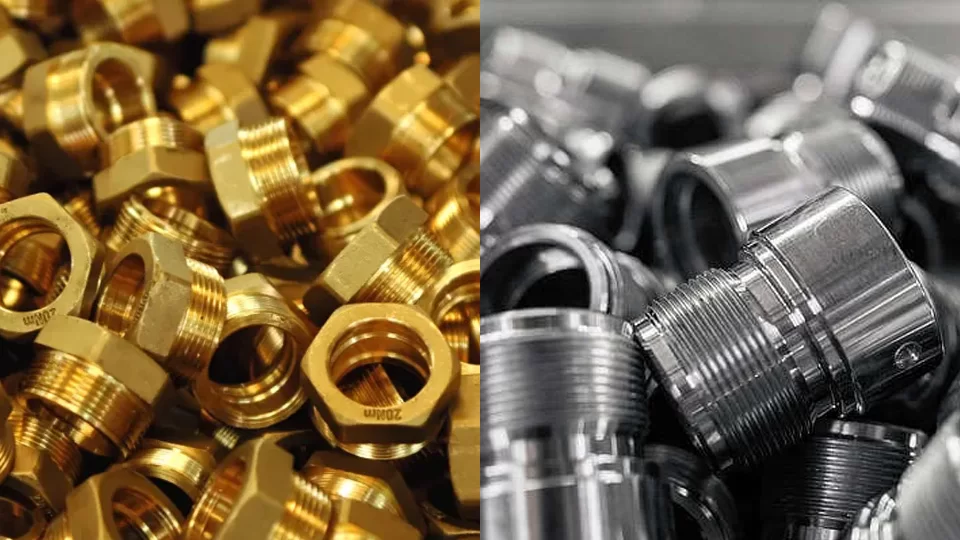
Selecting the right material often comes down to how the part interacts with its environment. In our experience at MS Machining, the choice between brass and stainless steel usually depends on whether the priority is resisting harsh elements or conducting energy efficiently.
Corrosion Resistance in Harsh Environments
When parts face moisture, aggressive chemicals, or saltwater, stainless steel corrosion resistance is the industry standard. Grades like 304 and 316 create a passive oxide layer that self-heals, making them ideal for medical devices and marine hardware where failure isn’t an option. While brass resists rusting better than standard carbon steel, it can tarnish (oxidize) over time, turning green or brown if not properly plated or coated. For applications requiring long-term structural integrity in corrosive settings, stainless steel remains the superior choice.
Thermal and Electrical Conductivity Differences
If the application involves electrical current or heat transfer, brass is the clear winner. Thermal conductivity brass ratings are significantly higher than stainless steel, making it excellent for heat exchangers and radiators. More importantly, brass is highly conductive electrically, which is why we frequently utilize our brass CNC machining services to manufacture precision pins, terminals, and connectors. Stainless steel, conversely, is a poor conductor of both heat and electricity, acting more as an insulator in these assemblies.
Suitability for Heat Dissipation and Electrical Components
- Brass: Best for electrical connectors material and components requiring rapid heat dissipation. Its ability to transfer thermal energy helps prevent overheating in electronic assemblies.
- Stainless Steel: Best for high-temperature environments where the material must retain strength rather than dissipate heat. It withstands extreme thermal cycling without warping, ensuring dimensional accuracy within our ±0.005mm tolerance standards.
Brass vs Stainless Steel Corrosion Resistance & Conductivity Matrix:
| Feature | Brass (C360/H59) | Stainless Steel (304/316) |
|---|---|---|
| Corrosion Resistance | Good (prone to tarnish) | Excellent (Marine/Chemical grade) |
| Electrical Conductivity | High (Standard for connectors) | Very Low |
| Thermal Conductivity | High (Efficient heat sink) | Low (Heat resistant) |
| Magnetic Permeability | Non-magnetic | Generally non-magnetic (Austenitic) |
Aesthetics and Surface Finishing: Getting the Right Look

When we manufacture components for consumer-facing industries, the visual finish is often just as critical as the dimensional accuracy. Choosing between brass and stainless steel significantly impacts the final aesthetic character of the part, ranging from vintage warmth to modern industrial sterility.
Visual Appeal and Natural Luster
Brass is renowned for its distinct, gold-like appearance. It offers a premium, classic look often used in architectural hardware, decorative fittings, and musical instruments. Its natural luster is easy to bring out with standard machining, though it can develop a patina over time if left untreated.
In contrast, stainless steel provides a sleek, silver tone associated with strength and hygiene. Grades like 304 and 316 maintain a clean, professional appearance, making them the standard for medical devices and high-end appliances where a sterile look is mandatory.
Surface Finishing Options CNC
At MS Machining, we utilize various surface finishing options CNC processes to enhance both durability and style:
- Polishing: Both metals respond well to polishing. Brass can achieve a mirror-like golden finish, while stainless steel can be buffed to a high-gloss chrome look.
- Passivation: Essential for stainless steel, this process removes free iron from the surface to maximize brass vs stainless steel corrosion resistance without altering the part’s dimensions.
- Plating: We frequently nickel or chrome plate brass components to prevent tarnishing and increase surface hardness.
- Bead Blasting: Creates a uniform matte texture, ideal for hiding machining marks on stainless steel parts.
To ensure every part meets cosmetic standards, we integrate these finishing steps directly into our manufacturing workflow, often utilizing special CNC machining processes to achieve specific textures or protective coatings required by the client.
Long-Term Appearance and Maintenance
Maintenance requirements depend heavily on the environment. Stainless steel requires minimal upkeep to maintain its shine, especially in moisture-heavy environments. Brass, while beautiful, requires lacquering or regular polishing to prevent oxidation and tarnish unless the “aged” look is desired. For parts requiring zero maintenance and high durability, stainless steel is generally the superior choice.
Cost Analysis: Material Price vs. Machining Value
When evaluating a project, focusing solely on the price per pound of raw stock can lead to inaccurate budget projections. At MS Machining, we help clients navigate the machining cost comparison between brass and stainless steel by looking at the total production picture. While the raw material cost for brass is often higher than standard stainless steel due to copper market rates, the final part cost depends heavily on how the metal behaves inside the CNC machine.
Raw Material vs. Machining Time
The biggest trade-off lies in the machining efficiency. Brass is significantly softer and has a higher machinability rating, allowing us to run our 3, 4, and 5-axis machines at much higher speeds and feeds.
- Brass: Higher raw material cost, but fast cycle times reduce machine hourly charges.
- Stainless Steel: Lower raw material cost (for grades like 304), but slower cutting speeds increase production time.
For complex parts requiring extensive milling or turning, the time saved machining brass often offsets its higher material price. Our comprehensive metal CNC machining services are optimized to balance these factors, ensuring you get the most cost-effective solution regardless of the alloy selected.
Tool Life and Scrap Value
Tool wear in CNC processes is a critical cost driver. Stainless steel is harder and generates more heat, leading to more frequent tool changes and downtime. Brass is gentle on tooling, allowing cutters to last much longer, which stabilizes process reliability and lowers consumable costs.
Additionally, scrap value plays a role in high-volume CNC production. Brass chips (swarf) retain high resale value, which can be factored back into the project costs for large runs. Stainless steel scrap has value, but typically less than copper-based alloys.
Break-Even Analysis: Volume Matters
- Low-Volume / Prototyping: For small batches, raw material price has a larger impact. If the part geometry is simple, stainless steel might be cheaper overall.
- High-Volume Production: As quantities rise, cycle time becomes the dominant cost factor. The speed advantages of brass usually make it the more economical choice for large orders of complex components, despite the initial material premium.
Application Guide: When to Choose Which Metal
Selecting the right material is critical for part performance, especially when balancing cost against environmental requirements. At MS Machining, we help clients navigate the CNC machining brass vs stainless steel decision based on specific industry standards and functional needs.
Ideal Applications for Brass
Brass is often the preferred choice for components that require low friction and high electrical conductivity. Because it is softer and chips easily, we can run brass at higher speeds, making it excellent for high-volume production of intricate parts.
- Electrical Components: Due to its conductive nature, brass is standard for pins, terminals, and connectors. For projects involving complex electrical assemblies, understanding insulators and conductivity types is essential for pairing the right brass alloy with insulation materials.
- Plumbing & Fluid Handling: Brass fittings, valves, and nozzles resist corrosion from water and non-corrosive chemicals better than standard carbon steel.
- Mechanical Gears & Bushings: The material’s natural lubricity makes it ideal for custom metal parts machining involving moving gears where minimizing friction is key.
Ideal Applications for Stainless Steel
When the priority shifts to structural integrity, hygiene, or resistance to harsh elements, stainless steel is the superior option. We utilize grades like 304, 316, and 17-4PH for applications demanding high tensile strength and thermal stability.
- Medical Devices: Surgical instruments and implants require the biocompatibility and sterilization resistance found in 316 stainless steel.
- Aerospace Components: For parts facing high stress and temperature fluctuations, 17-4PH offers the necessary toughness.
- Marine Hardware: Marine grade materials CNC processes rely heavily on 316 stainless steel to prevent pitting and rusting in saltwater environments.
Quick Selection Matrix
| Feature | Brass (C360, H59) | Stainless Steel (304, 316) |
|---|---|---|
| Primary Benefit | Machinability & Conductivity | Strength & Corrosion Resistance |
| Best For | Connectors, Fittings, Decor | Medical, Marine, Aerospace |
| Cost Efficiency | High (Faster Machining) | Moderate (Higher Tool Wear) |
| Aesthetics | Gold-like Luster | Industrial Silver/Polished |
Hybrid Approaches and Prototyping
For new product development, we often see a hybrid approach. Engineers might use brass for initial functional prototypes to verify geometry and fit quickly due to its ease of machining. Once the design is validated, production shifts to stainless steel for the final end-use durability. Our facility supports this transition with flexible CNC material selection and rigorous testing, ensuring that whether you choose brass or steel, the final components meet strict ISO 9001:2015 standards.
Frequently Asked Questions (FAQs)
Is brass cheaper to machine than stainless steel?
Generally, yes. While raw material costs fluctuate, the machining cost comparison usually favors brass. Brass is softer and has a higher machinability rating, allowing for faster cutting speeds and reduced cycle times. Stainless steel, particularly grades like 304 and 316, is harder and generates significant heat, requiring slower feed rates and more frequent tool changes. For high-volume CNC production, the efficiency gained with brass often results in a lower total part cost.
Which material offers better corrosion resistance for marine use?
Stainless steel corrosion resistance is superior for marine environments, specifically Grade 316. This grade contains molybdenum, which provides excellent protection against chlorides and saltwater. While brass resists rust, it is susceptible to dezincification in saltwater, which can weaken the component over time. For critical marine hardware, we recommend high-quality stainless steel CNC machining to ensure long-term durability and structural integrity.
Can stainless steel be used for electrical components?
Yes, but with caveats. Stainless steel is not a good electrical conductor compared to brass or copper. It is typically used for electrical housings, enclosures, or structural components where strength and corrosion resistance are more critical than conductivity. For pins, terminals, and electrical connectors material, brass remains the industry standard due to its excellent conductivity and ease of soldering.
How does material hardness affect CNC machining costs?
Material hardness directly impacts tool wear in CNC and machine run time. Harder metals like stainless steel require rigid setups, specialized cutting tools, and robust cooling strategies to prevent distortion. This increases the “machine time” per part, which is a primary driver of cost. Softer metals like brass exert less force on the spindle, allowing us to run parts faster with standard tooling, ultimately reducing the price per unit in custom metal parts machining.