Introduction
The types of metal fabrication methods used in manufacturing depend on many factors, including material properties, part geometry, production volume, dimensional requirements, and application conditions.
Metal fabrication is not a single manufacturing process. It is a combination of different techniques used to transform raw metal materials into functional components. Depending on the design requirements, manufacturers may use cutting, forming, machining, welding, casting, extrusion, or finishing processes.
Selecting the appropriate fabrication method is an important part of product development. A process that works well for a large structural component may not be suitable for a precision mechanical part. For example, sheet metal forming can be an efficient approach for creating enclosures, while CNC machining may be more suitable for components requiring tight tolerances or complex features.
In many manufacturing applications, multiple processes are combined rather than using only one method. A fabricated component may require cutting and forming to create its basic structure, followed by CNC machining to produce accurate holes, mounting surfaces, or functional features.
Understanding the differences between metal fabrication methods helps engineers and purchasing teams make better decisions regarding manufacturability, cost, and production requirements.
What Are the Main Types of Metal Fabrication Methods?
Metal fabrication methods can generally be divided into several categories based on how the material is processed.
Some methods remove material to achieve the required shape, while others reshape existing material or join separate components together.
The main categories include:
- Material removal processes
- Metal forming processes
- Joining processes
- Metal shaping processes
- Surface finishing processes
Each category serves a different purpose during manufacturing.
Material removal processes, such as CNC machining and cutting, focus on achieving specific dimensions and features by removing material.
Forming processes, such as bending and stamping, change the shape of metal without significantly reducing the material volume.
Joining processes, such as welding, connect multiple components into larger assemblies.
Shaping processes, including casting, forging, and extrusion, create parts through molding, compression, or continuous forming methods.
The suitable method depends on the relationship between part requirements and manufacturing capabilities.
Cutting Methods: Creating the Initial Shape of Metal Components
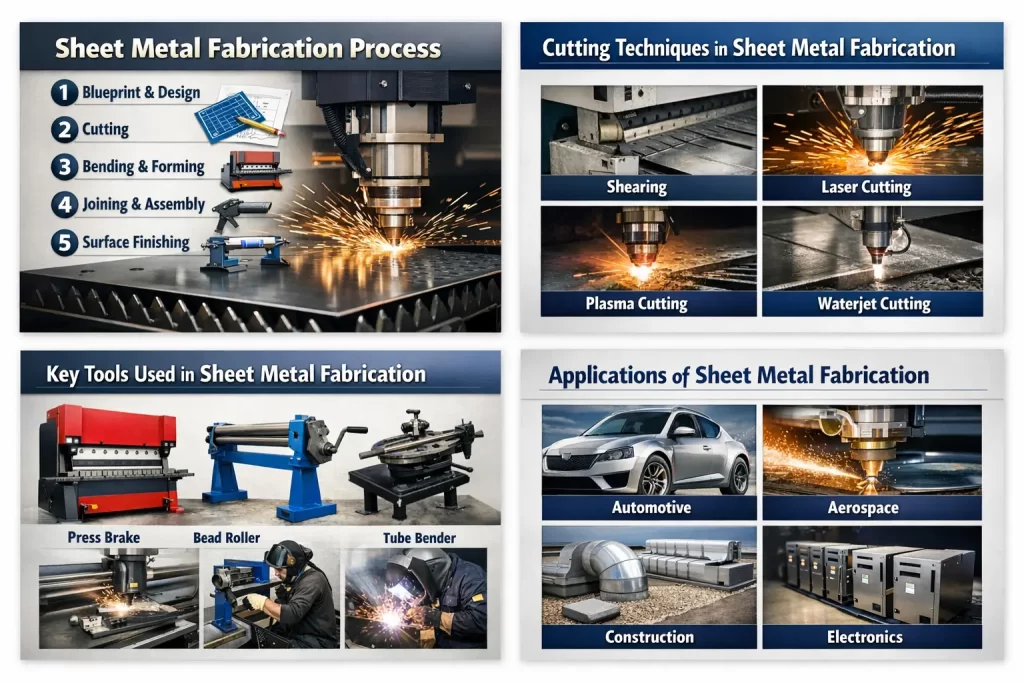
Cutting is often one of the first operations in the metal fabrication process. Its purpose is to separate raw material into a size and shape suitable for further processing.
The cutting method selected depends on factors such as material thickness, required accuracy, production quantity, and surface requirements.
Cutting operations establish the foundation for later processes. For example, inaccurate cutting may create difficulties during bending, welding, or assembly.
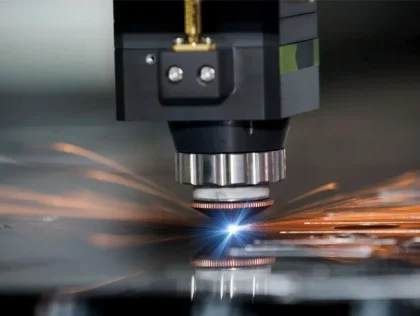
Laser Cutting for Sheet Metal Fabrication
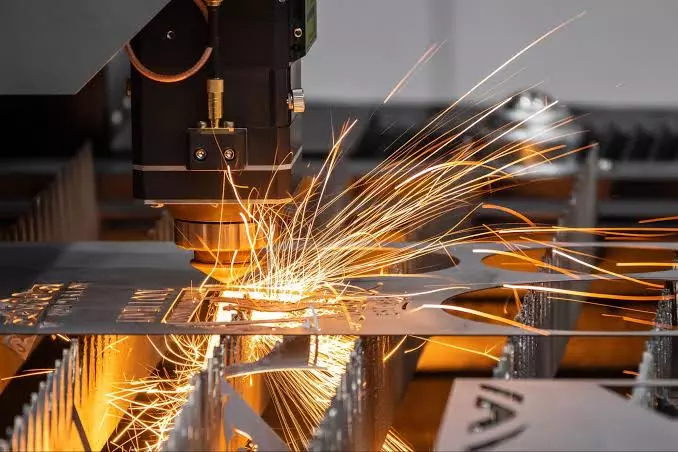
The process uses a focused laser beam to remove material along programmed paths. It is suitable for producing flat components with complex outlines, openings, and detailed profiles.
Laser cutting is often selected for:
- Sheet metal brackets
- Panels
- Enclosures
- Flat structural components
One advantage of laser cutting is that it requires relatively little tooling preparation compared with processes that rely on dedicated dies.
However, laser cutting is mainly a two-dimensional cutting process. When parts require precision features such as threaded holes, accurate mounting surfaces, or complex three-dimensional geometries, additional machining operations may be required.
Waterjet Cutting for Heat-Sensitive Materials
Waterjet cutting uses high-pressure water combined with abrasive particles to remove material.
Unlike thermal cutting methods, waterjet cutting does not introduce significant heat into the material. This characteristic can be useful when heat distortion or changes in material properties need to be minimized.
Waterjet cutting is commonly considered for materials such as:
- Stainless steel
- Aluminum
- Titanium
- Thick metal plates
The process provides flexibility for different materials and thicknesses, although production speed and operating cost may vary depending on the application.
Plasma Cutting for Thick Metal Components
Plasma cutting is frequently used for thicker conductive metals, especially in structural fabrication.
It uses a high-temperature plasma arc to cut through metal materials.
Compared with laser cutting, plasma cutting is often selected when material thickness and cutting speed are more important considerations than fine edge accuracy.
Typical applications include:
- Structural steel components
- Heavy equipment parts
- Large fabricated assemblies
Because the process generates heat, additional finishing or machining may be required depending on the final requirements of the component.
Forming Methods: Shaping Metal Without Removing Material
Metal forming processes create shapes by applying force to change the geometry of the material.
Compared with machining, forming can reduce material waste because the original material volume is largely maintained.
Forming methods are widely used for sheet metal parts and structural components where the overall shape is more important than complex internal features.
Bending for Sheet Metal Components
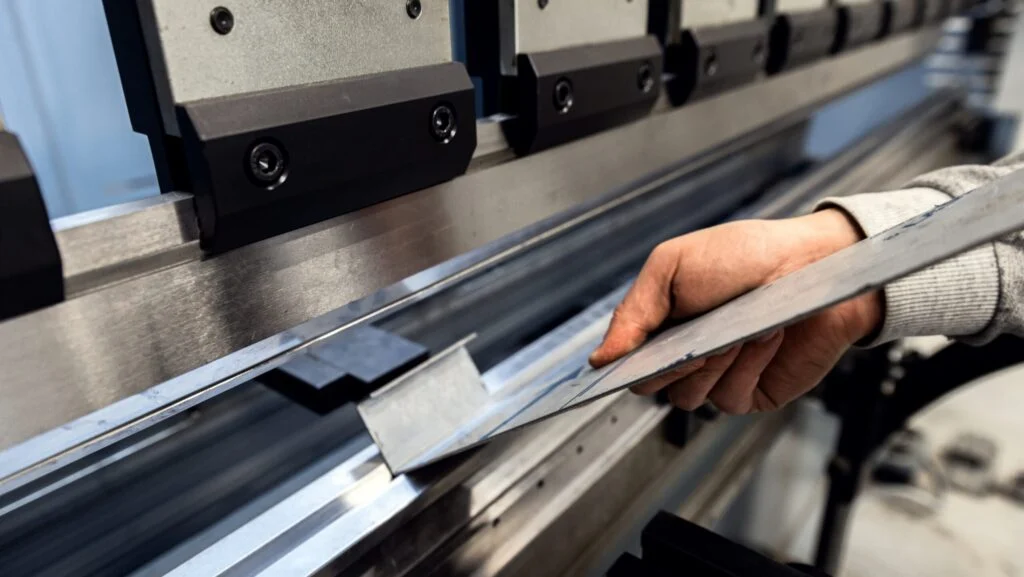
Bending is one of the most common metal fabrication methods for sheet metal parts.
Using equipment such as press brakes, manufacturers apply controlled force to create specific angles and shapes.
The accuracy of bending depends on several factors:
- Material thickness
- Material type
- Bend radius
- Tool selection
- Springback behavior
Springback occurs because metal tends to partially return toward its original shape after bending force is removed.
For components requiring accurate assembly, bending parameters need to be carefully controlled. In some cases, CNC machining may be required after forming to achieve precise mounting areas or functional surfaces.
Rolling for Curved Metal Structures
Rolling is used to create curved shapes from flat metal sheets or plates.
It is commonly applied to components such as:
- Cylindrical housings
- Pipes
- Tanks
- Curved structural sections
The process requires control of material thickness and bending radius to achieve consistent results.
For large fabricated structures, rolling is often combined with welding and additional machining operations depending on dimensional requirements.
Stamping for High-Volume Production
Stamping uses dies and presses to form metal into specific shapes.
It is commonly used when large quantities of similar parts are required because the process can produce repeated components efficiently.
Typical applications include:
- Automotive components
- Electrical parts
- Brackets
- Sheet metal components
However, stamping requires tooling investment, which may make it less suitable for prototypes or low-volume custom parts.
CNC Machining as a Metal Fabrication Method for Precision Components
Among the different types of metal fabrication methods, CNC machining plays an important role when a component requires accurate dimensions, complex geometries, or controlled surface finishes.
Unlike cutting or forming processes that mainly create the overall shape of a part, CNC machining removes material from a workpiece using computer-controlled cutting tools. This allows manufacturers to produce precise features that may not be practical to achieve through traditional fabrication methods.
CNC machining is commonly used for:
- Precision holes
- Threads
- Flat reference surfaces
- Slots and pockets
- Complex contours
- Tight-tolerance features
In many manufacturing projects, CNC machining is not used as a replacement for fabrication processes. Instead, it works together with other methods to achieve the required part performance.
For example, a component may be cut and formed to create its general structure, while CNC machining is used afterward to produce accurate mounting areas or functional surfaces.
This combination allows manufacturers to balance production efficiency with dimensional accuracy.
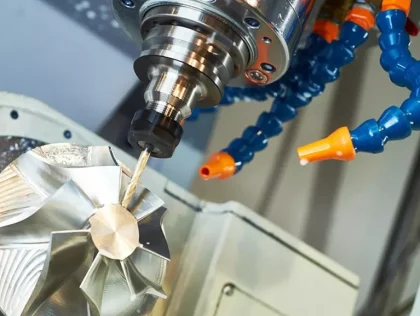
CNC Milling for Complex Features and Precision Surfaces
CNC milling is one of the most widely used machining processes in metal manufacturing.
During milling, rotating cutting tools remove material from a workpiece based on programmed tool paths. The process can create a variety of features, including:
- Flat surfaces
- Internal pockets
- Slots
- Holes
- Contoured profiles
Compared with fabrication methods such as bending or welding, CNC milling provides greater control over feature location and dimensional consistency.
For example, when a part requires accurately positioned holes or machined surfaces that must align with other components, CNC machining can provide the necessary precision.
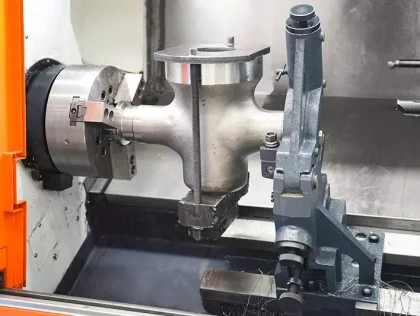
CNC Turning for Cylindrical Components
CNC turning is another important machining method used for metal components with rotational features.
During turning, the workpiece rotates while cutting tools remove material from the surface.
Typical CNC turned components include:
- Shafts
- Bushings
- Pins
- Sleeves
- Threaded components
CNC turning is commonly used when diameter accuracy, surface finish, and repeatability are important considerations.
The process can produce consistent cylindrical features while maintaining control over dimensions such as:
- Outer diameter
- Inner diameter
- Thread specifications
- Surface roughness
Why CNC Machining Is Often Combined With Other Fabrication Methods
Many metal components require more than one manufacturing process because different methods solve different production requirements.
Fabrication processes such as cutting, bending, and welding are effective for creating structures and assemblies. However, they may not achieve the dimensional accuracy required for certain functional areas.
CNC machining is often added when a component requires:
- Precise assembly locations
- Accurate hole positions
- Flat mounting surfaces
- Controlled tolerances
This is especially relevant for welded assemblies. Welding creates strong connections between components, but the heat generated during the process can introduce dimensional changes.
Post-welding CNC machining can help achieve the final specifications required for assembly.
A common manufacturing sequence may include:
Cutting → Forming → Welding → CNC Machining → Surface Finishing → Inspection
The exact sequence depends on the part design and manufacturing requirements.
Welding and Joining Methods for Metal Fabrication
Joining methods are used to connect separate metal components into a complete assembly.
Welding remains one of the most common joining methods because it creates strong permanent connections between metal parts.
However, welding involves more than simply joining materials together. The process also affects dimensional stability, heat distribution, and final part accuracy.
Manufacturers need to consider:
- Material compatibility
- Welding position
- Heat input
- Joint design
- Post-welding requirements
MIG Welding for General Fabrication Applications
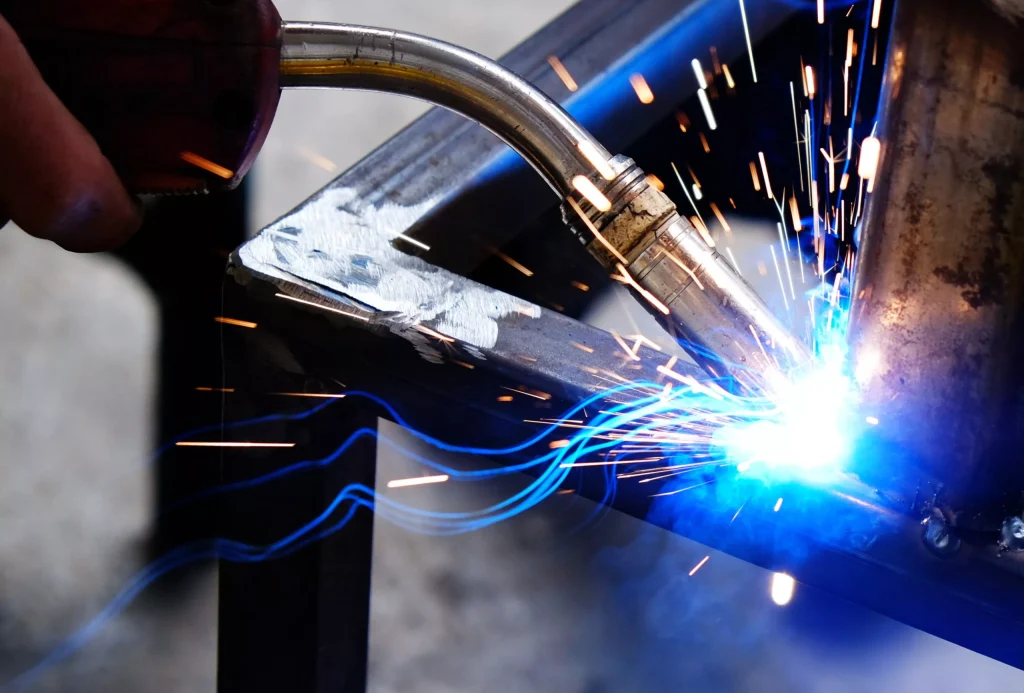
MIG welding is commonly used for industrial metal fabrication because it provides a practical balance between productivity and process control.
It is often applied to:
- Steel structures
- Equipment frames
- General fabricated assemblies
The process is suitable for many production environments because it can handle different material thicknesses and provides efficient welding speeds.
However, when components require very precise dimensions after welding, additional machining or inspection may still be necessary.
TIG Welding for Controlled and Precision Applications
TIG welding provides greater control over the welding process compared with many other welding methods.
It is commonly considered for materials such as:
- Stainless steel
- Aluminum
- Thin metal components
TIG welding can produce clean welds with good appearance, making it suitable for applications where surface quality and process control are important.
The selection between MIG and TIG welding depends on factors such as material type, part design, production requirements, and appearance expectations.
Mechanical Assembly as an Alternative Joining Method
Not all metal components require permanent welding.
Mechanical joining methods, including:
- Bolting
- Screws
- Rivets
- Fasteners
may be used when components need to be assembled, maintained, or replaced during service.
The choice between welding and mechanical assembly depends on the functional requirements of the final product.
Casting, Forging, and Extrusion: Other Types of Metal Fabrication Methods
While CNC machining, cutting, forming, and welding are common fabrication approaches, other manufacturing methods are used for specific applications.
Casting, forging, and extrusion create parts through different material-shaping principles and are often selected based on production volume, geometry, and mechanical requirements.
Casting for Complex Metal Shapes
Casting involves pouring molten metal into a mold and allowing it to solidify into the desired shape.
This method can produce geometries that may require significant machining if created from solid material.
Casting is commonly used for:
- Complex housings
- Engine components
- Industrial parts
However, cast parts may require secondary operations such as CNC machining to achieve accurate dimensions, improve surface quality, or create functional features.
Forging for High-Strength Components
Forging shapes metal through controlled pressure or impact forces.
The process changes the internal structure of the material, which can improve mechanical properties in certain applications.
Forged components are commonly used where strength and durability are important considerations.
Applications include:
- Automotive components
- Aerospace parts
- Industrial equipment
Due to the nature of the process, forged parts may also require machining to achieve final dimensions.
Extrusion for Continuous Metal Profiles
Extrusion forms metal by forcing it through a shaped opening to create a continuous profile.
Aluminum extrusion is widely used for:
- Structural frames
- Rails
- Heat sinks
- Enclosures
Extruded profiles often require additional operations such as:
- Cutting
- Drilling
- CNC machining
- Surface finishing
before they become complete components.
Surface Finishing Methods After Metal Fabrication
Surface finishing is an important stage in many metal fabrication projects. Although finishing does not change the basic geometry of a part, it can influence appearance, corrosion resistance, and surface performance.
The appropriate finishing method depends on:
- Material type
- Operating environment
- Required durability
- Appearance requirements
Anodizing for Aluminum Parts
Anodizing is commonly used for aluminum components.
The process creates a controlled oxide layer on the surface, which can improve:
- Corrosion resistance
- Surface hardness
- Appearance
It is often applied to CNC machined aluminum parts and fabricated aluminum components.
Powder Coating for Protective Surface Coverage
Powder coating is frequently used for steel and aluminum fabricated components.
The process applies a protective coating layer that can improve resistance against environmental exposure.
Common applications include:
- Equipment housings
- Frames
- Industrial enclosures
Coating thickness should be considered during design because it may affect final dimensions in precision assemblies.
Plating and Passivation
Plating applies a thin metallic layer to improve certain surface properties, such as wear resistance or corrosion protection.
Passivation is commonly used for stainless steel components to improve corrosion resistance by removing surface contaminants introduced during manufacturing.
How to Select the Right Metal Fabrication Method for a Project
Choosing among different types of metal fabrication methods requires consideration of several engineering and production factors.
The most suitable process depends on the relationship between the part requirements and manufacturing limitations.
Consider Part Geometry and Design Requirements
The shape and complexity of a component influence the appropriate manufacturing method.
Large structural parts may benefit from fabrication methods such as cutting, forming, and welding.
Components with complex features or tight dimensional requirements may require CNC machining.
Consider Material Properties
Different materials respond differently to manufacturing processes.
For example:
- Aluminum is widely used for lightweight components and is suitable for machining and forming.
- Stainless steel provides corrosion resistance but may require more attention during machining.
- Carbon steel is commonly used for structural applications.
Material selection affects not only performance but also manufacturing efficiency.
Consider Production Volume
Production quantity also influences process selection.
For prototypes and low-volume production, flexible processes such as CNC machining and laser cutting may be practical.
For high-volume production, processes requiring dedicated tooling, such as stamping or casting, may become more suitable.
Consider Tolerance and Functional Requirements
Tolerance requirements are one of the key factors when selecting fabrication methods.
Structural components may allow wider dimensional variation, while mechanical components often require tighter control.
When precise interfaces, alignment features, or functional surfaces are required, CNC machining is commonly used to achieve those specifications.
Why Choose a CNC Machining Supplier With Metal Fabrication Knowledge?
When selecting a manufacturing supplier, process capability is an important consideration. A supplier that understands both CNC machining and metal fabrication can provide better support when a component requires multiple manufacturing steps.
Many custom metal parts cannot be completed through a single process. The final component may require a combination of:
- Cutting
- Forming
- Welding
- CNC machining
- Surface finishing
- Inspection
Understanding how these processes interact helps reduce unnecessary operations and improves manufacturing planning.
For example, a supplier with knowledge of both fabrication and machining can evaluate whether a feature should be created during forming, welding, or machining. This type of process consideration can influence production efficiency, dimensional accuracy, and overall manufacturing cost.
Process Selection Support During Manufacturing
Manufacturing decisions are often made during the design review stage.
Important considerations may include:
- Material selection
- Part geometry
- Required tolerances
- Production volume
- Surface requirements
- Assembly requirements
A manufacturing supplier with experience in multiple processes can provide feedback on whether the design is suitable for the selected fabrication method.
This does not mean changing the original design unnecessarily. Instead, the goal is to identify potential manufacturing challenges before production begins.
CNC Machining Capability for Precision Requirements
For components requiring accurate dimensions, CNC machining capability is an important factor to consider.
CNC machining can provide controlled manufacturing for features such as:
- Precision holes
- Machined surfaces
- Threads
- Alignment features
- Complex geometries
When combined with fabrication processes, CNC machining allows manufacturers to produce parts that require both structural strength and dimensional accuracy.
Quality Control Throughout the Fabrication Process
Quality control is not limited to final inspection. It is involved throughout different manufacturing stages.
Depending on the part requirements, inspection may include:
- Material verification
- Dimensional measurement
- Weld inspection
- CNC machining inspection
- Surface finish inspection
For precision components, measurement equipment such as coordinate measuring machines (CMM) may be used to verify critical dimensions.
A consistent inspection process helps ensure that manufactured parts meet drawing requirements and customer specifications.
Frequently Asked Questions About Types of Metal Fabrication Methods
What are the most common types of metal fabrication methods?
The most common metal fabrication methods include cutting, forming, machining, welding, casting, forging, extrusion, and surface finishing.
The suitable method depends on factors such as material, part design, production volume, and required accuracy.
Is CNC machining considered a type of metal fabrication?
Yes, CNC machining is commonly considered a metal fabrication method because it transforms raw metal materials into finished components through controlled material removal.
However, CNC machining is often used alongside other fabrication methods rather than replacing them.
What is the difference between metal fabrication and CNC machining?
Metal fabrication is a broad term covering different processes used to create metal components.
It includes operations such as:
- Cutting
- Forming
- Welding
- Machining
- Finishing
CNC machining is a specific manufacturing process that uses computer-controlled tools to remove material and create precise features.
When should CNC machining be used instead of other fabrication methods?
CNC machining is often selected when a part requires:
- Tight dimensional tolerances
- Complex geometries
- Accurate hole locations
- Precision surfaces
- Repeatable production results
For larger structures or simple sheet metal components, other fabrication methods may be more efficient.
Can fabricated metal parts be CNC machined afterward?
Yes. CNC machining is frequently used as a secondary operation after fabrication.
For example, welded or formed components may require machining to create accurate mounting surfaces or connection points.
Which metal fabrication method is suitable for custom low-volume parts?
For low-volume or custom parts, flexible processes such as CNC machining, laser cutting, and welding are commonly considered because they require less dedicated tooling compared with processes like stamping.
The most suitable approach depends on the part design and manufacturing requirements.
Conclusion
The different types of metal fabrication methods provide manufacturers with various ways to transform raw materials into functional components.
Cutting processes help create initial shapes, forming processes modify material geometry, welding connects components, and CNC machining provides the precision required for detailed features and accurate assembly.
No single fabrication method is suitable for every application. The appropriate process depends on material properties, part design, production volume, tolerance requirements, and functional needs.
For many custom metal components, combining fabrication methods with CNC machining provides a practical approach to balancing structural requirements, dimensional accuracy, and manufacturing efficiency.
Understanding how different metal fabrication methods work allows engineers and purchasing teams to make more informed decisions when developing and sourcing metal parts.