

1. Why CNC Beats 3D Printing for Functional Testing
When you’re in the early R\&D phase, 3D printing is great for “look and feel.” But if your part needs to fly on a drone, handle high pressure, or survive a robotic arm’s vibration, you need the real deal.
That’s where aluminum prototype machining comes in. Unlike the layered, porous structure of 3D prints, a CNC-machined part is carved from a solid block. This means the metal’s internal structure is consistent, giving you the exact strength and thermal properties you’ll see in the final production run. If you want to find the breaking point of your design before mass production, you need a machined part that simulates end-use performance.
2. Choosing the Right Alloy: Don’t Just Guess
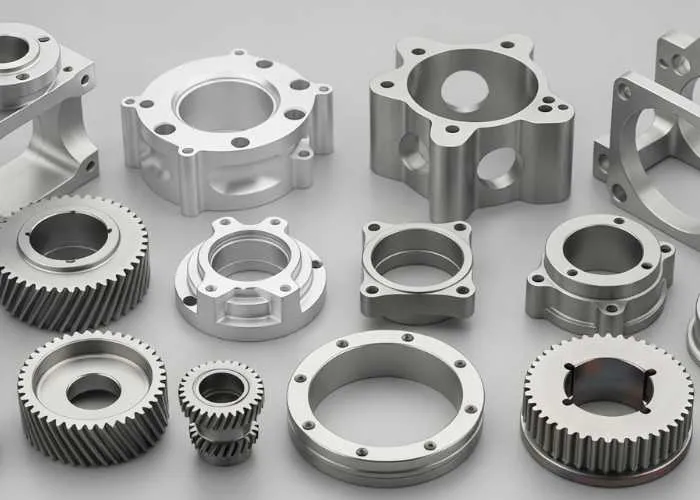
Picking the wrong aluminum can lead to a part that snaps under pressure or warps during machining. In aluminum cnc machining, we don’t just look at cost; we look at how the alloy behaves under the tool.
| Your Scenario | Recommended Alloy | Why? |
|---|---|---|
| General Brackets, Cases, Housings | 6061-T6 | The All-Rounder. It’s easy to machine, affordable, and looks amazing after anodizing. |
| Aerospace or High-Stress Parts | 7075-T6 | The Powerhouse. As strong as many steels, but 1/3 the weight. Perfect for high loads. |
| Precision Bases or Thin Plates | MIC-6 | The Stability King. A cast plate with zero internal stress. It won’t warp no matter how much you cut. |
| High-Vibration / Cyclic Loading | 2024-T3 | The Fatigue Specialist. It handles repeated stress better than 7075 without cracking. |
Pro Tip: We always look for T651 temper. That “51” means the material has been stress-relieved. If you use standard T6 for a complex part, the internal stress might cause the part to “banana” (warp) as soon as it comes off the machine.
3. Precision is More Than a Buzzword
In rapid prototyping, how we “attack” the metal depends on your geometry and required accuracy:
- CNC Milling: Best for complex blocks and pockets. For high-end work, we use 5-axis machining to finish the part in one go. This keeps your tolerances tight because we aren’t constantly moving and re-clamping the part, which is where errors usually crawl in.
- CNC Turning: This is the go-to for anything round. It ensures your shafts, bushings, and connectors are perfectly concentric.
While a standard ±0.05 mm is fine for most enclosures, we can hold ±0.005 mm for medical or robotics interfaces where the fit needs to be butter-smooth.
4. DFM: Let’s Save You Some Money
The best prototypes are “designed for manufacturing.” A few small tweaks in the CAD stage can slash your aluminum cnc machining costs:
- Watch the Deep Pockets: Long, thin tools vibrate (we call this “chatter”), which leaves a messy finish. Try to keep pocket depths within 3x the tool diameter.
- Radii are Your Friends: Avoid sharp 90-degree internal corners. If you design with a radius that matches a standard end mill, we can cut faster and the part will actually be stronger.
- Keep Walls Realistic: Aluminum is sturdy, but if you go thinner than 0.8 mm, the part might vibrate during machining, causing dimensional errors or a wavy surface.
5. Finishing Touches: More Than Just “Pretty”
Aluminum parts usually need post-processing to meet functional or aesthetic requirements:
- Anodizing (Type II \& III): Black, Blue, Clear—you name it. But it’s not just for looks. Hardcoat (Type III) significantly increases surface hardness and wear resistance.
- Bead Blasting: This gives you that high-end, matte “Apple-style” finish and hides tiny tool marks.
- Chemical Film: Also known as chromate conversion, this is ideal for parts needing corrosion protection while staying electrically conductive.
Heads up: Anodizing adds a tiny bit of thickness (usually 0.01mm to 0.05mm). If you have ultra-tight hole tolerances, tell us\! We’ll mask them or adjust our machining dimensions so everything fits perfectly after treatment.
6. Quality Control: Not Just a Caliper Check
A professional aluminum prototype machining service should come with “receipts” to prove the part is right:
- CMM Inspection: We use Coordinate Measuring Machines to make sure every complex angle and GD\&T requirement matches your file.
- Material Certification: We provide MTRs (Material Test Reports) so you know you’re getting genuine 7075-T6, not a cheap substitute.
- FAI (First Article Inspection): For small batches, we check the first part thoroughly to validate the setup before running the rest.

7. The Bottom Line: Find a Partner, Not Just a Vendor
In the world of hardware development, you need a team that speaks your language. A good shop won’t just hit “go” on a bad file—they’ll call you up and say, “Hey, if we change this internal radius, we can make this part better, faster, and cheaper.”
Ready to see your design come to life?
Submit your STEP or IGES files at MS Machining. Our engineering team will provide a comprehensive DFM review and a technical quote for your next aluminum prototype machining project.