

In the high-stakes manufacturing ecosystems of surgical robotics, aerospace UAVs, and implantable medical devices, the transition from a digital CAD model to a physical, mass-produced product is governed by a single, critical infrastructure: tooling. While a multi-axis CNC center provides the raw mechanical power, it is the specialized tooling—the cutting tools, fixtures, jigs, molds, and dies—that functions as the “intellectual substrate” of the production line.
For a Procurement Manager or an R&D Lead, the question “What is tooling in manufacturing?” transcends simple nomenclature; it is the primary lever for controlling your total cost per part and ensuring long-term structural integrity.
1. Cutting Tools: The Frontier of Material Integrity
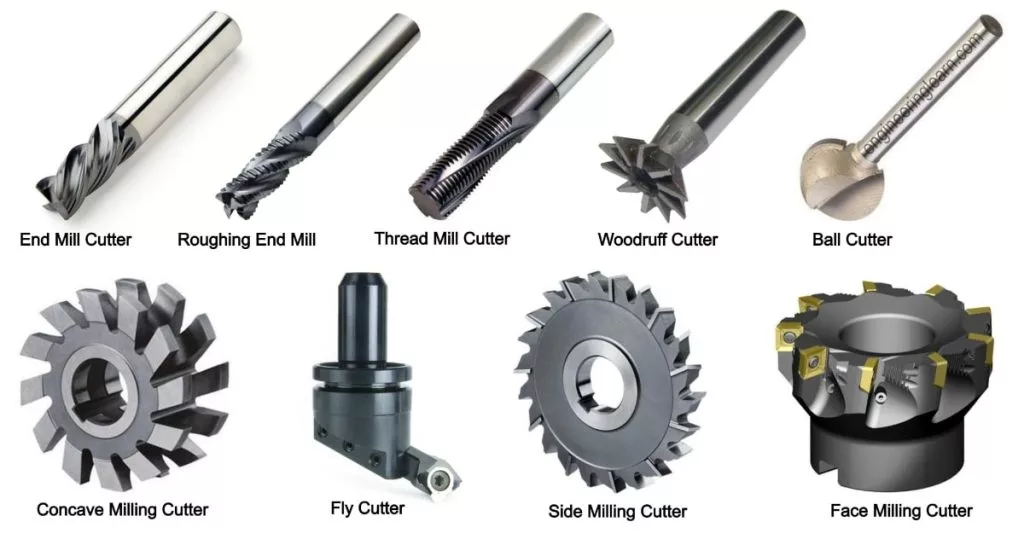
At the most granular level, manufacturing begins where the cutting tool meets the raw substrate. Whether you are machining Titanium Grade 5 or Stainless Steel 316L, the choice of cutting tool dictates the “Surface Integrity” of your final component. Professional CNC operations focus heavily on managing thermodynamics through tool geometry.
If a supplier utilizes low-quality or dull tools, the resulting friction generates excessive heat, creating what engineers call a Heat-Affected Zone (HAZ). This microscopic alteration of the metal’s crystalline structure is a silent project killer; it can lead to stress corrosion cracking that remains invisible until your drone or medical device fails under field load. By utilizing high-performance tooling that maintains a consistent Chip Load, we ensure the material’s original strength is preserved while achieving superior surface finishes that often eliminate the need for expensive secondary polishing.
2. Jigs and Fixtures: The Mechanics of “Zero-Point” Repeatability
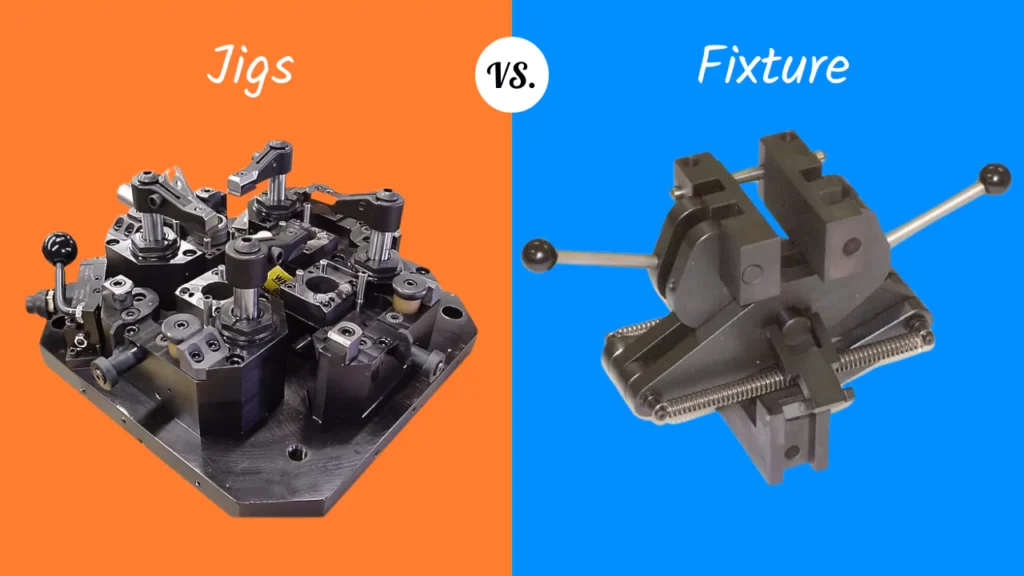
In professional manufacturing, “Close enough” is the precursor to assembly-line failure. This is where jigs and fixtures become the unsung heroes of precision. A jig is a specialized tool that both holds the workpiece and guides the cutting tool, effectively removing human error from the equation. In 5-axis manifold machining, for instance, a custom jig ensures 100% interchangeability—a non-negotiable requirement for FDA-regulated medical assemblies.
Fixtures, on the other hand, are the foundation of rigidity. For thin-walled Aerospace UAV structural components, standard clamping methods often “crush” or warp the material, leading to dimensional drift. To solve this, we design custom Vacuum Fixtures or Zero-Point Clamping Systems that distribute pressure evenly across the component. When a part is held with absolute repeatability, your assembly team spends zero time “adjusting” parts to make them fit; they simply click into place, significantly lowering your internal labor costs.
3. Molds and Dies: Architects of Scalability and Flow
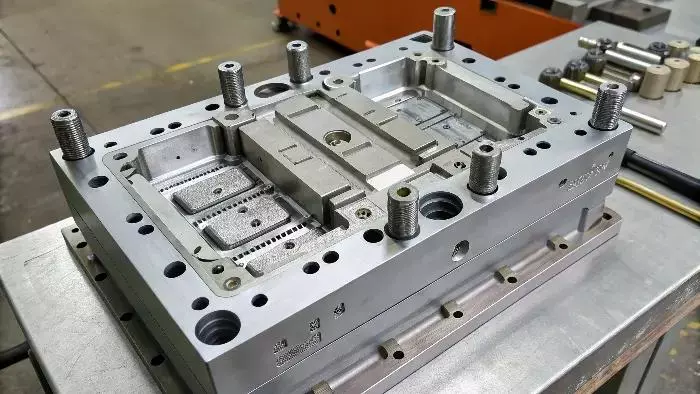
When your project scales from hundreds to hundreds of thousands of units, the focus shifts to molds and dies. These represent your most significant Non-Recurring Engineering (NRE) investments and require a deep understanding of material physics. A high-quality injection mold for a robotic sensor housing must manage the complex “cooling” of the plastic. We utilize advanced cooling paths that follow the part’s geometry to ensure even thermal contraction, preventing the Warpage that often ruins the aesthetic of high-end hardware.
Similarly, in sheet metal fabrication, precision dies are engineered to account for Spring-back—the metal’s natural tendency to return to its original shape after being bent. By calculating this displacement at the tooling stage, we ensure your chassis remains perfectly square and structurally sound throughout the entire production run.
4. Managing the “Coating Gap” through Tooling Offsets
One of the most common supply chain failures occurs when a part fits perfectly before coating but fails inspection after. Expert tooling must account for the physical thickness of surface treatments like Hard Coat Anodizing, Passivation, or Plating. These processes typically add 15 to 25 microns of thickness per surface.
High-end CNC operations calculate a Pre-Finishing Offset during the tooling phase. We intentionally machine your parts slightly “under-sized” or “over-sized” so that after the chemical treatment is applied, the parts reach the exact nominal dimension. This technical foresight eliminates the nightmare of receiving a batch of parts that won’t fit because the coating made them too large, saving you weeks of rework and thousands in lost material.

5. Tooling Maintenance and the Prevention of Quality Drift
Tooling is not a “set and forget” asset. As cutting tools wear and mold gates erode over thousands of cycles, you encounter what is known as Quality Drift, where the 10,000th part begins to vary slightly from the first approved prototype. To prevent this, professional manufacturers implement strict Preventative Maintenance protocols.
We track the “Cycle Count” of every tool, performing scheduled services—such as cleaning, lubrication, and seal checks—long before the quality begins to drop. Since you, the customer, own the intellectual property and the physical tool, we provide full transparency through a “Tool Life Log.” This level of detail ensures your supply chain remains predictable and prevents sudden production stops due to tool failure.
6. DFM and Tooling Synergy: Reducing Upfront Costs
The most effective way to lower your tooling investment is at the design stage, as tooling complexity is directly linked to your CAD geometry. This is the value of Design for Manufacturing (DFM). For example, in injection molding, every “undercut” in your design requires a complex mechanical slide in the mold, which can add thousands to your initial bill.
By adjusting the geometry to be a “straight-pull” design, we can often reduce your molding fee by 30% while also eliminating mechanical failure points. Furthermore, matching your design’s internal corners to standard cutting tool diameters avoids the need for expensive custom-ground tools or slow EDM processes, speeding up your delivery times by weeks.
7. Strategic Comparison: Tooling Categories at a Glance
| Category | Primary Function | Business Value | Typical Industry |
|---|---|---|---|
| Machining Tooling | Precision cutting | Clean surfaces & high speed | Medical & Aerospace |
| Workholding | Stability & Alignment | Perfect assembly fit | Robotics & UAVs |
| Forming Tooling | Mass production | Lowest unit price at scale | Housings & Chassis |
| Verification Tooling | Quality proofing | Zero-defect delivery | Defense & Safety |
FAQ: Navigating the Business Logic of Manufacturing Tooling
Why is there a separate “Tooling Fee” in my initial quote?
Tooling is a custom-made asset created specifically for your unique geometry. Unlike the CNC machine itself, which is a general-purpose tool, a mold for a surgical handle or a fixture for a robotic chassis cannot be used for any other client. This is why manufacturers treat it as a one-time setup cost. It is the foundation that allows for a much lower “price per part” as your volume increases.
Can I transfer my tooling to a different supplier if needed?
As the customer, you own the intellectual property and the physical tool. However, transferring tooling is a complex process. Different factories use different machine specifications, such as “platen sizes” or cooling connections. Moving a tool usually requires a “re-validation” period to ensure it performs correctly in the new environment, which should be factored into your project timeline.
How do design changes affect my existing tooling?
Minor design changes can often be handled by “re-cutting” or welding existing molds and dies. However, significant changes to the part geometry usually require building a new tool from scratch. This is why we place such a high priority on the DFM phase; we want to finalize the design before we start cutting expensive tool steel.
How do you manage thermal expansion during a long production run?
Metal expands as it heats up during the machining process. To maintain tolerances of ±0.005mm, we utilize climate-controlled facilities and Active Thermal Compensation. This ensures that a part produced at the start of the shift is identical to a part produced ten hours later, preventing the “dimensional drift” that causes assembly failures.
8. Conclusion: Tooling as Your Competitive Advantage
At the end of the day, you aren’t just buying parts; you are buying a reliable, scalable supply chain. Understanding what is tooling in manufacturing allows you to shift the conversation from “price per part” to “total project success.” High-quality cutting tools, precision fixtures, and robust molds are the only way to achieve the industrial trifecta: High Precision, High Volume, and Low Unit Cost.
In the medical, aerospace, and robotics industries, your reputation depends on the consistency of the components you receive. By choosing a partner who masters the tooling phase, you ensure a predictable, stress-free path from prototype to global launch.
Optimize Your Tooling Strategy Today
Are you moving from a prototype to a production run? Would you like us to do a free “Tooling Feasibility Review” of your CAD files? We can identify exactly where a minor design adjustment can save you thousands in tooling costs and weeks in lead time.