

How a 4-Axis CNC Mill Actually Works
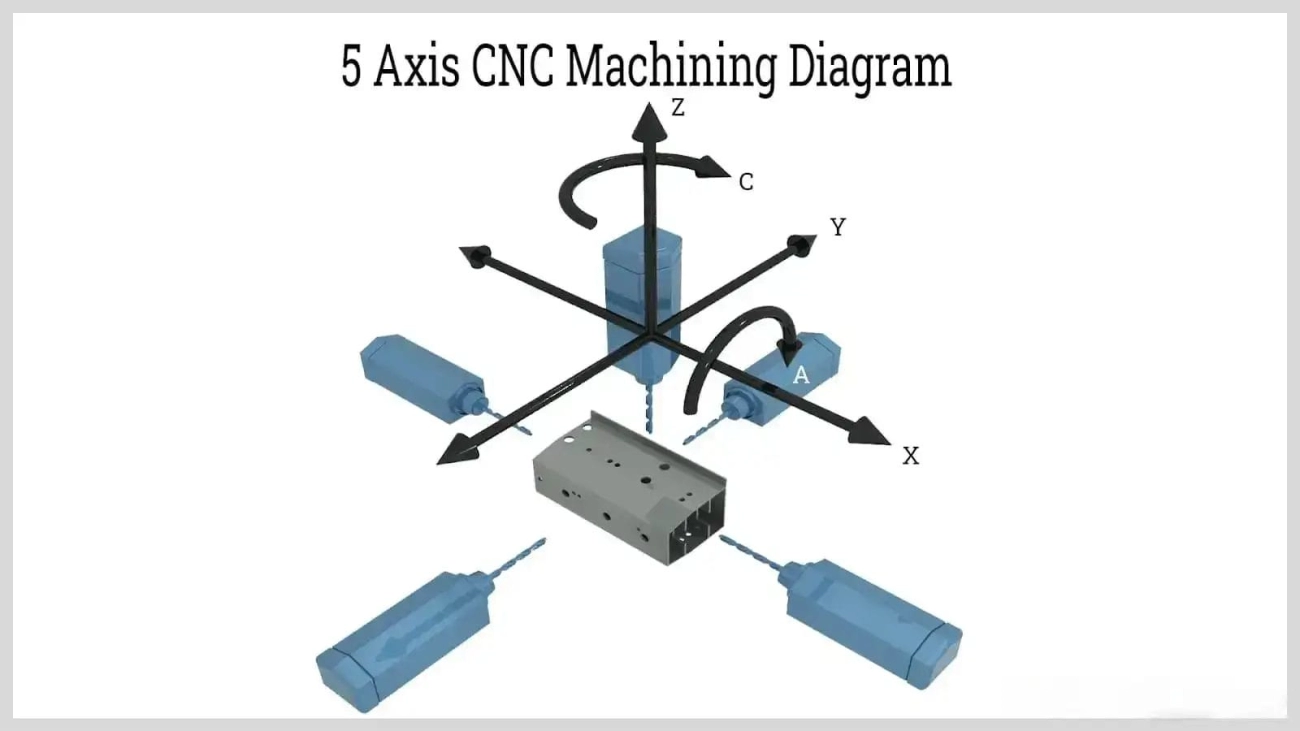
A 4-axlade CNC-fräs adds one rotary axis (usually called the A-axis) to the standard X, Y, and Z linear axes. This rotary axis spins the workpiece, letting you machine complex shapes that 3-axis mills can’t do easily. Instead of just moving up/down, left/right, and forward/back, the workpiece itself rotates, giving you access to new angles.
Indexing (3+1) vs Simultaneous (True 4-Axis) Machining
Indexing (3+1):
The rotary axis moves in fixed steps (or indexes) between cuts. The mill acts like a 3-axis machine during cutting, then rotates the part to a new position. It’s simpler but slower for complex jobs.
Simultaneous (True 4-axis):
The rotary axis moves continuously while the tool mills, enabling smooth, dynamic cuts around curves and contours. This allows for true 4-dimensional movement and better surface finishes on cylindrical or angled features.
A-axis vs Rotary Table vs Trunnion
A-axis: The rotary axis spins around the X-axis. Usually built-in or attached horizontally on vertical mills.
Rotary Table: A separate work-holding device mounted on the mill table, rotating the workpiece around a fixed axis (often the Z-axis). Popular for adding 4th axis capability to existing machines.
Trunnion: A more advanced device that tilts and rotates, often used in 5-axis machining. Sometimes considered an advanced 4-axis setup since it adds angular movement beyond simple spin.
| Konfiguration | Movement Axis | Typisk användning | Flexibilitet |
|---|---|---|---|
| A-axis | Rotates workpiece on X-axis | Integrated 4th axis mills | Good for angled features |
| Rotary Table | Rotates on Z-axis | Add-on for 3-axis machines | Simple indexing & continuous |
| Trunnion | Compound tilt + rotation | Advanced 4- or 5-axis | Most versatile but costly |
3-Axis vs 4-Axis vs 5-Axis: Quick Visual Comparison
| Funktion | 3-Axis CNC Mill | 4-Axis CNC Mill | 5-Axis CNC Mill |
|---|---|---|---|
| Axes of Movement | X, Y, Z | X, Y, Z + Rotary (A-axis) | X, Y, Z + A-axis + B-axis tilt |
| Workpiece Rotation | No | Yes | Yes, multi-directional |
| Complex Angled Cuts | Begränsad | Måttlig | Utmärkt |
| Förberedningstid | Higher (multiple setups) | Reduced (fewer setups) | Minimal (usually one setup) |
| Programming Complexity | Simplest | Måttlig | Advanced |
| Typiska tillämpningar | Simple prismatic parts | Cylindrical & angled parts | Aerospace, automotive parts |
Understanding these basics of how a 4-axlade CNC-fräs works helps you see the big picture. It’s not just an extra axis—it opens doors for efficiency and complexity that 3-axis machines just can’t match.
Key Advantages of 4-Axis Over 3-Axis Machining
Upgrading to a 4-axis CNC mill can seriously boost your shop’s efficiency and part quality. One of the biggest advantages is reducing setups—from as many as 4 to 6 on a 3-axis machine down to just 1 or 2 on a 4-axis setup. This means less time moving parts around, repositioning, and double-checking alignments.
With the added rotary axis, you can machine undercuts, angled features, and cylindrical parts without relying on complicated fixtures or multiple clamping steps. This capability opens doors to more complex designs and tighter tolerances.
Another plus is the improved surface finish you get on intricate contours. Since the 4th axis lets the part rotate smoothly during cutting, the tool maintains better contact and consistent feed, which results in cleaner edges and finer details.
Real-world cycle time savings are impressive too. For example, aerospace brackets that required 5 separate setups on a 3-axis can often be machined in a single setup on a 4-axis mill—significantly cutting lead times and labor costs. You can check out some practical examples showing how these time savings translate directly into dollars saved and faster delivery.
For shops working with parts like these, a 4-axis machine isn’t just a nice-to-have; it’s a game changer. If you’re interested in more about precision metal parts, explore our detailed CNC machined carbon steel components for insight into advanced machining capabilities.
When You Should (and Shouldn’t) Upgrade to 4-Axis

Jobs That Scream for 4-Axis
If your shop handles parts with complex geometries like undercuts, angled features, or cylindrical shapes, a 4-axis CNC mill is a game-changer. Jobs involving aerospace brackets, firearm components, or medical implants often demand multi-axis machining to reduce setups and improve finish. For example, you can machine a part completely in one or two setups rather than four to six, boosting throughput and precision. If you find yourself spending too much time manually repositioning parts or dealing with fixtures, it’s time to consider upgrading.
Jobs Still Perfectly Fine on 3-Axis
On the other hand, if your typical jobs involve simple prismatic shapes, flat pockets, or 2.5D features, sticking with a 3-axis mill often makes sense. Shops focused on large-volume production of standard parts, like basic brackets or simple housings, might not see enough ROI from a 4-axis upgrade. Also, if your budgets or floor space are tight, the added complexity and cost of a 4-axis might not justify itself.
ROI Calculator: Typical Payback Period
Most U.S. shops investing in a mid-tier 4-axis mill—priced between $65,000 and $120,000—can expect to see a return on investment within 12 to 24 months. This depends mainly on cycle time reductions, fewer setups, and less manual labor. For example, reducing four setups to one can cut production time by up to 50%, driving immediate savings. Keep in mind hidden costs like tooling, training, and maintenance when calculating payback.
For those aiming to maximize efficiency and expand capabilities without jumping straight to 5-axis machines, a 4-axis CNC mill delivers a solid balance of price and performance, especially for parts that require rotary machining or angled features. If you want more insights on precision parts that benefit from multi-axis work, check out our CNC-precisionstillverkningstjänster sida.
Critical Specifications to Compare in 2026
When shopping for a 4-axis CNC mill in 2026, some specs matter more than others. Here’s a quick rundown of what to look at:
| Specification | What to Check | Varför det är viktigt |
|---|---|---|
| Table Size & Travel (X/Y/Z/A) | Work envelope size, stroke lengths, rotary axis range | Bigger travel lets you machine larger parts and more complex angles. The A-axis travel is key for full 4-axis movement. |
| Spindle Power and Torque Curve | Peak and continuous power, torque at varying RPMs | More power and torque keep cuts consistent, especially in harder materials like aluminum or titanium. |
| Rotary Axis Torque and Accuracy | Holding torque and backlash specs | Higher torque prevents slippage; better accuracy means smoother, tighter finishes on complex geometries. |
| Control System | Brands like Fanuc 31i, Siemens 828D/840D, Syntec 22MA | Reliable and advanced controls improve programming ease and 4-axis tool path execution. |
| Tool Changer Capacity & Chip Management | Number of tools, automatic changer speed, chip conveyor quality | Bigger capacity means less downtime; effective chip clearance avoids crashes and helps surface finish. |
| Rigidity & Machine Weight | Frame build, weight, vibration damping systems | Stiffer machines cut more accurately with less chatter, leading to longer tool life and better finish. |
Each of these factors influences how well your 4-axis CNC mill performs in everyday operations. For example, a small table with limited rotary travel restricts your part size and the complexity you can achieve. Likewise, a machine with low rotary axis torque may struggle with continuous 4-axis machining, forcing you to settle for indexing (3+1) instead.
When deciding, also consider your typical workpiece size and materials, as well as future growth plans.
For more details on high-precision rotary setups, check out specialized CNC machining processes that leverage 4-axis capabilities effectively.
Top 4-Axis CNC Mill Models in 2026 (Mid-Range & Industrial)
When looking for a top 4-axis CNC mill in 2026, several standout machines offer a great mix of performance, reliability, and value—whether you’re a small shop or scaling up to industrial production.
Haas VF-2SS + TRT100 / UMC-500
Haas continues to be a favorite for U.S. shops because of solid build quality and ease of use. The VF-2SS paired with the TRT100 4th axis rotary table is perfect for those upgrading from 3-axis, offering tight A-axis indexing and good spindle power for aluminum and steel. The UMC-500 adds simultaneous 4-axis machining capabilities with a trunnion table, which is ideal for more complex profiles.
DMG MORI CMX 1100 V with 4th Axis
A versatile industrial-grade mill, the CMX 1100 V integrates a high-torque 4th axis rotary table for dynamic, simultaneous 4-axis operations. It shines in precision and surface finish, especially for aerospace and automotive parts. Expect industry-leading controller options and rigid construction here.
Okuma GENOS M560-V with 4-Axis Package
Okuma’s GENOS M560-V packs a punch with excellent spindle torque and a reliable 4th axis rotary table. It offers smooth indexing and strong chip evacuation, fitting well into shops that demand durable, long-lasting machines with competitive pricing and warranty support.
Chinese High-Value Options: MS Machining MS-540V-4 and MS-850Pro-4
For budget-conscious buyers, MS Machining’s MS-540V-4 and MS-850Pro-4 are powerful contenders. These machines punch above their weight with robust rigidity, efficient spindle designs, and well-balanced travel ranges. They offer a strong price advantage compared to Western brands, making them attractive for U.S. shops looking for cost-effective yet capable 4-axis CNC milling machines. Check out MS Machining’s capabilities in complex parts like titanium medical implants or aerospace brackets on their site to get a real sense of their machine’s performance.
| Model | Price Range | Spindle Power/Torque | Travels (X/Y/Z/A) | Warranty |
|---|---|---|---|---|
| Haas VF-2SS + TRT100 | $90k–$120k | 15k RPM, 30+ ft-lbs torque | 30″x16″x20″ + 360° rotary | 1 year + options |
| DMG MORI CMX 1100 V | $140k–$180k | 12k RPM, 40 ft-lbs torque | 43″x20″x20″ + continuous 4th | 2 years industrial |
| Okuma GENOS M560-V | $110k–$140k | 15k RPM, 35 ft-lbs torque | 24″x16″x20″ + indexed rotary | 1 year standard |
| MS Machining MS-540V-4 | $40k–$70k | 10k–12k RPM, 25 ft-lbs torque | 21″x16″x18″ + 360° rotary | 1 year limited |
| MS Machining MS-850Pro-4 | $60k–$80k | 12k RPM, 30 ft-lbs torque | 30″x20″x20″ + continuous rotary | 1 year limited |
The right choice depends on your shop size, parts complexity, and budget. For in-depth manufacturing of precision metal parts, including titanium or aerospace components, consider machines with proven rigidity and reliable 4-axis control systems. Explore more about advanced machining services and part finishing on MS Machining’s site to understand how a solid 4-axis mill can boost your production quality.
Software & Programming for 4-Axis Success

Getting the most out of your 4-axis CNC mill means using the right CAM software tailored for 4-axis machining. The top choices include Fusion 360, Mastercam, HSM, and SprutCAM—each offers strong support for complex 4th axis toolpaths. These programs handle wrap toolpaths perfectly, so cylindrical or rotary parts can be machined efficiently without complicated setups.
Key features you want in 4-axis CAM software are A-axis unwrapping och precise tool axis control. These help the software translate rotary motions into flat toolpaths and maintain the correct tool angle for undercuts or angled features. Most top CAM packages now come with free post-processors that simplify controlling your specific machine controller, whether it’s a Fanuc, Siemens, or Syntec 4-axis CNC controller.
A few common pitfalls to watch for:
- Improper setup of the rotary axis zero point, which can cause alignment issues
- Relying on 3-axis toolpaths without properly switching to 4-axis modes
- Not updating or customizing post-processors for your exact machine or rotary table configuration
Mastering these details can save a lot of trial and error, improving your cycle times and part quality. For customers looking to explore the differences between 4-axis and more advanced machining options, checking out our guide on best 5-axis CNC machining service can offer valuable insights into when to consider higher-axis setups.
Real Customer Case Studies (MS Machining Projects)
At MS Machining, real-world results show how 4-axis CNC milling transforms complex jobs. Take an aerospace bracket we completed recently: by switching to 4-axis machining, we cut down from 5 separate setups to just 1, slashing the entire process time and improving consistency without sacrificing quality.
Another standout project was a firearm lower receiver featuring multiple angled surfaces. The true 4-axis capability allowed us to machine all the complex contours in one go, eliminating manual repositioning and fixtures, which also improved surface finish and accuracy.
On the medical side, we tackled a titanium implant with intricate helical features. The 4-axis CNC mill managed this challenging geometry flawlessly, something nearly impossible with a standard 3-axis machine. This not only shortened cycle times but also reduced tooling wear and setup complexity—key for high-value medical components.
These case studies clearly highlight how investing in 4-axis CNC milling can boost productivity and precision across different industries, including aerospace, defense, and medical devices. For similar complex component machining, check out our expertise in tillämpningar för CNC-bearbetning av rostfritt stål och bästa anpassade CNC-fräkningsdelar tillverkning.
Cost & ROI – What Does a Good 4-Axis CNC Mill Cost in 2026?
When budgeting for a 4-axis CNC mill in 2026, prices vary widely depending on the brand, features, and capabilities. Here’s a quick breakdown to help you understand the typical investment and what to expect:
Entry-level Chinese 4-axis mills: These machines generally range from $40,000 to $70,000. They’re great for small shops or startups looking for affordable options, often offering solid rigidity and decent spindle power. Just keep in mind that aftermarket support and advanced features might be limited compared to Western brands. (Check out our detailed overview of Chinese CNC milling machines for more on this segment.)
Mid-tier 4-axis CNC mills: Popular models from brands like Haas, Doosan, and Brother fall in the $90,000 to $140,000 range. These machines usually offer better build quality, more precise rotary axes, higher spindle torque, and well-integrated controls like Fanuc or Siemens. They also come with better tool changers and chip management systems.
Full 5-axis capable trunnion machines: If you’re considering future-proofing or tackling more complex parts, 5-axis trunnion machines start around $180,000 and up. These are heavy-duty industrial-grade systems that can handle simultaneous 5-axis machining for the most intricate parts, but they come with a much higher upfront price tag.
Don’t overlook hidden costs
Purchasing the machine is just the start. Real costs add up through:
- Tooling: Specialized cutters, holders, and fixtures can be expensive, especially for complex 4-axis jobs.
- Coolant & maintenance: Keeping the machine running smoothly requires quality coolant systems and regular upkeep.
- Training: Operators and programmers may need extra training to fully leverage 4-axis capabilities, especially if upgrading from 3-axis.
Understanding these factors will help you better calculate the true ROI and payback period for your new 4-axis CNC mill. For more about CNC fundamentals and cost considerations, check out our guide on vad är en CNC-fräsmaskin.
How to Choose the Right 4-Axis CNC Mill for Your Shop
Picking the right 4-axis CNC mill isn’t just about price or brand. It’s about matching the machine to your specific needs and workflow. Here’s a quick 7-question checklist to help guide your decision:
| Fråga | Varför det är viktigt |
|---|---|
| 1. What materials will you mostly machine? | Determines spindle power and tooling requirements. |
| 2. What are your typical part sizes? | Influences table size and axis travels. |
| 3. Do you need true simultaneous 4-axis or just indexing? | Affects control system and machine cost. |
| 4. What’s your shop’s floor space and infrastructure? | Impacts machine footprint and setup feasibility. |
| 5. Which control is best for your operators? | Training and programming ease matter (Fanuc, Siemens, Syntec). |
| 6. What chip management and tool changer capacity do you require? | Keeps production smooth during longer jobs. |
| 7. What’s your budget including tooling and training? | Avoid surprises with hidden costs beyond the base machine. |
Common Mistakes Buyers Make
- Focusing only on upfront cost: Cheaper machines can lead to higher downtime and less precision.
- Ignoring true 4-axis needs: Buying an indexing-only CNC when simultaneous machining is required limits the complexity you can handle.
- Overlooking support and warranty: Local service and good coverage reduce costly delays.
- Not considering software compatibility: CAM programs like Fusion 360 or Mastercam should integrate smoothly with your chosen control.
- Underestimating operator training: Even the best mill needs skilled hands to maximize ROI.
Choosing wisely means balancing specs, usability, and long-term support. For more insights on CNC milling capabilities and to see if a 4-axis setup fits your production goals, explore our detailed precisions-CNC-fräsningstjänster sida.